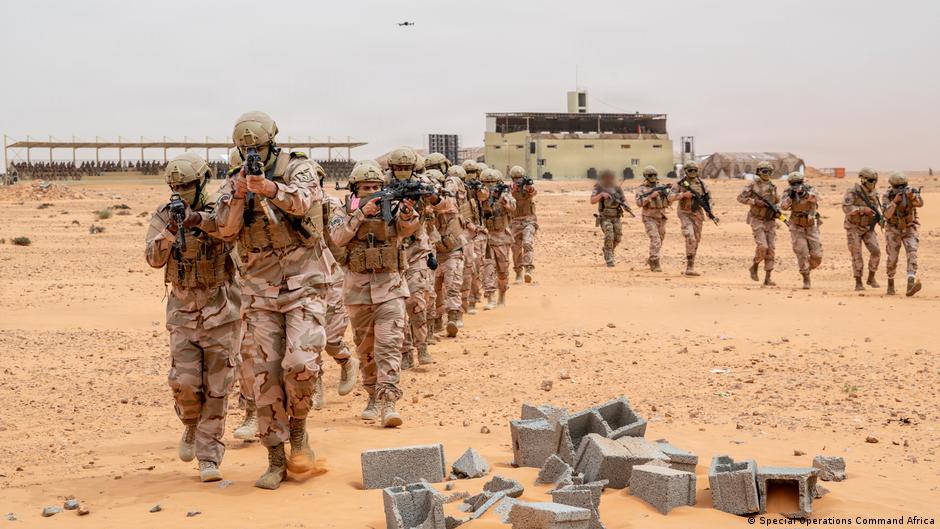
Troops from about 30 countries are training to fight terrorism in Flintlock, a US-led joint military exercise, practicing international cooperation and trying to strengthen the region’s fragile stability. Training takes place in Libya and Ivory Coast until the end of April.
For Libya, which is divided into East and West administrations after years of civil war, it is particularly significant that representatives from both parts of the country are participating in the exercise for the first time.
‘Visible Reconciliation’
“All things considered, this is a really remarkable political gesture,” Heger Ali, a political scientist at the GIGA Institute, a German think tank in Hamburg, told DW. Flintlock is part of an established US-led military exercise format; However, this time the location and participants make a difference, he said.
“The fact that this exercise is taking place for the first time in Libya and that both rival camps are represented is certainly a special feature,” he said. He said it was clearly part of long-term efforts to reunify armed forces that have been fragmented since the fall of Gaddafi in 2011.
Michael Bauer, head of the Konrad Adenauer Foundation (KAS) office in Tunis, agrees. “The public handshake between the two rival camps represents a rare, visible sign of rapprochement,” he said. This shows that cooperation is possible, at least at the operational level — although still under external mediation, especially by the US, he told DW.
idle state
This cautious rapprochement under American pressure involves a country that still barely functions as a state. “The country lacks a unified, functional government structure with a clear delineation between the executive, legislative, and judicial branches,” the recently published report said. Bertelsmann transformation index 2026 State.
In other words, political and economic power is divided between rival governments, armed groups, and other regional actors, resulting in a fragmented political environment that hinders the establishment of effective democratic governance.
Libya has been divided between two rival governments since 2014. In the west, the UN-recognized National Unity Government in Tripoli. In the east, the Government of National Stability in Tobruk is supported by General Khalifa Haftar’s Libyan National Army.
Against this backdrop, any form of cooperation is noteworthy – and military exercises are not the only example. Recently, for the first time in many years, a joint national budget was adopted. North Africa expert Bauer considers this “a solid sign of institutional rapprochement”, but warns against unrealistic expectations.
Hagar Ali also sees it as only one possible step in a longer process. “The joint budget could help rebalance economic power structures – especially vis-à-vis influential actors like General Khalifa Haftar, who rules the eastern part of the country and whose networks are deeply embedded in Libya’s economic structures,” he said, adding that at the very least, it represents an effort to more strongly centralize political and economic leverage.
Other factors at play
Both analysts emphasize that the motives behind the US-led military exercises extend far beyond Libya. Efforts have focused on countering terrorism throughout the Sahel region, the increasing proliferation of weapons there – for example as a result of the war in Sudan – and pushing back Russian influence. Hagar Ali points specifically to Moscow’s presence in eastern Libya, saying that “the US in particular is clearly trying to counter it more forcefully.”
Due to its geographical location in North Africa and oil resources, Libya is increasingly becoming a stage of international strategic competition.
“Libya’s oil production, currently stable under informal arrangements but structurally fragile, matters more than usual,” the Middle East Institute (MEI), a Washington-based think tank, said recently. said.
This may present an opportunity for Libya, however, as domestic political dynamics remain unpredictable, and key questions regarding the distribution of power and resources between rival centers of power remain disputed. “Succession in Libya is unlikely to be resolved through formal legal mechanisms alone,” the MEI analysis says. Sporadic signs of cooperation are unlikely to make much difference in solving this structural problem.
economic stress
The International Monetary Fund recently assessed, “Libya’s current fiscal path is unsustainable. Persistently large fiscal deficits are exerting pressure on the exchange rate, international reserves, and inflation.” Study. High public expenditure, inflation and currency pressures are putting pressure on the population and increasing social tensions. Reforms have long been considered urgently needed but are politically difficult to implement.
Despite recent signs of cooperation, North Africa analyst Michael Bauer sees little prospect of substantial progress between the warring parties and their leaders in the near future. “The division gives them access to resources and ensures their influence,” he told DW. “Temporary efforts at cooperation so far fall far short of what both sides consider useful,” the Libya expert said.
For Libyans, this means that cooperation on military exercises and the national budget could be real first steps. However, as long as key political actors continue to benefit from the division of Libya and maintain their power structures, a strong and united Libya will remain an illusion.
This article was first published in German.