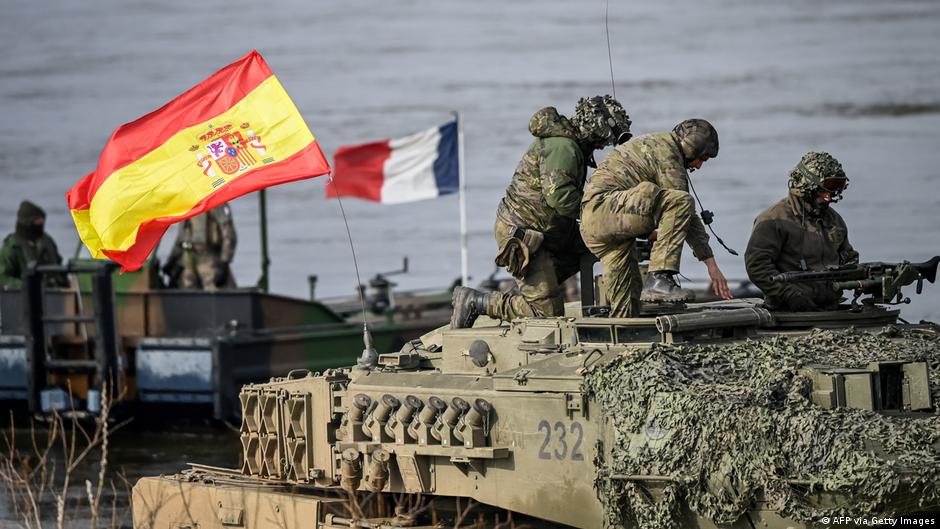
Spanish Prime Minister Pedro Sanchez said Friday he was “not worried” after a report that the United States was considering pulling Spain out of NATO for failing to support American operations in the war with Iran.
An internal Pentagon email outlines possible measures targeting NATO allies deemed uncooperative, according to a US official cited by Reuters news agency. The official said options included suspending Spain from NATO and reviewing the US stance on Britain’s claim to the Falkland Islands.
Spain – along with Italy and France – did not allow American aircraft to use their bases or airspace to attack Iran. Sanchez was one of the few European leaders to criticize the US-Israeli attack on Tehran that sparked the war, calling it a violation of international law.
Asked about the report ahead of a summit of EU leaders in Cyprus, Sanchez told reporters, “We do not work on the basis of emails. In this case of the United States we work on the basis of official documents and government positions.”
“The Spanish government’s position is clear – full cooperation with the allies, but always within the framework of international legality,” he said.
“Spain is a reliable member within NATO,” Sanchez said. “As a result, I’m not worried at all.”
Given that NATO works by consensus, it is unclear how a potential suspension would work, as there is no mechanism to allow such a move.
When asked about the reported Pentagon email, a German government spokesman said that Spain’s NATO membership was not in question.
“Spain is a member of NATO. And I see no reason why that should change,” the spokesman said.
Meanwhile, Italian Prime Minister Giorgia Meloni said NATO “must remain united.”
“We must work to strengthen NATO’s European pillar… which should clearly complement the American pillar,” he said.
Trump angry over alleged lack of support for NATO
US President Donald Trump has been vocal in his criticism of NATO countries that have refused to join the war and has questioned the purpose of US membership in the organization. He has also criticized the allies for not sending their navies to help reopen the Strait of Hormuz, a vital waterway effectively closed by Iran since the beginning of the war.
Responding to a question from DW about the issue in Cyprus on Friday, EU foreign policy chief Kaja Kallas said she was surprised by the US criticism, pointing out that Britain and France were leading the effort to help secure trade across the strait after the war ended.
He said the bloc met US requests “exactly what we are able to offer.”
“After the cessation of hostilities, destroying mines, taking ships, these are all things we are discussing. So I don’t understand whether we are really responding to their requests,” Callas said.
Asked for comment on the email, Defense Department Press Secretary Kingsley Wilson responded: “As President Trump has said, despite everything the United States did for our NATO allies, they were not for us.”
“The War Department will ensure that the President has credible options to ensure that our allies are no longer paper tigers and instead sidelined. We have no further comment on any internal discussions to this effect,” he said, referring to Trump’s nickname for the Defense Department.
What else was allegedly in the Pentagon emails?
According to the source cited by Reuters, who spoke on condition of anonymity, the email did not suggest the US withdraw from NATO or close military bases in Europe.
Rather, the official said, the proposed policy options would be intended to send a strong signal to NATO allies with the goal of “reducing the sense of entitlement on the part of Europeans.”
The email also suggested putting US support for Britain’s claim on the Falkland Islands under review, following Britain’s initial refusal to allow US aircraft stationed in Iran to use its bases. London later authorized “defensive” missions in the conflict.
UK spokesperson Pradhan MMinister Keir Starmer said Friday that sovereignty over the islands is a British matter.
“We could not be clearer about the UK’s position on the Falkland Islands. This has been a long-standing position, there has been no change to it,” the spokesman told reporters.
“Sovereignty remains with the UK and the islands’ right to self-determination is paramount. This has been and remains our consistent position,” the spokesperson said.
Edited by: Shawn Sinico