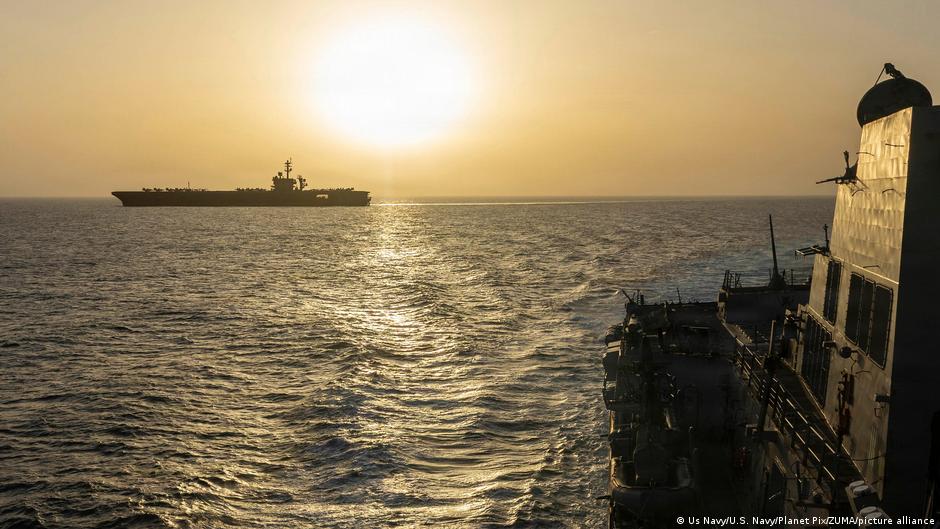
The situation in the Persian Gulf is messy. Officially, diplomatic channels are open between the US and Iran, with US President Donald Trump extending the ceasefire this week.
However, peace talks appear to be stalled. No new date has been set to continue the talks in Islamabad, and Trump’s announcements about resuming talks have also not materialized so far.
According to Friday’s report by Iran’s Tasnim news agency, there are no plans for talks with the US right now.
Moreover, any future talks will still have to deal with the Iranian nuclear program, which has served as a flashpoint between Tehran and Washington for decades. Now, negotiators face another major challenge – future use of the Strait of Hormuz.
Iran hopes to make the waterway a source of income. According to a senior Iranian lawmaker quoted by Tasnim, the first “toll payment” has already been deposited into Iran’s central bank.
Washington and Tehran are playing a ‘game of patience’
Experts say the current standoff is less a traditional military conflict and more a strategic tussle for time, influence and flexibility.
“At the moment, both sides are playing a kind of strategic game of patience,” said Hana Voss, a Middle East expert at Germany’s Friedrich-Ebert-Stiftung.
Iran, which is engaged in talks with America, has already been attacked twice. According to Voss, now Iranian leaders are extremely cautious about new talks.
“In Tehran, they are very worried that this could be a ploy, as if negotiations are taking place in parallel with military preparations,” he told DW.
Pauline Rabe, a political scientist at the Berlin think tank Middle East Minds, says these suspicions go hand in hand with Iran’s strategic calculations.
“There is obviously a lot at stake for Iran, because this is about its own territory,” he told DW. Therefore, Iran is deliberately using its influence, he said.
“With respect to the Strait of Hormuz, Iran is undoubtedly in a strong position – it is currently one of the strongest cards it can play,” Rabe said.
Iran ‘holds the upper hand’
Through the Strait of Hormuz, Iran can control the flow of oil and gas from the Persian Gulf and gain leverage over the global economy.
“It really doesn’t take a lot of effort to effectively block the strait,” Voss said.
She says mere threats could have a massive economic impact, with shipping companies backing out and insurance companies dropping coverage. Furthermore, drones and mines pose long-term risks.
According to Voss, “Strategically speaking, Iran currently holds the upper hand – and that’s what really creates the strategic advantage.”
Raabe, meanwhile, underlined the military dimension of this development.
“Iran’s ability to launch rockets on a regular basis was clearly underestimated,” he said. This contradicts the narrative that Iran has become decisively weak and points to the regime deliberately building up its capabilities in recent years.
According to Rabe, politicians may not have been briefed about the potential importance of the Strait of Hormuz.
“There were certainly war games that took this factor into account,” Voss said. “But the question is to what extent this knowledge actually influenced policy.”
clash of ideologies
This conflict extends beyond economic and military factors. In an analysis published last month, the Washington Institute for Near East Policy warned that the Iranian regime is ready to “prioritize its ideological mission” of religious and regional dominance over the needs of its population.
Voss agrees that Iranian leaders are prepared to “impose significant difficulties” on their own people.
“The level of suffering there has been much higher than in Western societies for decades,” he said.
Voss also points out that the fighting is stabilizing the regime in the short term. “This leads to internal consolidation.”
At the same time, internal pressure is increasing in America.
Raabe warned of rising fuel prices and widespread insecurity in financial markets, saying “(with a longer duration of the war) the economic consequences will be more and more noticeable.”
While pressure is mounting on Washington to find a diplomatic solution, Tehran is acting with increasing confidence, demanding concessions such as sanctions relief or the release of its funds.
Who can last longer?
Iran can also rely on its strategy of asymmetric warfare to meet its demands from Washington. according to US-based Center for Strategic and International Studies (CSIS)Tehran can exert significant influence with subversion and cyberattacks even after military setbacks.
The blueprint for the Washington Institute for Near East Policy has been prepared Several possible scenarios to end the US war in IranWhich includes agreement on change of power in Iran and resolving Iran’s nuclear dispute.
One of these options is a “disguised defeat” for America. This outcome would allow Iran to retain at least some elements of its nuclear program as well as its ability to threaten the Strait of Hormuz.
Conversely, in an “open defeat” Iran would continue to deploy weapons until the US and Israel are forced to end their military operations due to the “increasing pain inflicted on the Gulf states and the American public”.
In the end, the conflict seems to boil down to a single question: Who can hold out longer as the political, economic, and social costs of war rise?
Experts like Voss and Rabe give the advantage to Tehran.
“The timing is working for Iran,” Voss told DW.
This article was originally published in German.
Edited by: Amy Sasipornkarn