
Market analyst Knox Ridley warned that any bitcoin (BTC) rally in the coming weeks is doomed to fail before reaching the $116,000 area. According to their analysis, the lack of structural liquidity in the global economy will prevent the price of the crypto asset from consolidating a sustained upward movement.
Ridley explained in an analysis published yesterday, April 23, 2026, that, even if bitcoin manages to strongly surpass $79,000 in the short term, “such a rally will ultimately fail below the $106,000 to $116,000 resistance zone” due to current macroeconomic conditions. This warning is based on the strong impact that the strength of the US dollar and the stagnation of global liquidity has on risk assets.
The specialist noted that the dollar continues to be “the most powerful and persistent factor driving global liquidity.” When the DXY index strengthens—as has happened when it approaches 98 points—it reduces the availability of capital for investments in assets considered “risky,” such as bitcoin. This inverse correlation is still active, although the crypto asset has shown greater resistance than in 2022 by remaining close to $77,000 despite the rise in the dollar.
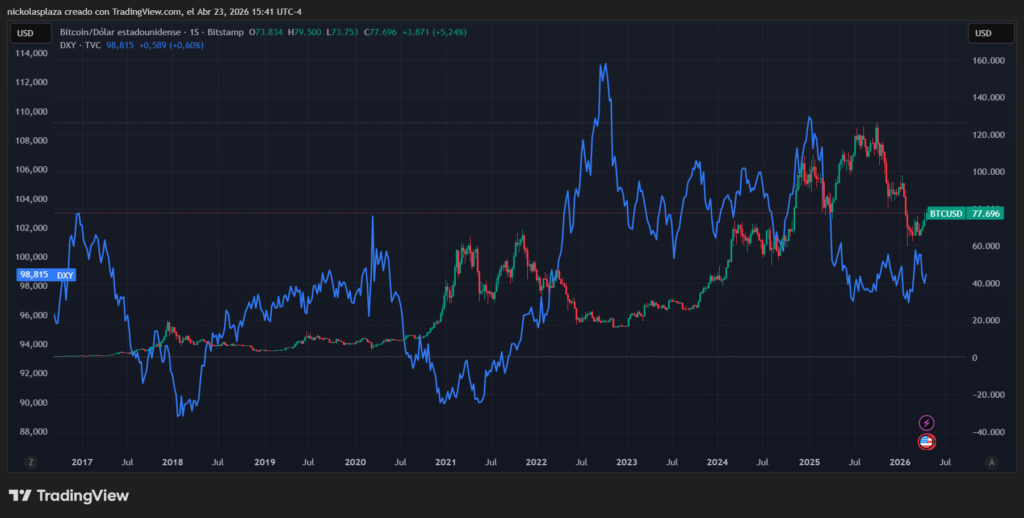
Behind this dynamic there is a structural reason. Around the 64% of global debt It is denominated in dollars. When the US currency becomes more expensive, foreign borrowers must allocate more resources to acquiring dollars to meet their obligations, draining capital that could otherwise flow into bitcoin.
Furthermore, the liquidity available today is used almost exclusively for refinancing existing debts instead of generating new productive investment. According to Ridley, three out of four global financial transactions are related to debt service, which severely limits the expansion of markets like bitcoin.
This liquidity restriction is confirmed in data from the International Monetary Fund (IMF), which indicates that the global gross public debt reached 94% of GDP in 2025 and is projected to reach 100% by 2029levels not seen since the post-World War II period.
In this restrictive environment, Ridley also warns of the immediate downside risk. If bitcoin loses the key support of $62,500, could trigger a fall towards the $55,000 to $40,000 rangewith the area between $48,000 and $46,000 as the level with the highest probability of finding a bottom.
Other analysts reinforce this vision of fragility. Michaël van de Poppe noted that although the resistance at $79,000 accumulates many short positions, any bounce risks not being sustained.
For his part, Julio Moreno, head of research at the CryptoQuant data platform, highlighted that recent price increases have been driven mainly by leverage in perpetual futures, while demand spot —the actual purchase of bitcoin— continues to contract, as reported by CriptoNoticias.
Long term, however, Ridley maintains a clearly bullish outlook on bitcoin. “Unlike the US dollar, bitcoin cannot be inflated,” says the analyst.
More importantly, “it is increasingly recognized, regardless of whether one agrees or not, as a store of value that transcends borders and is transferred directly between parties without intermediaries or government authorization.”
As national economies face unsustainable debts that require constant monetary expansion, bitcoin is positioned as the safe haven asset par excellence in a world dominated by inflationary currencies.