
Demand for bitcoin (BTC) from large institutions has returned strongly to the markets after a period of inactivity. This rebound in buying pressure, detected during this month of April 2026, marks the end of a negative trend that dominated the behavior of professional capital since the end of March.
This change in trend is supported by the behavior of the Coinbase Premium Index in its volume-weighted version of the CryptoQuant data platform. This metric calculates the price difference between the American exchange Coinbase and Binance, the largest exchange platform in the world. When the value on Coinbase is higher, the index becomes positive.
By giving greater weight to large-scale operations, the indicator filters out small transactions to focus on large transactions. This allows us to distinguish the movement of whales—entities that own 1,000 BTC or more—or institutional investors versus retail operators.
As seen in the chart, the market experienced an area of negative pressure between the end of March and the beginning of April. During that period, institutions remained on the sidelines, which influenced the fall in the price of bitcoin. However, the panorama changed drastically on April 9, a date marked as the definitive turning point.
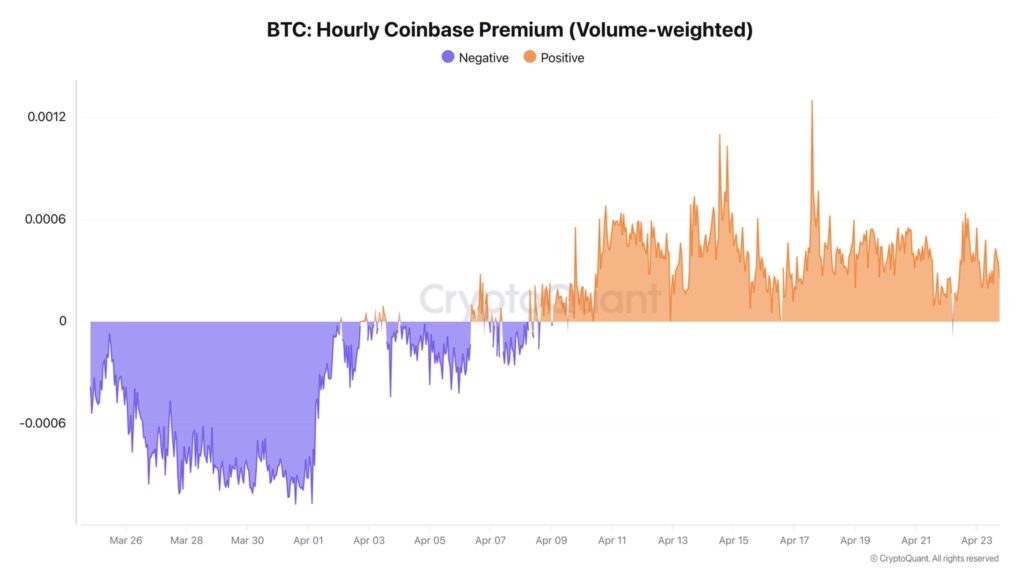
The market analyst who identifies himself as “Darkfost” detailed that, although activity “remains relatively moderate for now,” the determining factor is that “the trend has persisted since early April” after going through a cycle of disinterest.
Since mid-April, the indicator has shown a predominance of orange, reflecting a positive premium. “This suggests that institutional buying activity is driving the price higher relative to the more retail-driven flow on Binance,” the analyst explained. This phenomenon indicates that large capital is willing to pay a premium in the United States to acquire the asset.
ETFs and Strategy lead bitcoin purchases
In this context, spot bitcoin exchange-traded funds (ETFs) in the United States have played an important role. These financial instruments, which allow investors to gain exposure to the price of BTC without directly custody it, recorded nine consecutive days of capital inflows from April 14 to 24. In total, they accumulated income of 2,114 million dollars.
Added to this flow is the aggressive strategy of Strategy, the company with the largest corporate reserve of bitcoin in the world. The organization led by Michael Saylor intensified its acquisition pace by purchasing 34,164 BTC last week. With this move, the company reached a total reserve of 815,061 BTC in its treasuryas reported by CriptoNoticias.
Currently, bitcoin is trading at levels close to $77,000, which represents a rise of close to 10% in the last month. This increase fully coincides with the increase in the flow of capital into ETFs and the consolidation of massive corporate purchases.
While this may set the stage for the bitcoin market to rise, analyst Knox Ridley maintains a cautious stance regarding the durability of this growth. Ridley warned that any rally in the coming weeks “is doomed to fail before reaching the $116,000 area.” Ridley fbases its skepticism on current macroeconomic conditions that could limit the rise.
The specialist pointed out that, if bitcoin fell below $62,500, it could trigger a fall towards the $55,000 or $40,000 range. However, proponents of the current trend argue that institutional support provides a solid foundation. “When bullish trends are supported by this type of demand, they tend to become more sustainable,” Darkfost concluded.