An ostentatious piece of bizarre history decorated with a gilded iguana and pineapple atop a bouquet of fruit is on sale today at the Berlin branch of Germany’s Lempertz auction house with an estimate of €300,000-€450,000 ($350,000-$525,000). This porcelain vase, measuring more than 116 centimeters tall, is believed to have been made by Germany’s last emperor, Kaiser Wilhelm II, as a gift to his friend Prince Philip of Eulenburg-Hertefeld.
Little known today, the relationship between the Kaiser and the prince was at the center of a scandal, the so-called Eulenburg affair, which German historian Norman Domeier says shocked all of Europe and changed public opinion on the monarchy.
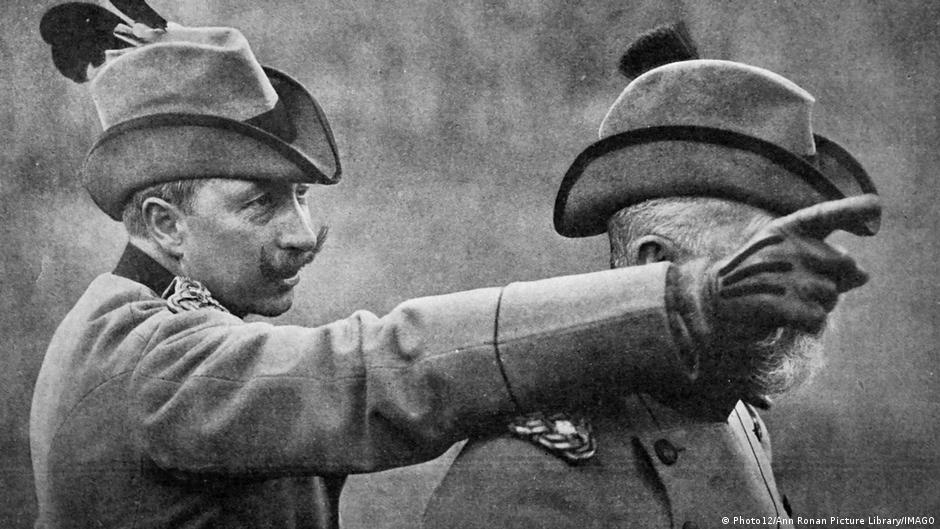
Wilhelm II ascended the German throne in 1888. As Kaiser, Wilhelm had a reputation as a ruthless, insecure and erratic leader, obsessed with his own press coverage, who developed increasingly authoritarian tendencies.
Eulenberg was a diplomat who soon becameAISER’s most important extra-parliamentary advisor. He often hosted hunting and artistic retreats for his close friends at Liebenberg castle, north of Berlin. As later revealed in court, members of that circle would refer to Eulenberg as “Fili” or “Filin” and Kaiser Wilhelm as “Liebchen” (“dear”).
Historian Robert Beachy, in his book “Gay Berlin: Birthplace of a Modern Identity”, writes, “It also became clear that he cultivated a cult of neo-romantic male friendship, and his correspondence was full of seemingly homosexual attestations of friendship.”
condemnable conspiracy to topple the monarchy
Liebenberg’s group of friends was despised by many of the Kaiser’s critics, who framed them as sycophants who abused their closeness to the Kaiser to influence policymaking.
Those critics included the influential Berlin journalist Maximilian Harden, an ardent German nationalist. He was confident that the German threat to go to war with France over Morocco during the First Moroccan Crisis (1905–06) was dismissed as a bluff by the French based on information leaked to the French ambassador in the Liebenberg hunting party.
“Harden thought there had to be a way to force change, and he was cynical enough to the point that his only option as a journalist and publisher was to smear these people for the purpose of bringing them down,” says Domeier, author of “The Eulenberg Affair: A Cultural History of Politics in the German Empire.”
On November 17, 1906, Harden published an article titled “Preface”, in which he accused the Kaiser’s entourage of “weaving threads from invisible quarters, threads that make it difficult for the German Reich to breathe.” He specifically described Eulenberg as a corrupting influence. Harden wrote in his widely read and very influential weekly magazine, “They do not dream of a world in flames; they are already hot enough.” Future. At the time, “warm” was common slang for homosexuals.
Eulenberg immediately left Berlin for Switzerland, reportedly for “health reasons”. But he could not stay away long and returned to Berlin in 1907, angering Harden.
This was followed by a series of courts martial and public trials that attracted worldwide attention and resulted in a scandal with similar effects to the trial of Oscar Wilde for “gross indecency” in England in 1895 and the Dreyfus affair that had begun in 1894, which became a symbol of injustice and anti-Semitism in France.
“It’s really interesting how much this scandal divided German society,” Domeier told DW. “You could see how the German Empire, which was so ostentatious and ostentatious on the outside, was on the inside what a weak and unstable entity it was, with huge differences between North and South, East and West. This scandal completely broke down those divisions.”
One of the most sensational trials of the Eulenburg affair involved General Kuno von Moltke, who ultimately resigned from his role as city commander responsible for the military defense of Berlin and sued Harden for defamation. In the Berlin courtroom, Harden said that von Moltke, who was apparently known as “Tutu” among the Liebenberg circle, liked to wear rouge and “flashy dresses” such as kimono and long skirts at home.
During the trial of von Moltke’s ex-wife, Lili von Elbe sensationally blamed the Commandant’s close friendship with Eulenberg for the failure of her marriage and claimed that von Moltke refused to share a bed with her.
Harden also brought in sexologist Magnus Hirschfeld to provide expert testimony on the issue of Moltke’s sexuality. In 1897, Hirschfeld founded the Scientific-Humanitarian Committee in Berlin, the world’s first gay rights organization. His assessment, based on his observations in the courtroom, was that von Moltke had a feminine side and displayed “unconscious homosexuality”. Harden was acquitted.
Hirschfeld’s theories about gender and sexuality, brought to the attention of the wider public by the trial, were unprecedented at the time. To them, sexual orientation was an innate, natural biological trait, not a lifestyle choice, a disease, or a crime. “In a way it is an early version of the ‘born this way’ concept, as claimed by various libertarian movements,” says historian Friedrich Doctor of Europa-University Flensburg.
important part of gay history
Long before the heyday of Weimar, Berlin had already gained a reputation as the party capital of Europe with a lively queer scene. At a time when sexual acts between men were criminalized under Article 175 of the German Criminal Code, the city even had a special police unit – not to prevent homosexual activities, but to protect high-ranking members of society from potential blackmailers.
According to the doctor, the Eulenberg affair had unintended consequences for Berlin’s gay scene. “This ultimately led to more homophobia, broader ideas of ‘degradation’, gays being defined as effeminate men and debates about tightening Article 175 – which the Nazis implemented decades later in 1935 – and ultimately gay men’s freedom to live out their sexuality,” he told DW.
Homosexuality is associated with lack of patriotism and even treason. In 1908, New York State NewspaperAn important voice for Germans in America, also recommended a “bright and cheerful little war” to rid Germany of homosexuality.
In a grim foreshadowing of Nazi Germany, the press also used anti-Semitic slurs against Harden, his lawyer Max Bernstein, and Hirschfeld. “We cannot allow this German man [von Moltke] Being dragged through the mud by fellow Jews,” fumed the German daily newspaper Die Bürgerzeitung.
The scandal destroyed Eulenberg’s reputation and he later became the subject of a defamation case brought by Harden. During that trial, an elderly fisherman and a petty criminal were tested on allegations that they had had sexual relations with the prince in their youth. After collapsing at court in 1909, Eulenberg was routinely found by court doctors to be too ill to stand trial. His friends shunned him until his death in 1921.
Liebenberg’s group of friends continued to gather around Kaiser Wilhelm II, who was never far from a scandal.
During a hunting dinner at Donaueschingen castle in 1908, a Prussian general, Dietrich Graf von Hulsen-Haessler, head of the Kaiser’s military cabinet, died of a heart attack while walking. According to some accounts, she was wearing a hostess ballgown and a hat decorated with peacock feathers, according to others, a pink tutu and a rose crown.
This incident caused the Kaiser, who was already under pressure following the publication of very undiplomatic comments about the British, to suffer a nervous breakdown.
He was eventually sidelined by the military during World War I and abdicated the throne in 1918. The last emperor of Germany, he died in exile in the Netherlands in 1941.
Edited by: Katherine Sharer