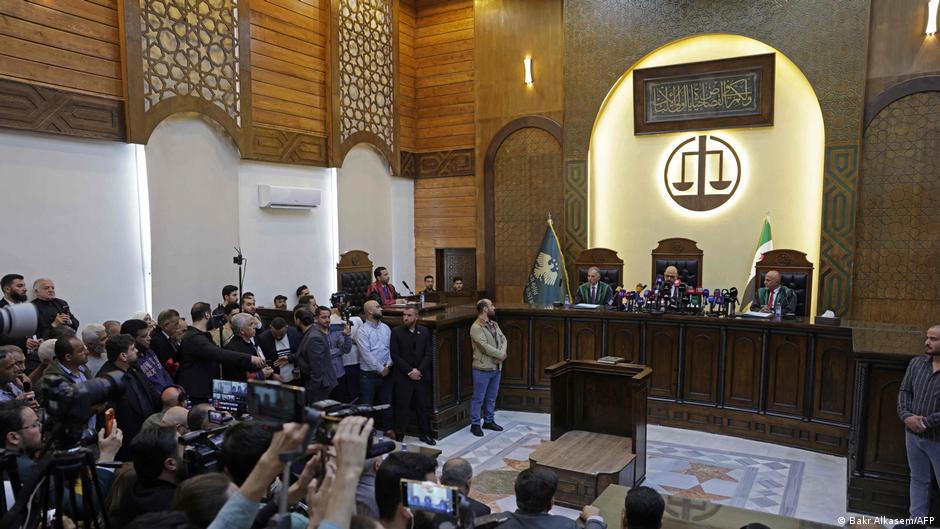
A Syrian court held a session on Sunday to prepare for the trial of several former officials of President Bashar Assad’s ousted government, with only one of the defendants present in court.
Assad’s government was removedIn December 2024, after more than a decade of civil war. He, his brother and other senior officers faced trial for alleged crimes committed amid fierce fighting.
“Today we begin the first trial of transitional justice in Syria,” Judge Fakhr al-Din al-Aryan said as he opened the session. “This includes defendants in custody, those in the dock, as well as defendants who have fled justice.”
Who is facing trial, in court or in absentia?
Bashar Assad, whose family ruled Syria for more than five decades, and his brother Maher fled Syria as the former government fell. Both are believed to be in Russia.
One of his cousins, former security official Atef Najib, was in the dock in Damascus on Sunday in handcuffs and in striped prisoner garb.
Najib, who was arrested in January 2025, previously led Syria’s political security branch in the southern province of Daraa, where Syria’s 2011 uprising first erupted, which soon turned into a 14-year civil war.
He is accused of leading a campaign of repression and arrests in the area. Syria’s SANA state news agency reported that he faced charges related to “crimes against the Syrian people”.
Najib was not questioned by the judge during Sunday’s brief session, which was devoted to “initial administrative and legal procedures”.
The next hearing has been scheduled for May 10.
AFP news agency, citing an unnamed judicial source, said other officials facing personal trial would include another relative of the president, Wasim Assad, former Grand Mufti Ahmed Badreddin Hassan, as well as military and security officials arrested by the new authorities.
Many members of Assad’s inner circle are believed to have fled Syria.
What else do we know about the prosecution process under the new government?
A crowd gathered outside the court to celebrate, waving flags and jostling to enter the building, with police present to maintain order.
The government of interim President Ahmed al-Sharaa, himself the leader of an Islamist militant group that fought during the war, has faced criticism over delays in starting a promised transitional justice process against former regime officials.
The country is struggling to recover and remain peaceful after 14 years of internal conflict that has divided the country into several factions. An estimated five lakh people were killed and lakhs were displaced.
Assad and his brother Maher, a former commander of the Syrian Army’s 4th Armored Division, were charged in absentia. Opposition activists allege the military division is carrying out killings, torture, extortion, drug trafficking and running its own detention centers.
Edited by: Dmytro Lyubenko