Global military spending to increase for 11th consecutive year in 2025. According to new data from the Stockholm International Peace Research Institute (SIPRI), governments spent a total of $2.887 trillion (€2.47 trillion) on ships, aircraft, missiles and other weapons. This is the highest level of military spending ever recorded.
“It really speaks to countries’ reactions to ongoing wars, tensions and geopolitical uncertainty,” said Xiao Liang, a researcher in SIPRI’s military expenditure and arms production program. Fighting in Ukraine and Gaza continued in 2025, while conflicts such as the war in Sudan also increased global instability. “With all of these crises still ongoing, and many countries’ long-term spending plans already on hold, this trend will likely continue into 2026 and beyond.”
Europe accounted for most of the global increase in military spending in 2025. Spending there increased by 14% to $864 billion. Russia’s full-scale invasion of Ukraine in early 2022 has changed the way European countries view their security. Many European governments fear that Russia could pose a broader threat beyond Ukraine. In response, European states – particularly NATO members – are increasing defense spending to strengthen their armies and deter further aggression.
“He is definitely the greatest driver,” Xiao Liang said. “In recent years, we have seen Russia and Ukraine’s own spending as the main driver in Europe. Their spending was still growing in 2025. But in terms of overall spending, the focus has shifted more toward Central and Western European countries, as their militarization and spending plans begin to materialize. They posted the highest annual growth since the end of the Cold War last year.” Spain’s defense budget increased by 50%, Poland’s by 23%, and Italy’s by 20%.
Germany redrafts its budget rules to finance military construction
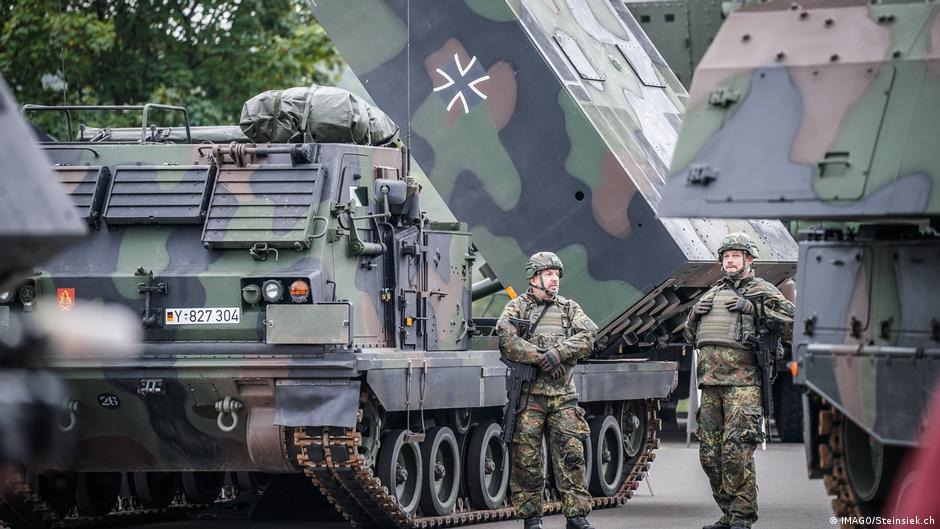
Among European countries, Germany was the largest military donor in 2025. Its defense budget increased by 24% to $114 billion, making it the fourth largest in the world. For the first time since 1990, German military spending reached 2.3% of GDP, surpassing the NATO benchmark of 2%. To pay for it, Germany’s parliament changed its financial rules in 2025. Military spending above 1% of GDP is now exempt from Germany’s strict debt brakes, allowing the government to borrow more for defense growth.
“I don’t think Germany’s military capability is growing as fast as the spending figures suggest,” Liang said. “But I think in the long term, Germany is becoming more powerful militarily and more independent.”
In addition to Russia’s war in Ukraine, Germany’s increased spending also reflects uncertainty about future US security guarantees. Like other NATO allies, the German government is trying to reduce its dependence on the United States – especially after US President Donald Trump again questioned the alliance’s collective defense commitments.
Why will US military spending fall in 2025?
The US spends less on its military – only $954 billion in 2025. This is 7.5% less than last year. The main reason for this decline was that the US Congress, unlike the previous three years, did not approve any new military aid to Ukraine. SIPRI counts such aid as part of the donor country’s military expenditure.
“That trend is already changing,” Liang said. “The new 2026 budget approved by the US Congress is indicating a big increase. With the war in the Middle East and rising tensions in Asia, the recession is probably going to be short-lived.” According to the Pentagon, the cost to Iran alone in the first six days of 2026 was US$11.3 billion.
Even in 2025, the US continues to invest heavily in nuclear and conventional weapons, aimed at maintaining military dominance and deterring China in the Indo-Pacific – a key goal of the US national security strategy.
The US remained the world’s largest military donor in 2025, accounting for about a third of global defense spending. But since 2020, its share is continuously decreasing.
“This is less about cuts by the largest donors, and more about broad increases elsewhere, particularly among middle-power countries,” Liang said.
Some argue that a more evenly distributed military balance could make the world safer. Liang disagrees. “It means more weapons and more weapons,” he said. “A new arms race undermines trust and increases the risk of miscalculation” – and it makes the world more dangerous.
China remains the world’s second-largest military donor and has increased its defense budget every year for the past 31 years – more than any other country tracked by SIPRI. Spending increased by 7.4% in 2025 as China advances its plan to modernize its armed forces by 2035. Last year, China tested a new sixth-generation fighter jet prototype and moved closer to fielding its H‑20 stealth bomber.
China’s military buildup will have major regional consequences, Liang said. “China’s military modernization and tensions with neighbors have long led to increased spending in the region, especially in countries like Japan, Taiwan and the Philippines,” he said. “But in 2025, it was also about changing security thinking among US allies. There is increasing pressure on countries like Australia, Japan and Taiwan to spend more on defense and become more self-reliant.”
Japanese military spending to reach $62.2 billion in 2025, an increase of 9.7% from 2024. The increase supports a build-up plan launched in 2022, driven by security concerns about China and North Korea. The expansion of missile and drone programs signals a major shift, putting Japan on track to become one of the world’s top military donors.
India was the world’s fifth largest military spender in 2025. Its defense budget increased by 8.9% to $92.1 billion, mainly due to tensions with China. But China was not the only factor, Liang said. “There was also a war between India and Pakistan in 2025. That was a big reason and they had invested heavily in aerospace and drones, which were used extensively in that conflict.”
massive cost of militarization
A country’s military spending as a share of its economy – often called the military burden – reflects how much of a society’s wealth is being directed toward defense rather than other needs. This is one of the clearest ways of comparing the real economic cost of military spending between countries.
This burden is projected to rise to 2.5% of global GDP in 2025, the highest level since 2009. This means that governments are not only spending more in absolute terms, but also devoting a larger share of their economic output to the military.
That change will have consequences beyond security policy. “This will affect other areas of public spending,” Liang said. “Governments could cut social services or development aid. So, it’s not just about wars and weapons – it will have a deep impact on the whole of society.”
Edited by: Frank Suyak, Don McCoitir