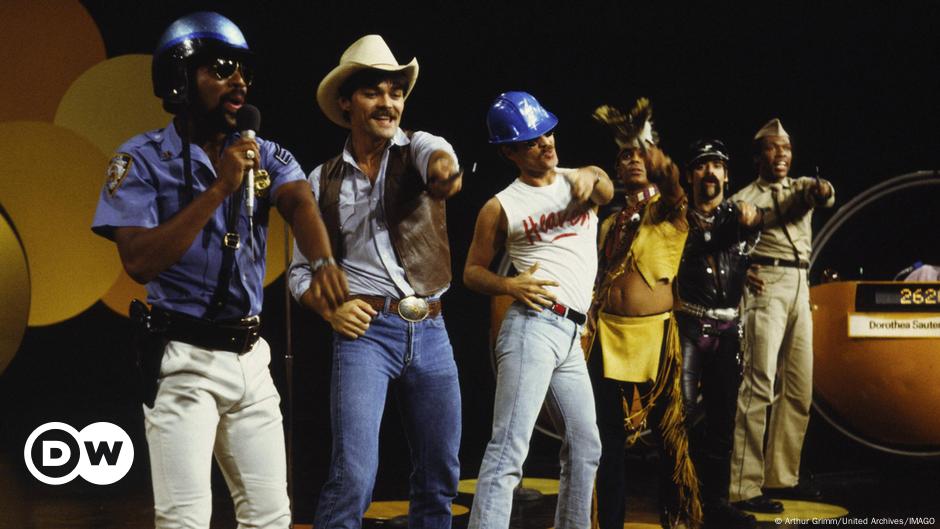
During the 2016, 2020, and 2024 US presidential election campaigns, the list of musicians who voiced opposition to their songs being used by Donald Trump was long, from ABBA to the White Stripes and – at some point – the Village People. .
In June 2020, the band’s frontman Victor Willis publicly objected to the Trump campaign’s use of Village People songs at its rallies. Criticizing Trump’s threat to use military force against Black Lives Matter protesters, Willis wrote on Facebook, “Sorry, but I can no longer look the other way.”
money Talks
But Willis later changed her stance, noting that “YMCA” was enjoying new success during the 2024 campaign: As Trump continued to use the iconic hit at his rallies, the 46-year-old’s track topped the Billboard Spent several weeks at the top of the U.S.’s most popular tracks. -Selling dance song charts.
Willis acknowledged in a Facebook post in December 2024, “The financial benefits have also been great, as ‘YMCA’ is estimated to have earned several million dollars since the President-elect’s continued use of the song.”
So now, the Village People are willing to look the other way, and are accepting invitations from the president-elect’s team to perform at several inauguration ceremonies, including at least one ceremony attended by Trump himself.
The band announced their involvement in a statement posted on their official Facebook page, writing, “We know some of you won’t be happy to hear this, however we believe that music should be made regardless of politics. must be submitted.” “Our song ‘YMCA’ is a global anthem that will hopefully help bring the country together after a tumultuous and divided campaign where our favorite candidate was defeated. So, we believe that now the music It’s time to bring the country together.”
The announcement drew thousands of comments on Village People’s and Willis’ official Facebook page. While Trump supporters praised the decision, many LGBTQ+ activists were shocked, pointing out that the disco group originally began in the 1970s as a symbol of the gay community and Trump’s MAGA (“Make America Great Again”) The movement is openly anti-homosexuality and opposes it. For gay marriage.
“You can’t put politics aside when it’s the same politics that will strip LGBTQ, women and other people of their rights. You’re not singing at a celebration but at the funeral of American values,” Aundre Guess, executive director of GRIOT. Wrote. The Circle is a New York-based non-profit organization dedicated to eliminating all forms of oppression against minorities.
From gay icon to mainstream
Village People was founded in 1977 by French music producers Jacques Morali and Henri Belolo, who wanted to produce hits in America.
Although only Morali was openly gay, attending gay disco parties in Greenwich Village led him to come up with the concept of putting together a group of singers and dancers who would wear costumes that embodied various gay fantasy figures. : a policeman, a Native American chief, a cowboy, a construction worker, a leather-clad biker and a sailor.
The Village People were therefore a manufactured boy band like many others, but it was designed specifically to target the gay community, which developed during a decade of significant gay liberation and political activism that emerged from disco culture. Was also closely connected.
Music historian Alice Echols, in her book “Hot Stuff: Disco and the Remaking of American Culture” (2010), cites an interview given by the French music producer, writing that “Morali was a powerful force in ending the cultural invisibility of gay men.” Was committed to. rolling stone magazine in 1978: “I think there’s no group of gay people,” Morali said after identifying himself as gay, “There’s no one to privatize gay people, you know?”
While the group played an important role in making gay culture visible, straight people did not necessarily interpret the performers’ style as gay macho drag, as Echols also writes in his book.
Village folk songs, played at special male bands in military regiments (“Navy”) or Young Men’s Christian Association hostels (“YMCA”), were soon adopted by the mainstream.
In fact, anyone from kids to seniors can have a ton of fun chanting the YMCA letters using hand movements along with the hit song, without thinking about the potential double meaning of how a youngster can learn more by staying at the YMCA. Can enjoy.
Echols concludes that Village People “contributed to the presentation of urban gay masculine identities as simple media products.”
‘I have to be a manly man’
Warming up his crowds with the Village People’s “Macho Man” at his rallies, Donald Trump and his MAGA agenda resonate with men who see feminism and the LGBTQ+ rights movements as a threat, and who are critical of hypermasculinity. Trying to redefine his role through – the strong man by embodying hyperbole.
When analyzing how Donald Trump and the Village People unexpectedly fit together, many writers refer to American critic Susan Sontag’s 1964 essay “Notes on ‘Camp’.” As he points out in the essay, camp is a concept that is very difficult to define; This is something that can be recognized upon seeing, causing the reaction “It’s good because it’s terrible.”
As Sontag discussed, camp “neutralizes moral outrage” through playfulness. The LGBTQ+ community readily adopted camp as a defensible aesthetic to promote their lifestyle and values, but as Sontag noted as early as 1964, camp is not gender or sexuality specific.
Similarly, Trump plays to the camp, keeping them from being shocked with his derisive pronouncements – no one knows when he is joking or not. As Dan Brooks explains in a The New York Times Magazine The piece, “The miasma of undefined but ever-present irony makes it almost impossible to make fun of Trump.”
disco fights
As the band’s lead singer, Willis co-wrote some of the band’s best-known hits with Morali, including “Macho Man,” “YMCA,” “In the Navy,” and “Go West.” However, he left the Village People in 1979, hoping to go solo.
In the 2010s, Willis went through a years-long legal battle to obtain 50% of the copyright of several of the group’s songs.
Following a court settlement in which he was found to be the sole surviving owner of the rights to the song (Morali died of AIDS-related complications in 1991), Willis rejoined the group and replaced all members. He now owns the band and is actively working on rebranding their songs.
He threatened to sue any media outlet that portrayed “YMCA” as a gay anthem.
To him, it was never intended as a political or cultural statement: “When I say ‘hang out with all the boys,’ it was simply a 1970s black term for black people talking about sports, gambling or Had to hang out together for anything,” Willis wrote. Facebook in December 2024. “There’s nothing gay about it.”
Edited by: Christina Barak