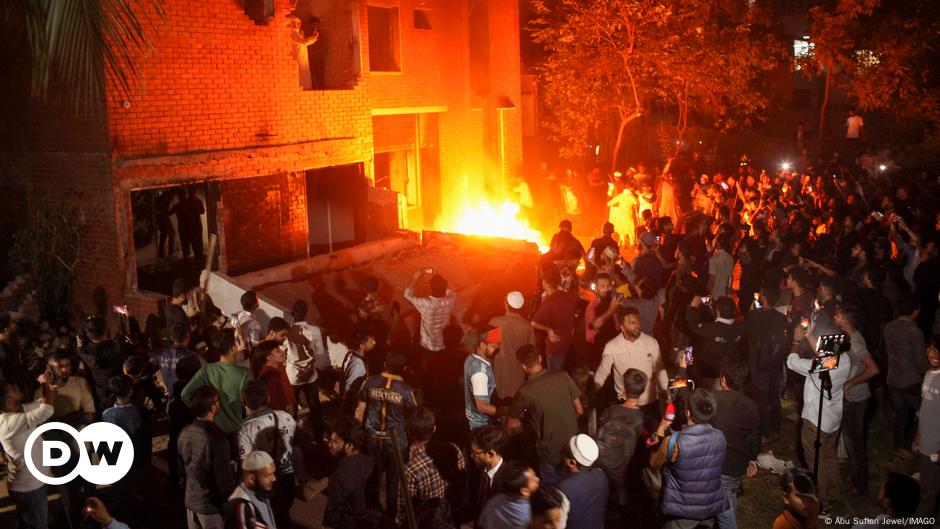
Thousands of protesters in Bangladesh, angry at Prime Minister Sheikh Hasina, have tortured the house of their father and country’s founder leader Sheikh Mujibur Rahman in Dhaka.
The incident occurred on Wednesday night as Hasina gave a fierce speech that urged supporters to oppose the interim government.
Hasina gave the address from neighboring India, where she is currently in exile.
The protesters threatened to “bulldoz” the important building – which was a symbol of Bangladesh’s independence – if Hasina further with her speech.
As soon as the deposit leader started online address, the protesters created a storm in the House and started vandalism of their brick walls.
Media reports stated that some people in the crowd were seen carrying sticks and hammers, while others used to bring a crane and excavator to demolish the house.
Hasina said during her speech, “They do not have the power to destroy the country’s freedom with bulldozers. They can destroy a building, but they will not erase history.”
Symbolic building
The house was where Bangladesh’s freedom leader Sheikh Mujibur Rahman declared the country’s formal break from Pakistan in 1971.
Where was this Mujibur Rahman and most of his family members murdered in 1975.
Hasina, who survived the murder, later converted the building into a museum.
The House was set earlier last year as the protesters targeted the symbols of the Hasina government.
Mob justice
The acting government of the country, led by Nobel Prize winner Muhammad Yunus, is struggling to stop the mob justice against the supporters of Hasina.
On Wednesday, protesters attacked several homes and businesses related to Hasina’s Awami League supporters.
In 2024, Hasina was excluded from a 15 -year power hold in Bangladesh during a deadly rebellion of a deadly student.
The interim government has accused 77 -year -old Hasina of comprehensive corruption and human rights violation during its rule, which began in 2009.
In his speech, the former Prime Minister alleged that the new leaders of the country took power by “inconvenience”.
Edited by: Wesley Dakri