
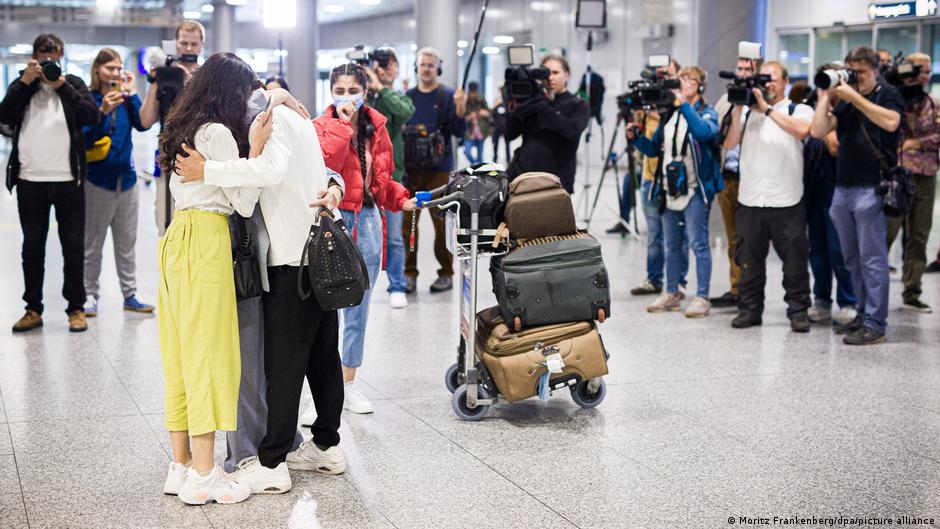
Afghans who were told they could go to Germany will be informed over the next few days “that there is no longer any political interest in their entry.”
With these brief words, German Interior Ministry spokesperson Sonja Koch revealed that 640 people in Pakistan waiting to be transferred to Germany may not be able to come after all.
The group had already been promised asylum by the German government, amid fears of persecution and reprisals by the Taliban regime in Afghanistan.
But the pledge is being canceled as Chancellor Friedrich Merz’s government in Berlin aims to end resettlement programs “as far as possible.” The conservative CDU and CSU parties and the Social Democrats agreed to this in their coalition agreement earlier this year.
The previous government, composed of Social Democrats, Greens and Liberals, had promised to accept women’s rights activists, lawyers, journalists and other opposition figures from Afghanistan through a “human rights list” and a “bridging list”.
However, Interior Minister Alexander Dobrindt did a U-turn on these commitments, which are due after the Taliban take power in Afghanistan in 2021, and dismissed them as “legacy issues.”
Afghans working for German ministries were also rejected.
This is the first time that the third resettlement program of local staff working for German ministries in Afghanistan has been affected. According to the aid organization “Kabul Airlift”, these workers and their families received the news via email last week. About 130 people who received commitments from the German government’s local worker program were told they would no longer be housed in Germany, group spokeswoman Eva Baer told DW.
The email was sent by GIZ, the German government’s development aid agency. Its concluding sentence reads: “After further detailed investigation, it has been decided that there are no grounds to deny entry to Germany under section 22 of the Residence Act.” The message does not give any specific reason for the reversal. Sonja Koch of the German Interior Ministry confirmed that this means only 90 of the remaining 220 local workers can now claim entry.
Interior Minister says he wants to stick to commitments to local workers
Interior Minister Alexander Dobrindt (CSU) was not aware of these developments when DW asked him about the rejection of local workers. “I have read a report on this, which I cannot fully assess, but I have asked my office to provide me with an assessment today,” he said.
Dobrindt assured DW: “There is no change in my decision, which I have made clear for some time. Where we have legally binding entry commitments, we will fulfill them. We see ourselves as having an ongoing responsibility towards so-called local employees.”
A condition for entry is passing a security check.
According to government data, Germany has accepted a total of 4,000 local workers and about 15,000 family members since the Taliban seized power in 2021 until April 2025. The group still waiting in Pakistan is relatively small in comparison.
Uncertainty about Germany’s immigration plans
With Pakistani authorities threatening to hand over Afghans living in German guesthouses in Pakistan to Taliban rule at the end of the year, time is running out.
Several hundred thousand people have been evacuated from Pakistan to Germany since the current government took office, in addition to the particularly vulnerable local staff already mentioned, but approximately 1,000 more Afghans are still waiting to cross to safety in Germany.
Under the fourth rehabilitation programme, they were promised that they would be allowed to resettle. However, in recent months, Interior Minister Alexander Dobrindt has ignored these pledges: only those who have successfully sued in German administrative courts to enforce entry commitments will still be excluded.
According to the aid organization “Kabul-Luftbruk”, which connects Afghans with lawyers, 84 cases have been successful so far, with another 195 pending. Dozens more cases are being prepared. It is doubtful whether these proceedings will be completed before the end of the year.
“This is an incredible situation of uncertainty that some people have been living in for months, some for years,” Baer, of the Kabul Airlift, said, referring to people stranded in Pakistan. “This uncertainty itself is psychological torture.”
Over the course of four years, approximately 3,500 commitments were made under the resettlement programme, mainly to former employees of German NGOs who were at risk following the seizure of power by the Islamic Taliban.
‘A litmus test for the credibility of the German government’
Nearly 250 organizations, including Human Rights Watch, Pro Asylum and Brot für die Welt, have sent an open letter to Interior Minister Dobrindt calling on him to bring endangered Afghan families to Germany before the end of the year without bureaucratic obstacles.
Pro Asylum co-director Helene Reizen called the rescue of all those with promises of entry a “litmus test for the trustworthiness, credibility and humanity of the German government.”
Kock said at least those affected will not be immediately homeless. He said, as long as the land border between Afghanistan and Pakistan remains closed, they can stay in rented guest houses in Pakistan.
The German government is also offering to book flights for prospective refugees to fly back to the Afghan capital, Kabul – even though their fate there will be completely unclear.
This article was originally published in German.