The financial reality of Venezuela stopped being a story of paper money to become one of codes and digital wallets for the use of cryptocurrencies. This transition defines the role of digital assets in the country, where they are already part of an economic survival infrastructure, according to data from the analysis tools provider. on-chain TRM Labs.
The report What Latin America’s Crypto Surge Means for Compliance Teams (what the rise of cryptocurrencies in Latin America means for compliance teams), published this April 6, 2026, places the nation in 11th place in its Global Adoption Indexa notable increase compared to the previous year, which reflects unprecedented regional dynamism.
The analysis highlights how the Latin American ecosystem went from being a promise to a high-volume market, where the growth of retail transactions exceeded 125% in the last year. This has been driven by a mix of foreign currency shortages and a banking infrastructure that fails to meet the demand for agility of its citizens.
It is in this context of accelerated expansion where the precision of the figures becomes relevant. Although firms like Chainalysis also weight adoption by purchasing power, ranking Venezuela 18th overall by their own metric, the value of TRM Labs’ analysis lies in its “specific weight” methodology.
By contrasting flows directly with the size of the real economy, the report manages to make visible how digital assets fit into everyday life of a nation with exceptionally high financial operability.
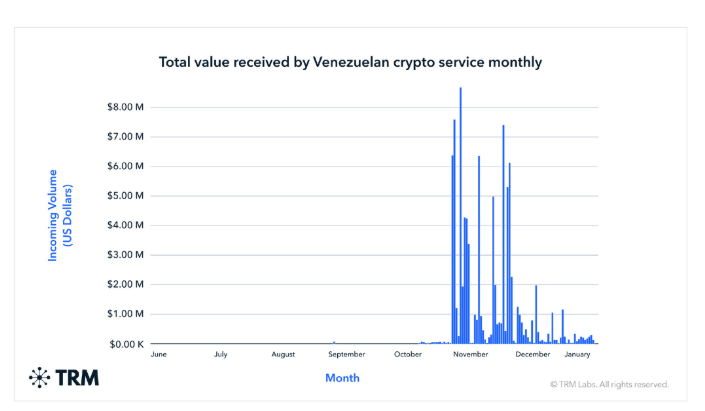
USDT in search of digital refuge
To understand the magnitude of this phenomenon, it is necessary to look at stablecoins. In Venezuela and the rest of the region, these currencies linked to the dollar They are the engine of an economy that seeks alternatives to crude arithmetic.
This comes from the fact that the bolivar depreciated approximately 750% in the informal market during 2025. This strong depreciation accelerated the dollarization of the Venezuelan economy through cryptocurrencies, especially stablecoins such as Tether’s USDT, which is used today for everyday payments and sending remittances, as noted in the report, coinciding with what was reported by CriptoNoticias.
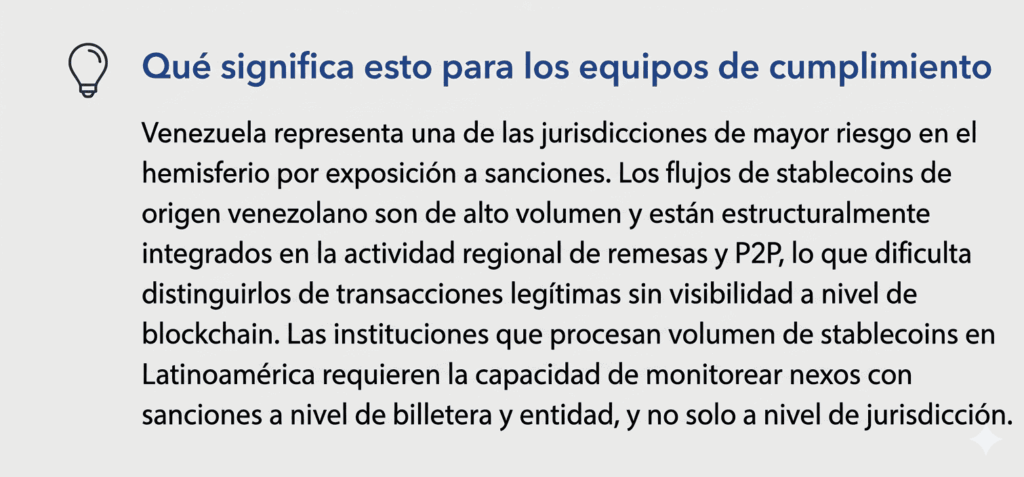
However, the report highlights that this dynamism also poses integrity challenges, given that stablecoins today represent 95% of the flows received by sanctioned entities all over the world. This data places regional activity under the microscope of global compliance organizations, just at a time when Venezuela is going through a complex process of relief from international sanctions.
In a context of persistent sanctions, stablecoin tracking can simultaneously function as a payment mechanism and as a source of information for regulators and compliance companies, according to analysis from firms like Elliptic.
Stablecoins, a continental-scale movement
This behavior places Venezuela at the forefront of a phenomenon that spans the entire continent, with Brazil already occupying fifth place globally and countries such as Argentina, Mexico and Colombia consolidating themselves in the top 25.
The scale of this movement is monumental. According to the TRM Labs report, stablecoins accounted for 30% of all transaction volume on-chain globally and reached more than 4 trillion dollars in transaction volume during the first seven months of 2025, an increase of 83% compared to the same period in 2024. This magnitude forces monetary authorities to recognize the paradigm shift.
Gabriel Galípolo, current president of the Central Bank of Brazil, validates this trend by pointing out that almost all of the growth of digital assets in his country is linked to stablecoins. With this, it makes it clear that the average user seeks access to a currency similar to the digital dollar that the local financial system cannot always guarantee efficiently.
The regulatory crossroads in Latin America
However, this accelerated digitalization is forcing governments to enter a regulatory race to mitigate money laundering risks. In that sense, Brazil implemented mandatory authorization regimes for virtual service providers this February 2026. Venezuela, for its part, is navigating these waters in a context of restructuring its regulatory body, the National Superintendence of Crypto Assets (Sunacrip).
Meanwhile, in Venezuela, domestic platforms tolerated by the government coexist with rails informal peer-to-peer (P2P). Indeed, the country has a fragmented regulatory environment following the restructuring of its main regulator, leaving supervisory gaps in an economy with limited access to traditional banking, according to the report.
At the end of the day, the adoption of cryptoassets in Latin America is presented as a two-way reality: on the one hand, it works as a tool of inclusion and protection against inflation for millions of citizens; on the other, it constitutes a complex security puzzle for the international financial architecture.
What the 2026 figures make clear is that, as long as macroeconomic instability and gaps in banking access persist, The “cryptonization” of the region will hardly be a passing phaseconsolidating itself as the new language of money in a market that stopped waiting for conventional solutions.