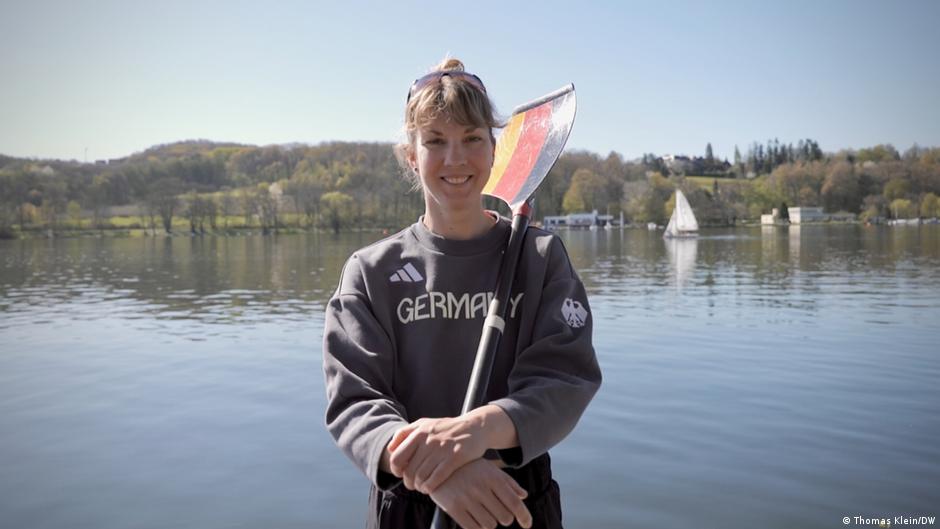
A little tired but with a smile on her face, Catherine Marchand arrived for her first training session of the day. Along with his rowing partner Valentin Luz, the para-athlete will spend the first few hours of the day on the water in the double scull. A few quick stretches, and then they’re off.
“Five years ago, I never thought I’d be sailing this much again,” Marchand told DW. “I consider it fortunate that I can still compete at an elite level.”
Marchand, now 35, made her Olympic debut in London in 2012 as part of the German women’s eight. Four years later, she competed for the second time at the Summer Games in Rio de Janeiro.
After the Olympics in Brazil, Marchand ended her sporting career, completed her medical degree and then began working as a doctor in 2018 – until a stroke in 2021 turned her life upside down.
He recalled, during an indoor cycling class, the left side of his body suddenly became numb. “I didn’t immediately think about stroke then because I was so young. I was 30 and had no pre-existing medical conditions,” she said.
Marchand did not call an ambulance until an hour after the incident. The stroke was confirmed after an MRI scan at the hospital. “In that moment, you think: ‘What did I do to deserve this?'”
adjusting to a new reality
The medical bolt suddenly changed the life of the young doctor. Since then, Marchand has had problems with concentration and forgetfulness, difficulty orienting himself, as well as a limited field of vision. It has taken him a long time to get used to his new reality and come to terms with his limitations.
“It’s really hard when you’re suddenly taken away from your everyday life,” he said. “I will never be healthy again. I have learned that the body is not a machine, even though I sometimes want it to be.”
This setback means it has had to retreat on many fronts. “I’ve had to lower my standards. I’ve set lower goals for myself, but I’ve also learned not to be so hard on myself.”
But Marchand is determined to make the best of his situation. “I’ve changed my perspective. Of course my limitations bother me, but in the end, it depends on how you deal with them.”
From Rio to Paris and from Olympics to Paralympics
Just a few months after her stroke, Marchand was back rowing a boat – this time, however, as a para-athlete. He said, “Sports teach you a lot about how to deal with negative events. A sports career is not always easy, there are some ups and downs, but there are positives too.”
Marchand did not have to wait long for the first successes in his “new” discipline. She won her first medals at the European and World Championships and also qualified for the 2024 Paralympics in Paris, where she finished fourth in the German mixed four-person boat.
Marchand said, “I had nothing to do with para sports and I had nothing to do with it.”
“But then I talked to para-athletes and started to look into it. I went to my first training session and it was absolutely amazing. Everyone there was disabled, and then you see: ‘Hey, having a disability isn’t so bad.’ “It was an entirely positive experience.”
Marchand created sports history
After competing in the Summer Paralympic Games for several years, Marchand took it a step further with a new challenge: para cross-country skiing. His first winter training session on narrow skis was not easy, but he adapted to such an extent that he qualified for the Milan-Cortina Games earlier this year.
In doing so, she became the first athlete in history to compete in the Summer Olympics, Summer Paralympics, and Winter Paralympics.
Since then, Marchand’s profile has risen. She has become a public figure in Germany – and wants to use it to encourage others facing similar challenges.
“I’m just living my life and it feels amazing when I can inspire other people or serve as a role model,” she said. “I’m always happy when I get messages saying, ‘Hey, we love what you’re doing, and it’s helped us get through some tough times.'”
2028 Paralympic medal target
Marchand tries to get as much out of his life as possible, and believes that “in the end, the stroke has given me more than it took away.” She admits that other people often find this strange.
“I was healthy before, and now I’m sick. Why would anyone want to be sick when they can be healthy?”
His explanation is simple: “Before the stroke, my life was much more stressful; I worked a lot and took very little pleasure in the work I did.”
“It is sad to admit,” he said. “I could have changed my life earlier, but I didn’t. It’s a shame that it takes a moment of luck to realize so many things.”
Today, Marchand is satisfied with her life and knows her limitations. Still, she has set a big goal for herself at the Los Angeles Summer Games in 2028, where she hopes to eventually win her first Paralympic medal in para-rowing boat.
This article was originally written in German.