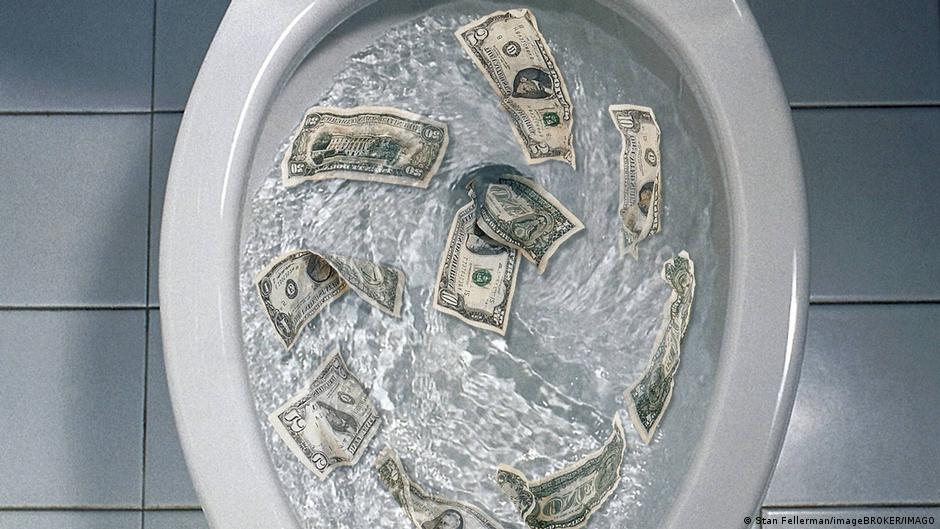
If you’ve been flushing a toilet in the US, you’ve probably become used to the feature as a stream of water fills the bowl and then flushes the contents down with a dramatic gulp.
In Europe, on the other hand, the process looks very different. There is almost always a choice of a lighter or stronger flush, depending on what you need. And the water doesn’t suction, but simply pushes the waste down. In contrast, in Germany and the Netherlands, waste sometimes falls onto a ceramic shelf located directly above a pool of water.
All this potty talk isn’t just vulgar dinner table conversation. How we flush our toilets has a significant impact on the water supply. This is an urgent issue in the US as climate change worsens drought conditions and many communities across the country, especially in the West, face water shortages.
The country’s unique siphon design once required gallons of water with each flush to create a suction effect. But in 1992, a landmark water efficiency law overhauled American plumbing and restricted the use of water in new toilets. This saved an estimated 18.2 trillion gallons (68.9 trillion litres) over two decades.
President Donald Trump is now insisting on abolishing this rule. However, environmental engineers say such a move would run counter to the actions needed to increase the country’s water supply.
“It took us this long to actually make a small impact on the American mindset of saving water,” Samuel Sandoval Solis, a water resources expert at the University of California, Davis, told DW. He sees the proposal as a “backward” step.
What is Trump proposing?
Trump wants to “repeal wasteful water pressure standards” that he considers “burdensome.”
Matin Duran, an environmental engineer at Villanova University in Pennsylvania, says it’s part of a long-standing American tradition of resisting environmental governance.
“Culturally, people in America don’t like rules,” Duran said. “In Europe, people are more open to these types of regulations if it’s for the greater good,” he said.
In May, the Trump administration issued a directive prohibiting enforcement of the toilet water limits in the 1992 water efficiency law. He also recommended that Congress attempt to repeal the law, which would lead to a more permanent transition that would eliminate a single president’s term.
House Republicans took up the issue and passed the colorfully named “Don’t Mess with My Home Appliances Act,” which would make it easier for the Department of Energy to weaken energy conservation standards. It is unlikely to pass the Senate.
Trump has complained for years about weak toilets and showerheads, promised to “make showers great again” and scrapped home energy standards.
“People are flushing toilets 10 times, 15 times instead of once,” he said in 2019. “You go to a new building or a new house or a new house and you don’t get water, you practically can’t wash your hands, there’s very little water [that] Comes out of the tap.”
Engineering experts say this is an old complaint. Although toilet redesign in the 1990s caused a public outcry about “low flow”, things have come a long way since then.
Burke said, “When presidents complain about their toilets not flushing properly – that’s a thing of the past. There may be some older toilets that didn’t perform well a long time ago. That’s possible. But today’s toilets go through rigorous testing.”
Where today’s toilets have become obsolete
Nevertheless, toilets in the US still use a lot of water. A 1992 law mandates that any newly installed toilet use only 1.6 gallons per flush. In Europe, it is standard for a strong flush, but many toilets across the continent also offer dual flush options with less than a gallon per flush for liquid waste. Despite being a water-efficient option, dual flush never really took off in the US.
Additionally, older unusable models are still common across the country. According to a 2019 study by trade group Plumbing Manufacturers International (PMI), one in five toilets still uses 3.5 gallons or more per flush. If they were manufactured before 1980 some use 5 gallons or more.
In drought-stricken California, PMI estimates that about 2.4 million of these so-called legacy toilets are still in use – replacing them with more efficient models could save the state as much as 14.1 billion gallons of water.
With California facing the possibility of major droughts in the future, ongoing depletion of the Colorado River and the nation’s two largest reservoirs at about one-third of their normal capacity, the state is trying to conserve water wherever possible.
“What the Trump administration is proposing is really in direct conflict with the challenges that many communities across the United States are facing in maintaining reliable, affordable water supplies,” Burke said.
Edited by: Jennifer Collins, Sarah Stephan