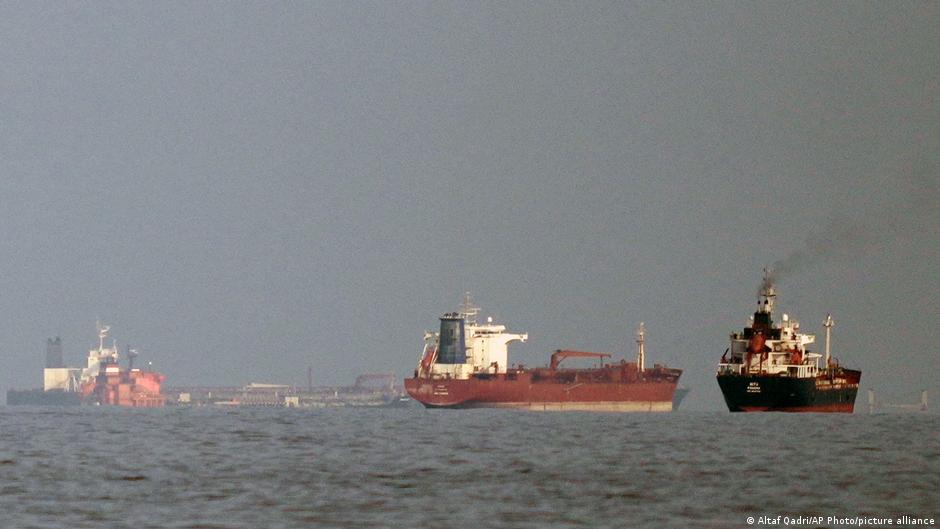
The US naval blockade of the Strait of Hormuz, announced by President Donald Trump shortly after talks with Iran in Islamabad failed over the weekend, took effect on Monday.
The US has said it will block ships from leaving or entering Iranian ports.
The move, which comes after Iran effectively closed the narrow sea route in retaliation for US-Israeli air strikes that began on February 28, has jeopardized a fragile two-week ceasefire and sent already rising oil prices even higher.
The blockade of Iranian ships and oil will also affect China, the largest buyer of Iran’s oil.
What has China said about the US naval blockade in Hormuz?
At a press conference on Tuesday, a spokesperson for China’s Foreign Ministry described the move as “dangerous and irresponsible”, warning that the blockade “will only escalate the confrontation, escalate tensions and undermine the fragile ceasefire.”
Speaking in Beijing on Monday during a meeting with visiting UAE officials, Chinese Foreign Minister Wang Yi said blocking the Strait of Hormuz “does not serve the common interests of the international community.”
The strategic waterway, a vital artery for Middle Eastern energy exports, would normally hold about 20% of global oil supplies.
“This blockade will include other countries,” Trump said, writing on his Truth social platform on Sunday, without specifying which countries he was referring to.
However, Chinese state media rejected that claim. It argued that Washington “has distorted the logic of the issue by drawing more countries into the conflict, as the root cause of the Hormuz blockade lies in the US-Israeli military campaign against Iran.”
The framing echoes comments from Chinese Foreign Ministry spokesman Guo Jiakun, who said at a regular press briefing on Monday that the disruption to navigation in the strait was caused by the conflict with Iran and that the solution lay in an immediate ceasefire.
Chinese state media also described Washington’s move as “a blockade in response to a blockade”, comparing it to “stealing a bicycle and then failing to lock another”. So then, how does China explain the US blockade – and who is Washington really trying to pressure?
Is putting pressure on China to intervene
In an interview with DW, Zhang Lun, a professor at CY Sergi-Paris University, described the US blockade as “responding in kind.” He argued that Washington’s move also aims to “force China onto the stage”.
Zhang points out that the White House may be able to avoid conflict – and save face – if Washington can pressure Beijing to force Tehran to accept America’s terms.
Noting Trump’s transactional style, Zhang suggested that if China “gives Trump this victory”, Beijing would gain leverage in future negotiations on issues such as Taiwan.
However, Zhang does not believe that China will directly intervene in the war in the Middle East. Even though the blockade of the Strait of Hormuz will affect Chinese interests, Beijing’s paramount strategic priority is to maintain a delicate balance by maintaining stable relations with all parties involved.
China’s statement: ‘Great exit’ and ‘Victory of packaging’
Meanwhile, Chinese state media have portrayed the US blockade as part of a “supremacist logic” of resorting to force if negotiations fail.
According to that narrative, Washington has been mobilizing militarily in the Middle East in preparation for escalating war, both during negotiations prior to the conflict’s outbreak and, more recently, during negotiations brokered by Pakistan.
Chinese media are portraying the US as “eager for a graceful exit” from the conflict, even resorting to “packaging victory” by claiming that it has achieved its objectives in Iran, including regime change and successful attacks on targets.
But state media have described the Strait of Hormuz as a “fatal vulnerability” for the US that cannot be avoided: failure in Iran, coupled with losing control of the strait, coupled with rising oil prices and inflation, could have direct consequences for the Trump administration in the US midterm elections in November.
a high stakes gamble
China’s official narrative interprets Iran’s blockade of the strait as evidence that the US and Israel have been “defeated” by Tehran. From Iran’s perspective, Washington’s shift from issuing an ultimatum to returning to the negotiating table reflects its flexibility and refusal to bow to US military pressure.
Meanwhile, the US decision to block Iranian ports is being seen as an attempt to compensate for insufficient leverage at the negotiating table after earlier military actions in China failed to force regime change, one of Trump’s main goals in the early days of the war.
The argument for cutting off access to the strait is that it could deprive Tehran of vital revenues, weakening its bargaining power and forcing it to agree to a deal with Washington.
However, Chinese state media often describe the US blockade as a “gamble”, arguing that while Washington hopes to break the impasse through maximum pressure, Iran’s missile capabilities could create further tensions. Since both sides are already in a state of military readiness, a breakdown in talks would significantly increase the risk of a wider conflict.
Long-term pressure on China’s energy security
Zhang told DW that beyond responding to Israeli demands, long-standing U.S.-Iran tensions and concerns about Iran’s nuclear program, another important factor is Washington’s broader objective of controlling global energy resources — which Trump has repeatedly emphasized.
In this context, Zhang argued, there is a dimension of “comprehensive strategic pressure” on China. The United States has already tightened its grip on Venezuela; If Iran were also brought under American influence, and if Washington were to coerce Russia – possibly through concessions related to Ukraine – it could significantly disrupt China’s access to oil resources.
Despite pressure from Beijing for an energy transition, oil remains important.
As Iran’s largest oil buyer and a key partner, China reportedly held talks with Iranian officials during last week’s ceasefire talks and urged Tehran to accept the terms brokered by Pakistan. However, it is unclear whether China will publicly assume the role of guarantor in any future agreement.
Military support or alternative ‘tools’?
According to a recent report by American media outlet CNN, American intelligence sources have claimed that China has provided or is preparing to provide weapons to Iran.
Trump warned that Beijing could face new tariffs of up to 50% if it offers military aid to Tehran. China’s Foreign Ministry on Monday dismissed the allegations as “baseless slander.”
Hu Zijin, a prominent Chinese media personality, published a comment on Chinese media outlet Phoenix.com, saying such claims were meant as a “preemptive accusation” to deter China. He said Beijing “still has many cards to play.”
Zhang also said China retains excess equipment, including rare earth exports. “If the United States weaponizes the Straits,” he said, “China can also weaponize rare earths.”
Edited by: Carl Sexton