
This article was written by CoinCodex.
__________________________________________
Gold’s recent decline has raised concerns about a possible shift toward a bear market, but leading strategists and financial institutions agree that the pullback reflects temporary pressures rather than a fundamental change in the outlook.
The decline has been attributed to a stronger US dollar, profit taking and easing geopolitical tensions. However, Analysts Emphasize Gold’s Core Investment Thesis Remains Intactsupported by its role as a safe haven asset during periods of uncertainty.
Ed Yardeni, president of Yardeni Research, reaffirmed his long-term bullish stance, projecting that gold could reach $10,000 by the end of the decade. At the same time, it adjusted its shorter-term forecast to $5,000 per ounce by the end of the year.
Short-term headwinds create “tactical opportunities”
Several analysts characterize the current weakness as a buying opportunity rather than a reversal. Justin Lin of Global X ETFs described the pullback as a “attractive entry point”, maintaining a base scenario of $6,000 for gold at the end of the year.
Similarly, Wells Fargo analysts noted that rising interest rates and competition from dollar-denominated assets have temporarily pressured gold. However, They expect these pressures to ease as inflation moderates and monetary policy changes..
Wells Fargo now forecasts gold prices between 6,100 and 6,300 dollars by the end of the year, which represents a significant improvement over its previous forecast. The bank cited potential policy changes, including tariffs and deregulation, as additional catalysts that could boost demand for gold as a hedge.
Central banks and investors support structural demand
A constant theme in the forecasts is the role of central bank purchases, particularly in emerging markets. Institutions like Goldman Sachs expect this demand to remain strong, with projections of approximately 60 tons of gold purchases per month in 2026.
This trend reflects a broader effort by countries to diversify their reserves away from the US dollar. Combined with steady flows into gold-backed exchange-traded funds (ETFs), this creates a lasting support base for prices.
Goldman also notes continued interest from private investors, especially high-net-worth individuals and institutions seeking protection against long-term macroeconomic risks, such as fiscal instability and questions about the credibility of monetary policy.
Gold price targets are between $5,000 and $6,300 in the medium term
Using an algorithmic model, the gold price prediction of CoinCodex expects gold to reach up to $6,570 per ounce in 2026. This would represent a 38% increase compared to the current price of the metal. While the forecast is certainly optimistic, it is not far off from 2026 price targets for the asset provided by precious metals market analysts, with Wells Fargo’s $6,300 target being a glaring example.
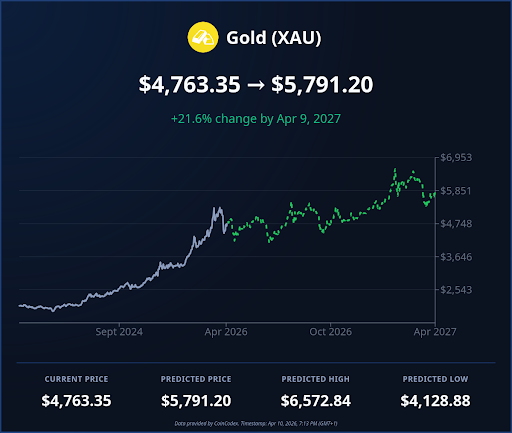
Among major institutions, gold price targets show a relatively narrow range over the medium term:
- Standard Chartered expects a rally towards $5,375 in the next three months, with technical support around $4,100.
- Goldman Sachs maintains a target of $5,400 by 2026.
- Yardeni Research and Global X project levels around $5,000 to $6,000 in the short term.
- Wells Fargo stands out with a higher range of $6,100 to $6,300.
Despite the differences in the exact figures, consensus suggests considerable upside potential from current levelsassuming that macroeconomic conditions evolve as expected.
Long-term gold projections reach up to $10,000
Beyond the short and medium-term objectives, some strategists present more ambitious scenarios. Yardeni’s $10,000 forecast for the end of the decade reflects expectations of prolonged geopolitical instability, sustained accumulation by central banks and a gradual weakening of fiat currencies.
Goldman’s concept of the “depreciation trade” aligns with this view, highlighting investor concerns about government debt and the credibility of monetary policy as long-term drivers of gold demand.
Outlook depends on rates, dollar and geopolitics
Looking ahead, analysts identify several key variables that will shape gold’s trajectory:
- Interest rates: Lower rates typically support gold by reducing the opportunity cost of holding non-yielding assets
- US Dollar Strength: A weaker dollar tends to boost gold prices
- Geopolitical risks: Global tensions reinforce gold’s appeal as a safe haven
- Central bank activity: Continuous accumulation provides structural soil
Although short-term volatility may persist, the prevailing view among major financial institutions is that the long-term bull case for gold remains firmly in place.