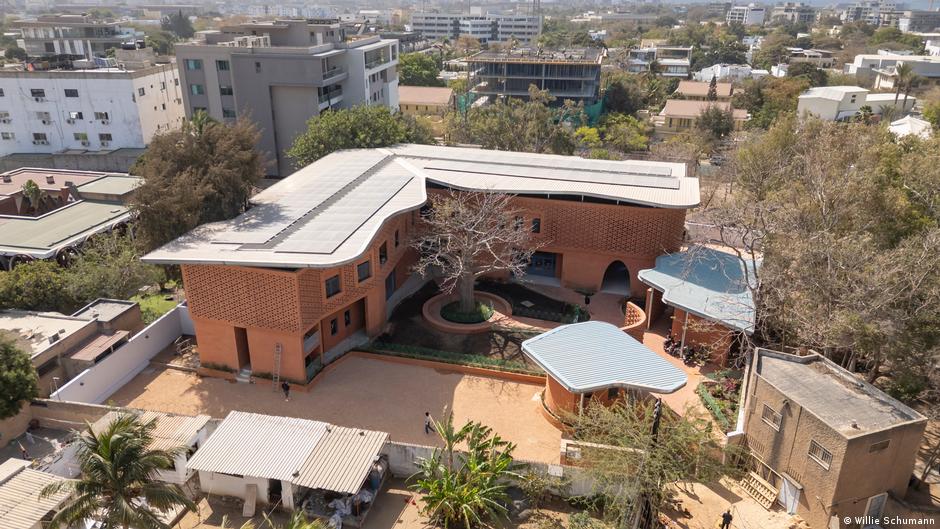
In Dakar, the Goethe-Institut has much more to offer than just a new building. Encircling a baobab tree, it provides an open space for cultural education and exchange. It signals both respect for local traditions and boldness in global vision.
The Goethe-Institut has had a home in the Senegalese capital since the mid-1970s. Their new, sustainable building complex received support from the United Nations.
Architect Francis Kéré: sustainability as a mindset
Seven years earlier, standing on a sandy plot of land, Francis Kéré had made the first sketches in his notebook.
In 2022, an internationally renowned architect from Burkina Faso became the first Black person to win the Pritzker Prize. He has also been awarded the Premium Imperial of Japan.
For Dakar, his goal was to create a building that combined modern architecture with the African culture of construction. To achieve this, they chose a millennium-old building material that keeps out heat and ensures a cool interior: clay. The idea was to mix Senegalese red clay with a minimal amount of cement and press it into bricks.
Airy clay design
Francis Kéré told DW that clay was a very conscious choice of material: “I modified the properties of clay to make uniform bricks, creating a building with a modern look.” It was material that he knew people would be familiar with. “This is so important: people really feel respected and taken seriously,” says Kerrey.
The architecture blends harmoniously into its environment – with shaded façades, interconnected spaces and natural ventilation. Only some supporting elements were built with reinforced concrete.
Bioclimatic architecture in the heart of Dakar
Construction is managed by Dakar-based architecture firm Vorophila, founded by Nzinga Mboup and Nicolas Rondet. He has specialized in bio-climatic architecture, an approach that relies on passive cooling, cross ventilation and the use of local materials.
The courtyards promote airflow, while the thick mud walls retain their coolness, slowly releasing heat into it. This is a time-tested tradition for construction in the Sahel region. “Here, I can feel the sea breeze,” says Nzinga Mboup, architect of Vorophila. “There is something very essential and powerful in creating with the earth that reconnects the body with the material. It’s not something that can be explained – you have to experience it yourself.”
By choosing clay architecture for its new building, the Goethe-Institut is sending a signal to the world. The project proves that building sustainably at scale is possible – even as global conditions become more complex.
Dakar is one of the fastest growing metropolitan areas in Africa. With that growth comes challenges: housing shortages, rising temperatures and rising CO₂ emissions from concrete buildings, often combined with energy-intensive air conditioning systems.
Speaking to DW, Ghanaian architecture scholar Leslie Lokko says sustainable alternatives are urgently needed. “Our continent is urbanizing faster than any other continent, we are facing incredible time pressure,” he said. “I want to use that pressure to my advantage. We don’t have a hundred years. We need to think and act now.”
Now, a new generation of architects is turning to earth as a building material for the future. The new Goethe-Institut in Dakar serves as a model for sustainable construction. Its message is clear: the world’s urban future can begin with the convergence of ancient wisdom, modern technology and social responsibility – and the red soil of Africa.
After years of construction, the cultural institute is scheduled to open in Dakar on April 18, 2026. The Goethe-Institut Senegal also oversees activities in Gambia, Cape Verde and Guinea-Bissau.
This article was originally written in German.