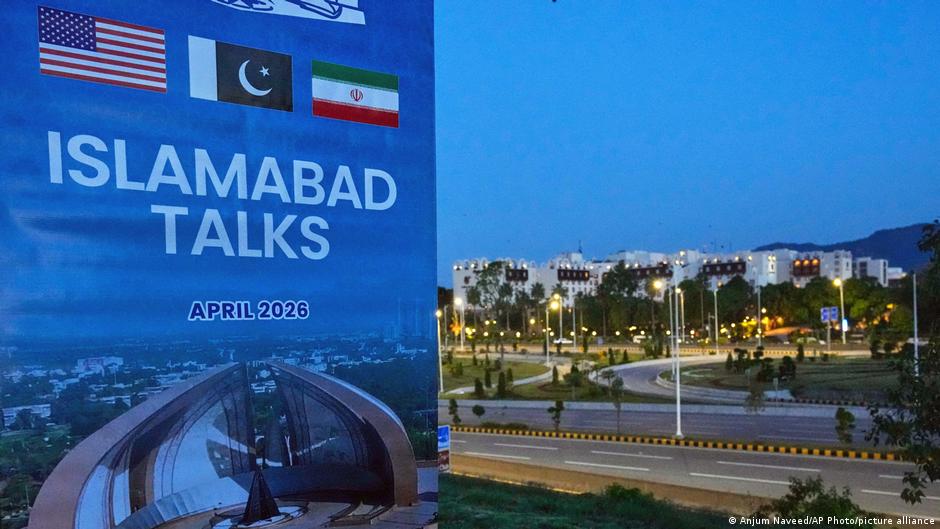
“There’s a very good chance we’re going to make a deal with Tehran,” US President Donald Trump told reporters on Thursday amid expectations of a second round of talks between the United States and Iran this weekend aimed at ending the Middle East conflict.
“They have agreed to give us back the nuclear dust,” he said, referring to Iran’s rich uranium reserves, which Washington says can be used to make nuclear weapons.
Trump also claimed that Iran had offered not to possess nuclear weapons for more than 20 years.
The US President said, “Iran wants to make a deal. They are willing to do things today that they were not willing to do two months ago.” “We are having very successful negotiations right now. If that happens, it will be announced soon.”
Trump said the next round of US-Iran talks could take place over the weekend and an extension of the two-week ceasefire was possible, but would not be needed because Tehran wanted a deal.
He also gave a positive assessment of the ceasefire agreed on Thursday in Lebanon, where Israel is fighting the Iran-aligned Hezbollah militant group.
Trump said he is confident that if the US and Iran reach an agreement, “oil will go down a lot, prices will go down a lot, inflation will go down a lot.”
Pakistani mediators, who have been facilitating high-risk talks between the warring sides, say backdoor diplomacy has achieved progress.
A Pakistani source involved in mediation efforts told Reuters news agency on Friday that the two sides are likely to sign a memorandum of understanding at an upcoming meeting, followed by a comprehensive agreement within 60 days.
“Both sides agree in principle. And the technicalities come later,” the unnamed source said.
Skepticism in Iran
Meanwhile, a different tone is emerging from Iran, with state media reporting that the government is united behind Speaker of Iran’s Parliament Mohammad Bagher Ghalibaf and his negotiating team, who are conducting the talks from the Iranian side.
Coverage has portrayed it as reflecting national unity and “increased power diplomacy”.
Meanwhile, Ghalibaf has emphasized close ties between the Islamic Republic and its “axis of resistance”, which includes Iran-allied groups in the Middle East such as the Hezbollah terrorist organization in Lebanon, the Houthis in Yemen and Hamas in the Gaza Strip. He insisted that in both war and armistice they were “one body”.
At the same time, skepticism is growing in Iran, where many believe Washington is using the ceasefire to increase its military efforts.
Reports of further US military deployments reinforce that notion.
Therefore, Iranian officials say they are approaching potential talks with “great caution” and that the military is prepared to deal with any threat.
Deep mistrust between the two sides means that reaching an agreement will be particularly challenging, not only regarding the nuclear program but also on other thorny issues such as the Strait of Hormuz, international sanctions against Iran and support for Tehran’s regional proxies.
made progress?
“It appears that the first round of talks in Islamabad has failed,” Hamidreza Azizi of the German Institute for International and Security Affairs (SWP) told DW. “However, both American and Iranian sources indicate that at least some progress has been made.”
Three issues are important, he said: the Strait of Hormuz, Iran’s nuclear program and Tehran’s regional proxies.
Conrad Schechter, peace and conflict researcher and director of the Bonn International Center for Conflict Studies, echoed this view.
“Overall, the prevailing perception is that the two sides have not made progress on key issues, neither with respect to U.S. demands nor with respect to Iran’s demands,” he told DW.
At the same time, the expert said, the rhetoric has been relaxed somewhat recently, which at least opens up some room for maneuver.
Iran’s nuclear program remains an obstacle
The future of Iran’s nuclear program remains the main issue. “The United States is demanding that Iran remove this material from the country,” Azizi said, referring to enriched uranium.
Tehran, on the other hand, is willing to reduce its stockpile, but only gradually – and only in exchange for guarantees that it will not be attacked again.
Shechter believes it is hardly realistic for the US to launch another military action to achieve its goals, but reaching an agreement remains difficult.
He said a temporary relaxation could be imagined. “If an agreement can be made for about 10 to 12 years, that would probably be a viable agreement.”
Dispute over the Strait of Hormuz
The second major point of contention is the Strait of Hormuz.
This is a strategic lever for Iran, Azizi said. However, for the West the waterway is a lifeline for global trade.
Shechter also warned of the risk of escalating tensions, saying even isolated incidents could lead to “a major military conflict.”
Azizi said that even if an agreement is reached, the fundamental confrontation between the two sides will continue, with tensions and indirect conflict more likely to form a “gray zone”.
Reports published by several global think tanks have also dimmed hopes for lasting peace in the near future.
Experts at the Washington Institute for Near East Policy wrote, “Rapid or comprehensive progress in negotiations is unrealistic,” while Chatham House said, “A ceasefire would be welcomed as a necessary step back from the brink.”
Dwindling hopes for domestic political change
However, talks with the US are unlikely to weaken the regime in Tehran. “I don’t expect any fundamental improvement here,” Shechter said. The expert underlined that the regime has shown it can remain stable even under immense pressure, and said that harsh repression domestically and its resilience in the war have actually strengthened it.
Shechter said that for the Iranian people, this means that hopes for political change are becoming increasingly bleak.
Many people may conclude that it is almost impossible to overthrow this regime despite external pressure. At the same time, the regime’s demonstrated ability to function and survive acts as a deterrent, he said, adding that no increase in civil liberties should be expected in the short term.
This article was originally written in German.