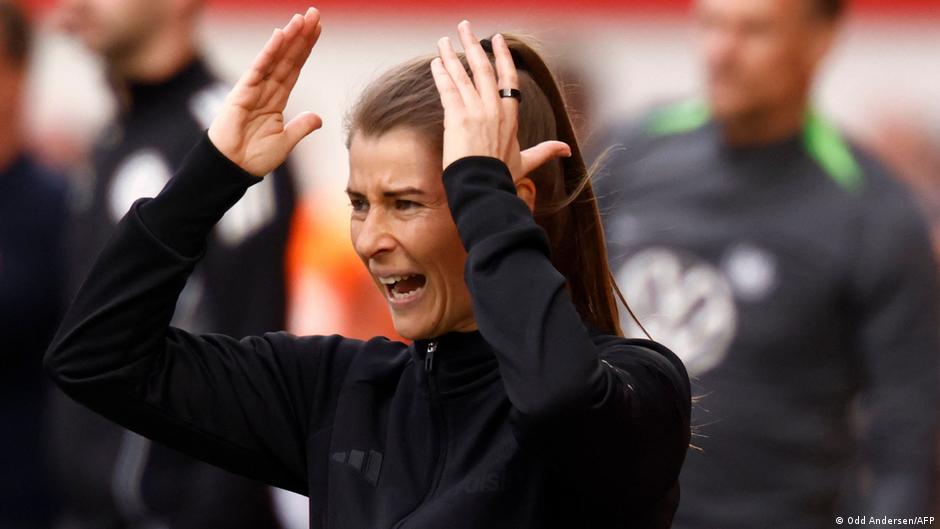
Bayern Munich won their 13th of the last 14 men’s Bundesliga titles in one of the least surprising stories to emerge from German football this weekend. There was another online misogynistic reaction to Marie-Louise Eta becoming the first woman to coach a match in the top five European men’s leagues.
Eta’s Union Berlin team suffered an unfortunate 2-1 defeat to fellow strugglers Wolfsburg, but the discussion on social media was fueled by general comments, with Union’s social media administrator taking a number of users to task.
German Football Association (DFB) vice-president Celia Sasic said this style of community management was “absolutely the right thing”. in an interview with t online portal, Sasic said that: “The comments are unacceptable. They are not directed at just one individual, but call into question the values that are central to our sport: respect, fairness and equality.”
Eta wants to focus on football
As has been his way during the past week’s storm, Etta tried to keep the focus on football but accepted the abuse. “It says more about the people who are posting it online rather than the people who are being talked about,” he said after the match.
Helen Nkwocha is one of the few women who has had similar experience first-hand. The Black British coach became the first woman to coach a men’s European top-division football team in 2021 when she took over as head coach from Faroe Islands’ Tvoir Boltfelag.
“As female coaches, especially if we’re coaching at a competitive level, we experience things like this a lot,” she told DW. “In the Faroe Islands, I got really racially offensive messages and a lot of stuff about how no one knows where the Faroe Islands are.”
Nkwocha said it was important that the union continued to support Eta. “I’m sure this won’t be the first time he’s faced adversity,” he said. “I think a club always needs to be smart when recruiting a new coach. I don’t think they should make too big an issue of it and keep the focus on football.”
Women’s football ‘has caused harm’
While the union has celebrated the appointment, both he and Atta have tried to normalize a story that made headlines around the world.
A more subtle, element of sexism underpinning much of the reaction has been the suggestion that Eta – hired on a temporary basis until the end of the season – will automatically choose a potential job offer for the men’s position over his planned move to the union’s women’s team.
Union president Dirk Zingler said after the game, “I’m not having a discussion that says if she does well she stays with the men, if she does poorly she coaches the women. That hurts women’s football.”
While it is common for men to coach women’s football, it is unusual for a woman to take charge of a high-level men’s team, even if this occurs in the lower European leagues. Professional footballer Robin Afamefuna, captain of fourth division club Fortuna Colón and a cultural anthropologist whose research focuses on sexism and racism in football, said Eta’s example would be important.
Visibility of coaches is important for the future
“When we talk about visibility and role models, what young girls look up to now, commitment is very important,” Afamefuna told DW. “Girls see that there’s a possibility of having this job someday. And it just wasn’t available before.”
The DFB has approximately 4,000 female coaches who hold a C or Pro license and are authorized to coach professional teams. But despite recent progress, Afamefuna said society still has some way to go before these women have the same opportunities as their male counterparts.
“This is a very deep-rooted, structural, systemic problem that affects women in football,” she said. “We need to talk about the fact that women are disadvantaged in football, and these structures need to be broken down.”
While the introduction of Eta has shown that the patriarchal structure of football can be challenged, the reaction to it has highlighted the truth that many obstacles still remain.
Edited by: Jonathan Crane