When in mid-1934 it became clear to the famous German actress Tila Durieux and her husband Ludwig Katzenelnbogen, a businessman of Jewish origin, that their residence permit in Switzerland would not be renewed, the two decided to leave for Zagreb – the capital of Croatia, which was then the Kingdom of Yugoslavia.
Few Europeans actually realized where Zagreb was located, Durieux later noted in his diary. “People thought that Zagreb was a suburb of Vienna or Prague. Yugoslavia was somewhere ‘down there,’ in a part of the world that no one could quite make sense of.” The couple’s friends praised their courageous decision, although they feared they might be attacked by robbers on the way.
escape from germany
By that time, the couple had been fleeing Germany’s Nazi regime for over a year. He left the German capital Berlin on March 31, 1933. At that time, Adolf Hitler had already achieved complete political control, basic rights were suspended, and Nazi terror was widespread. SA thugs kept roaming on the streets. Thousands of people were arrested, sent to concentration camps, tortured, and murdered.
Those who were able to escape, packed their belongings and moved abroad, included many Germans of Jewish origin, communists, social democrats, trade unionists, artists and intellectuals. Most people fled westwards to Switzerland, France and Britain and even the United States. Many Jews crossed the Mediterranean Sea to Palestine.
run to the balkans
Many of these stories are well documented. Less attention has been paid to those who took refuge in the Kingdom of Yugoslavia between 1933 and 1941 – in today’s Slovenia, Croatia, Bosnia and Herzegovina, Serbia, Kosovo, Montenegro and North Macedonia.
“Very few people wanted to stay there for long,” German historian Marie-Janine Calik tells DW. Yugoslavia had ports on the Adriatic Sea from where it was possible to continue onward journeys. And while many European countries closed their borders to immigrants from Germany after 1933, entry into Yugoslavia was possible with a temporary visa that could be extended several times. Initially, refugees were also allowed to work.
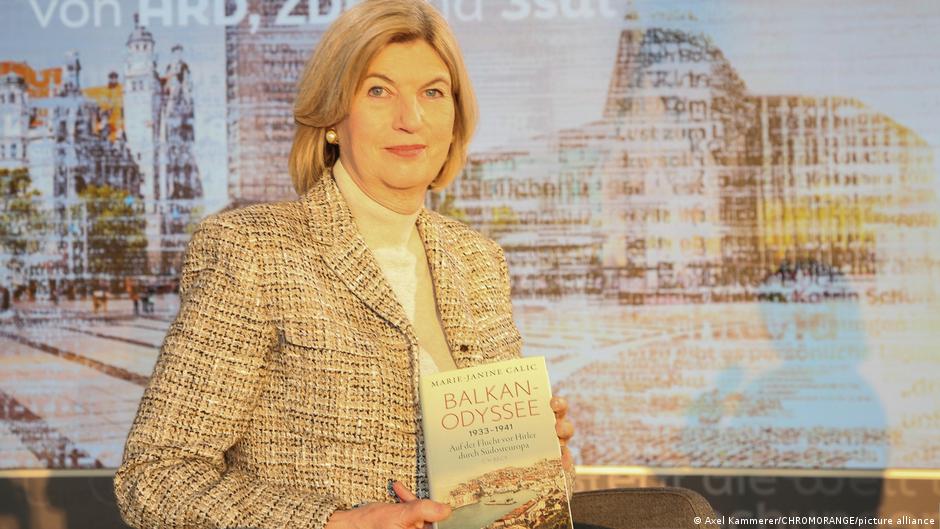
“It attracted people to the country, even though most knew very little about Yugoslavia – and what they did know was often negative and associated with killings and World War I,” explains Calic. his book Balkan odyssey 1933-1941 Examines an often overlooked chapter of World War II history and was awarded the Leipzig Book Prize for non-fiction in 2026.
Refugees receive help and support
Durieux and Katzenelnbogen reached Zagreb without incident. Industry, banking, trade and transportation were developing at a rapid pace in the city, which boasted modern buildings as well as Belle Époque architecture influenced by Le Corbusier, one of the pioneers of modern architecture. As in Western Europe, people in Zagreb enjoyed tennis and golf, car and motorcycle racing, movies, and jazz concerts. Emancipated young women can be seen wearing Parisian fashion and hairstyles.
“Initially many migrants came to Zagreb, where humanitarian organizations, especially Jewish ones, were present. They collected money, registered refugees and helped them continue their journey,” says Calik.
Common people also helped. “All the documents and evidence left by these new people express deep gratitude for the support provided by everyday people,” Calcic told DW. Often, refugees received assistance from people they met by chance, who would take them in, make arrangements for their onward travel, provide food, or provide assistance in other ways.
Many refugees fled Nazi Germany because they pursued professions, held values, or lived lifestyles inconsistent with the regime’s ideology. Callick says, “Take the example of progressive teacher Annemarie Wolfe-Richter. She ran a home for difficult-to-educate children and sought to shelter and support them in accordance with modern educational principles and progressive philosophies of education.”
His progressive mindset was in contrast to Nazi ideology, which considered troubled children inferior. Annemarie Wolff-Richter was thus arrested, yet she later managed to escape Nazi Germany with all the inhabitants of her children’s home. They found refuge in Mali Zaton, near the Croatian city of Dubrovnik.
occupation of yugoslavia
According to available data, at least 55,000 people had fled Germany to Yugoslavia by 1941, although the actual number is likely higher. Some traveled by ship to Palestine or other Mediterranean countries. Others stayed and tried to build a new life.
In April 1941, the Wehrmacht and its allies occupied Yugoslavia. Then they started to persecute the Jews and other people in the country. About 5,000 refugees were unable to get out in time. “Beginning in October 1941, hundreds of Jewish refugees were shot,” Kalic told DW.
Those who managed to escape to the Italian-occupied part of Yugoslavia along the Adriatic coast were in a better situation, as the Italians interned the refugees, but did not kill the refugees. In contrast, refugees who found themselves in the Independent State of Croatia (NDH), a Nazi-collaborated country created in 1941, were murdered in the Jasenovac extermination camp.
Life in fascist Croatia
After the Croatian fascists came to power, teacher Wolf-Richter continued to run the home for her children. At times, she cared for up to 17 children, including the children of murdered communists. His partner, Erwin Sussman, was arrested and executed in Jasenovac in December 1941. In 1944, Wolf-Richter was also deported there, where he died shortly before the end of the war.
Durieux survived thanks to relatives who kept her in Zagreb, although her husband was arrested while trying to escape in 1941 and deported to Germany, where he died. After the war ended in 1945, Durieux lived in Zagreb for the next nine years. He was highly respected because he supported the Yugoslavian partisans during the period of Croatian fascism. He helped establish the Zagreb Puppet Theater and was granted Yugoslavian citizenship.
After returning to Germany, Durieux continued her theater career and remarried. She often visited friends in Zagreb, a city she loved and to which she felt deeply connected. To this day, the Zagreb City Museum displays items from his estate.
This article was originally written in German.