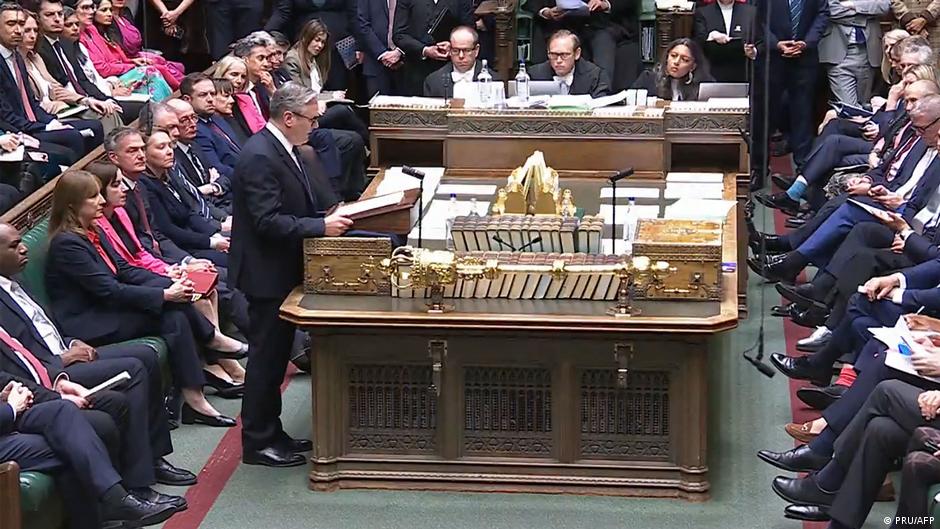
Keir Starmer delivered a statement in the House of Commons on Monday seeking to provide more information on the investigation and controversial appointment of Britain’s former ambassador to the US, Peter Mandelson, a well-known associate of Jeffrey Epstein who resigned amid the scandal last year and now faces legal investigation for alleged misconduct in public office.
Starmer told the House that while Mandelson had failed his security vetting process, British Foreign Office officials decided to reject this recommendation, and then neglected to tell Starmer or any senior government official about this.
He also said that if he had been told about Mandelson’s failed check, he would not have appointed him to the prestigious job in Washington.
The case has been putting pressure on Starmer’s already unpopular premier for several months, with crucial local and regional elections due in May.
Starmer: Decision to appoint Mandelson ‘was wrong’
The Labor Party leader began his comments on the process of Mandelson’s investigation, appointment, dismissal and subsequent investigation, making more general comments on the decision to place an already controversial Labor grandee with known ties to Jeffrey Epstein into the role.
“At the core of this is a decision of mine that was wrong,” Starmer told MPs. “I should not have hired Peter Mandelson. I take responsibility for that decision. And I apologize again to the victims of pedophile Jeffrey Epstein, who were clearly failed by my decision.”
Mandelson was appointed in December 2024 and was fired the following September as more details emerged about her ties to convicted sex offender and financier Jeffrey Epstein. At several points since then, the handling of his appointment and dismissal has caused major headaches for Starmer’s government, as new information has emerged through the so-called “Epstein files” and other sources.
Meanwhile, he has resigned from both the Labor Party and the upper house, the House of Lords, and faces a criminal investigation into alleged wrongdoing in public office dating back nearly two decades.
A number of senior government officials and civil servants have been dismissed amid the fallout, but Starmer and his cabinet ministers have so far been spared dismissal.
What did Starmer say about the investigation process?
The Prime Minister then set out the latest findings about Mandelson, who had not been cleared for so-called “devolved investigative clearance”, the UK process that recommends senior civil servants for access to top secret information, and also said that this information had not been shared with any of his senior government ministers.
“Last Tuesday evening… I learned for the first time that on January 29, 2025, before Peter Mandelson took up his post as Ambassador, Foreign Office officials granted him devolved vetting clearance against the specific recommendation of the United Kingdom Security Vetting (UKSV) that devolved vetting clearance should be denied,” Starmer said.
“Not only this, the Foreign Office officials who took this decision did not give this information to me, the Foreign Secretary [Yvette Cooper]to his predecessor as Deputy Prime Minister [David Lammy]”To another minister, or even to the former Cabinet Secretary Sir Chris Wormald,” Starmer said.
Starmer said that government ministers were not briefed even after Mandelson’s dismissal and during the first round of the scandal regarding due process, leading members of his government to inadvertently mislead the House by saying that Mandelson had approved the investigation process.
Finally, Starmer said that in February this year he had become so concerned that Mandelson had apparently not raised any red flags, given the extent of the allegations and the subsequent criminal investigation against him, that he ordered an internal review of UKSV investigation procedures. Yet, he said, no one thought to mention that Mandelson had failed the check.
“The fact that I was not told even when I ordered a review of the UKSV process is truly shocking,” he said.
“I know that many members across the House will find these facts unbelievable,” Starmer said late in his speech, prompting louder laughter in the House than they probably had heard. “To that, I can only say that they are right. It beggars belief that, throughout the course of events, Foreign Office officials saw fit to conceal this information from the most senior ministers in our system of government.”
How did opposition leaders react?
Kemi Badenoch, leader of the centre-right Conservative Party, said in reaction to Starmer’s statement: “His reputation is at stake. Everyone is watching.”
“This goes beyond property and morality. This is a matter of national security,” Badenoch said. “At every turn, with every clarification, the government’s story has become vaguer and more contradictory. It is time for the truth.”
Badenoch, like Ed Davey, leader of the Liberal Democrats, accused Starmer of letting others take the rap for a decision that can originally be traced to him, namely appointing Mandelson to the role despite his checkered past.
“It’s 2022 again,” Davy said in reference to Prime Minister Boris Johnson’s final days, the successive dismissals and resignations and allegations of misleading Parliament.
Davy asked, “Why did he ask so few questions about the investigation process,” speculating that Starmer “knew” that appointing Mandelson was a risk, but “he decided it was a risk worth taking – a catastrophic error of judgement.”
Meanwhile, Reform UK MP Lee Anderson was thrown out of the chamber for breaching the rules after accusing Starmer of “lying” to the House and refusing to change his language when challenged by the Speaker.
Who is Peter Mandelson?
Mandelson, 72, has been a prominent figure in British politics since the early 1990s, when he first took a seat in the House of Commons.
He was particularly known for his skills as a strategist and fixer, having worked as the Labor Party’s communications director even before holding elected office.
Mandelson held various ministerial posts in the governments of Labor Prime Ministers Tony Blair and Gordon Brown, including the organizational role of Business Secretary and First Secretary of State, often compared to the role of Deputy Prime Minister, neither of which was filled permanently.
He is no stranger to scandal or resignation in the past, having resigned from Tony Blair’s Cabinet in 1998 over an undisclosed loan for a house from a party colleague with links to a media mogul. In 2001, he once again had to resign, this time on charges of trying to improperly influence a passport application.
He also faced criticism for potentially inappropriate relations with Russia and China.
Between roles in British governments, Mandelson also served as European Trade Commissioner in Brussels from 2004 to 2008.
Despite his association with Epstein, Mandelson himself has not been accused of any sexual misconduct.
Edited by: Rana Taha