
63% of millennials in Latin America lead the global interest in investing in crypto assets.
Half of heirs abandon traditional advisors when receiving their estate.
Time is transforming the safes of Latin America, where interest in bitcoin (BTC) and cryptocurrencies intensifies after the arrival of 2026, which is already in its second quarter.
This year consolidates a demographic milestone in which the first members of the generation baby boomer (generation born between 1946 and 1964) began to celebrate their 80th birthday, accelerating what economists call the ‘Great Transfer of Wealth’.
It is estimated that, in the next two decades, more than 84 trillion dollars will change hands globallybut in countries like Peru and Colombia, this flow of capital is avoiding traditional financial products to seek refuge in the digital environment.
This phenomenon, on this occasion, marks a break in the investment strategy. According to the report 2026 Natixis Wealth Transfer Report, published on April 14, the region’s heirs show an unprecedented inclination towards digital assets.
While wealth donors maintained conservative profiles, millennials and Generation X are reallocating their portfolios towards higher risk assets, with bitcoin as one of the prominent protagonists.
The France-based firm Natixis surveyed more than 3,400 investors with assets greater than $100,000 in several countries. The key participants are baby boomerswho transfer wealth, and millennials (30-45 years old) along with Generation X, who receive it.
The data reflects a deep generation gap, with 63% of millennials in Latin America planning to increase your exposure to cryptocurrenciesthe highest proportion recorded in all study regions.
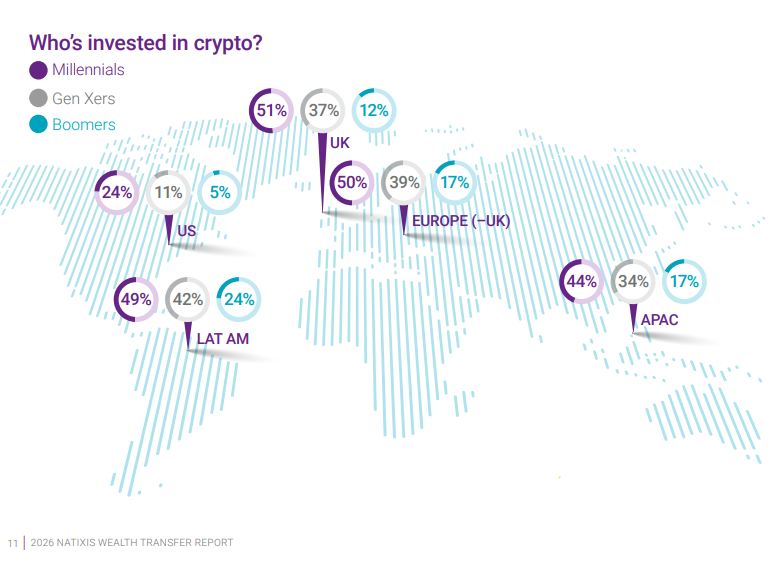
This transformation is causing a break with the traditional banking model. The fact that half of the heirs decide to abandon their parents’ financial advisors, upon receiving their assets, suggests that the new generations in Peru and Colombia are no longer seeking to delegate their future to the usual institutions, but rather to take direct control of their assets, relying on decentralization.
This appetite for bitcoin in the region is no coincidence, as CriptoNoticias has been reporting. In economies where inflation or monetary instability have been constant, the new generation sees technology as a preservation tool that their parents, accustomed to owning real estate or gold, are only beginning to glimpse.
However, the report also sounds a note of caution. 64% of global participants still classify cryptocurrencies as a primarily speculative investment. Despite this, in economic contexts such as those of Peru and Colombia, the risk tolerance of heirs is combined with an active search for diversification outside traditional markets.
For the financial industry, the conclusion of this relay is technical, since The survival of investment firms will depend on their ability to integrate digital innovation into their services. In this new stage, the preservation of capital is no longer the only mandate and the inheritance of the future is being written in code.