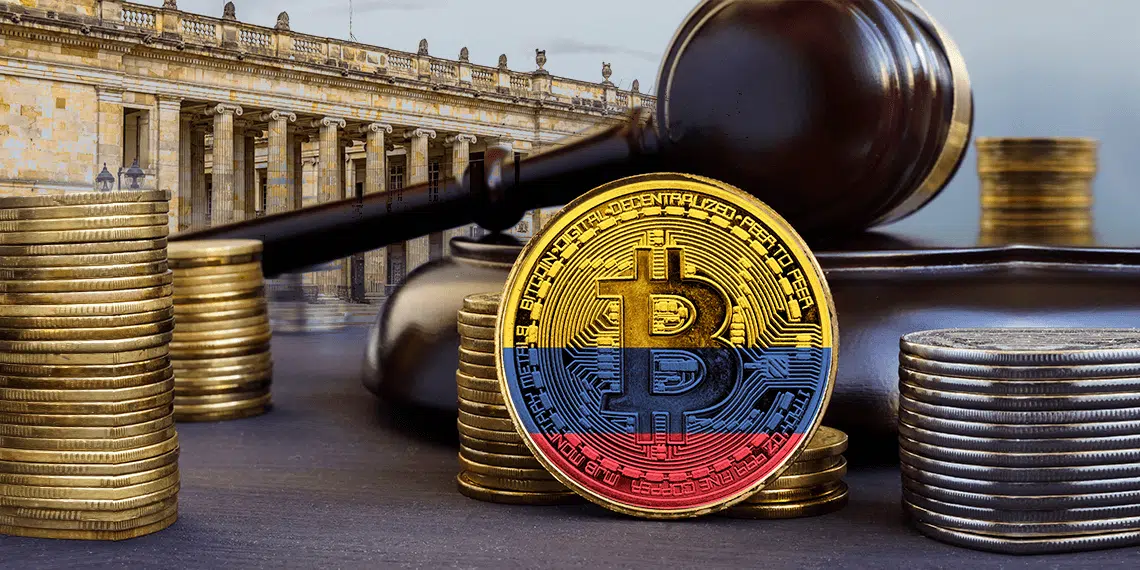
Colombia is among the 20 countries with the highest volume of cryptocurrency transactions in the world.
13.7% of Colombian fintech companies already incorporate stablecoins and this is projected to double.
The underlying problem for the growth of cryptocurrencies in Colombia lies in the absence of a clear and consolidated regulatory framework. This is explained by Julián Colombo, senior director for South America at Bitso.
Although the country registers a significant use of cryptoassets—close to 6 million Colombians already operate with related platforms, according to the Colombian Chamber of Electronic Commerce—, and positions itself among the five most active in Latin America and the 35th globallythis potential has not yet been fully realized.
Five years ago, many users viewed regulation as distant or even undesirable, according to Colombo. Today the perception has changed. “This lack of regulation is what prevented us from reaching out to a more mass public and a corporate public as well, which needs clear rules of the game,” affirms the manager.

The most conservative companies demand certainty, They need to know that there is a regulator who will respond if something goes wrong with the money. Without this support, traditional banks continue to close accounts for companies in the sector, which generates real operational barriers and limits integration with the formal financial system, according to the spokesperson.
Colombia is one of the most dynamic markets in the region. It competes with Brazil and Mexico in trading volume and occupies a prominent place among the 20 countries that transact the most cryptocurrencies worldwide, as reported by CriptoNoticias.
However, the bills have been stalled in Congress, without reaching consensus between the Financial Superintendency, the Bank of the Republic and the Ministry of Finance. In fact, a possible regulation is currently being analyzed in Congress itself.
Failed experiments and lack of progress have kept the ecosystem in a limbo that hinders trust and scalability. This uncertainty has concrete impacts.
For users, the risk of fraud and untrustworthy platforms increases. For companies, complicates payment to international supplierstreasury management in digital dollars and global talent hiring.
On the other hand, for Colombo, stablecoins – such as USDC or USDT – have proven to be the most widespread and practical tool since they combine technology inspired by bitcoin with value stability.
The most obvious case is that of remittances. Historically, sending money from abroad had costs between 5% and 10% (and even 20% at some brokers). With cryptocurrencies, money arrives almost free and in a minute.
It is important to comment that 13.7% of the fintech Colombians integrate stablecoins and this figure is expected to double in the coming years. In addition, the National Tax and Customs Directorate (DIAN) has imposed new reporting requirements for operations with bitcoin, Ethereum and stablecoins, indicating greater fiscal scrutiny, but also an implicit recognition of the sector.
Colombo offers practical recommendations such as finding out about basic risks, differentiate between volatile assets like bitcoin and stablecoins and choose reliable and regulated platforms in other markets.
According to the executive, Colombia has the talent, the demand and the real use cases. What is missing is the legal framework that allows us to move from informal and fragmented adoption to a mature, safe and massive ecosystem. Without regulation, the local Colombian cryptocurrency market will continue to grow, but it would not take off with its full power.
It should be noted that, although clear regulation by governments could provide greater legal certainty and facilitate institutional adoption, Bitcoin operates under its own rules, already defined and enforced immutably in its source code.
Bitcoin needs no additional regulations beyond those already inscribed in its protocol: mathematical, cryptographic and economic rules that anyone can verify and that no one can unilaterally change.