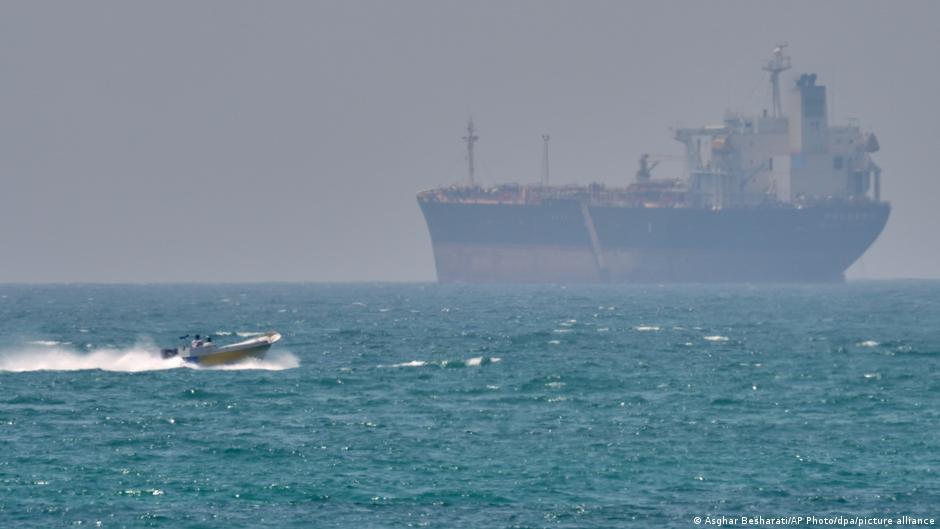
The long-running standoff between the US and Iran has disrupted international oil and gas trade, the impact of which is likely to last even if the two sides manage to reach an agreement on exporting energy through the Strait of Hormuz.
The war has also caused resentment among US allies in Asia – Japan depends on shipment through the blockaded waterway for 93% of the crude oil it consumes, while 70% of the oil and 20% of natural gas used in South Korea follows the same route.
Furthermore, both countries have been forced to acknowledge that a similar crisis closer to home – possibly in the South China Sea or on Taiwan – would likely be even more devastating for them.
Trade worth trillions of dollars flows through the South China Sea
Singapore’s S. “The sea lanes are absolutely vital for both Japan and South Korea, as they depend on maritime trade for exports and vital imports such as energy, raw materials and food,” said Joseph Cristanto, a maritime security analyst at the Rajaratnam School of International Studies.
“If these sea routes were blocked for a long period of time, the impact would go far beyond shipping delays.” he told DW. “Energy prices will rise, factories will struggle to maintain production levels, food and input costs will rise and both economies could face a major strategic shock.”
The South China Sea has been identified as a key flashpoint since China began deploying troops and building airfields and defensive installations on the disputed islands in 2012. An estimated $3.36 trillion (€2.86 trillion) worth of global trade passes through the tense waters surrounding these islands each year.
Asian sea routes create a ‘connected maritime battlefield’
However, Cristanto warns that “the vulnerability extends beyond one location.”
“The sea routes serving Japan and South Korea form a continuous corridor, with the South China Sea and the Taiwan Strait closely connected,” he said. “Even if ships can safely pass through the South China Sea, they will still have to go through Luzon or Taiwan to reach Northeast Asia.”
In a crisis, especially one involving Taiwan, these northern routes could be as important, if not more, than the South China Sea, he said.
“Rather than focusing on any single point, it is more accurate to view the region as an interconnected maritime battlespace stretching from Southeast Asia to the Taiwan Strait.”
There is no doubt that China is attempting to establish greater control over large areas of the Western Pacific. Last week, Beijing issued an official protest after a Japanese destroyer passed through the Taiwan Strait.
Tokyo said the transit was to demonstrate “unwavering commitment to the principle of freedom of navigation under international law.”
A spokesperson for the Chinese Foreign Ministry countered that the Japanese navy’s deployment “seriously undermines the political foundation of China-Japan relations and endangers China’s sovereignty and security.”
US allies nervous as Washington moves troops out of Asia
A recent report by Reuters news agency claimed that China has deployed ships and installed a series of temporary barriers at the entrance to the area of the South China Sea that Beijing disputes with the Philippines. The Chinese action coincides with the US dispatching all three of its active aircraft carrier groups to the Middle East as its troops and military materiel move out of the Indo-Pacific region, the report said.
“There is clearly concern about the weakening of the US military in Asia, and we see China taking steps that show it is seizing the opportunity to expand its reach and strengthen its position in these contested regions,” said William Yang, a Taiwan-based analyst at the International Crisis Group who focuses on Chinese foreign policy and geopolitical developments.
“Japan and South Korea are completely dependent on maritime trade, and any disruption in sea routes or, in the worst case, losing control of those sea routes to a rival would be a nightmare,” he said.
Exploring alternative shipping routes
In March, Korea Gas Corporation (KOGAS), the world’s largest importer of liquefied natural gas, and Japan’s JERA signed a memorandum of understanding aimed at promoting energy security. This included swapping out deliveries in the event of a shortage at any company and analyzing supply and demand to optimize both deliveries and terminal utilization.
Analysts say there are steps Japan and South Korea can take to reduce the risks, including diversifying, storing up, switching to new energy sources, improving efficiency and increasing domestic food production. However, these measures come with obvious limitations.
“These strategies can increase resilience, but they cannot fundamentally replace their reliance on the maritime domain,” Cristanto said. “Both economies will remain highly trade-intensive and reliable on secure sea lines of communication.”
And just as Tokyo and Seoul are considering new sources of energy, now that the fragility of existing routes from the Middle East has been demonstrated, they are also looking to other delivery routes.
“Alternative routes, such as through Lombok and Makassar Straits (via Indonesia) or to the Far East in the Pacific, are theoretically available,” Kristanto said. “However, diversions are costly and only partially reduce the risk. They add distance, time and fuel use.”
“More importantly, the Pacific bypass also does not completely eliminate the strategic weakness of these countries, as ships still have to reach Japan and Korea through waters that could be disputed in the event of a broader conflict,” he said.
China is exerting pressure in the Pacific region
Beijing has in recent years been deploying its aircraft carrier battle groups and long-range bombers and reconnaissance aircraft beyond the “first island chain” – which includes Japan, Taiwan and Borneo – and further into the Pacific.
Cristanto said the moves were part of Beijing’s efforts to control the battlefield in the event of a conflict, also known as an “anti-access/area-denial” strategy.
“Therefore, using different suppliers and routes may reduce the risk in some cases, but the main vulnerability remains. In the end, ships will still have to ‘fight’ to reach Northeast Asia,” he said.
Edited by: Darko Janjevic