Aave lost 8.45 billion in deposits in just 48 hours after the incident.
Whales increase orders in the 85-95 USD area, historical accumulation level.
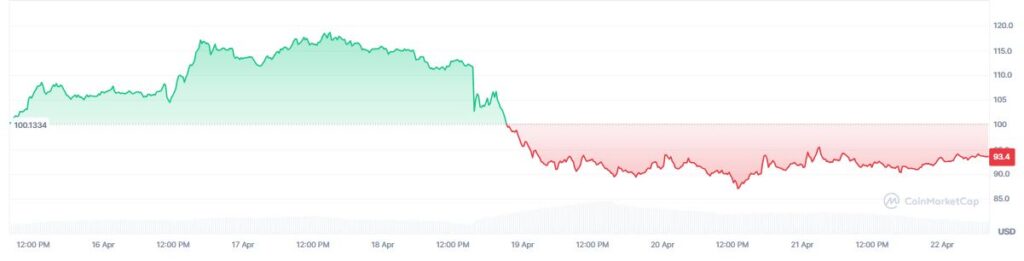
The Aave protocol is going through one of the most critical weeks in its history. After the Kelp DAO hack, which occurred on April 18, 2026, there was a sharp drop in deposits in Aave and in the price of its token.
After the attack, AAVE plummeted below $100 and, at the time of publication of this note, on April 22, it is trading around $93.
As the market reacts with fear, signs of accumulation by large investors begin to appearknown as “whales”. These actors, with high capital capacity, usually influence the market and their movements have coincided in previous cycles with floor zones.
In a analysis carried out by Ignacio Moreno de Vicente, CryptoQuant analyst, the focus is on the indicator “average order size in the spot market” (Spot Average Order Size). This metric measures the average size of executed orders, dividing the total volume traded by the number of transactions. When this value increases in the large order category, it suggests large capital inflow.
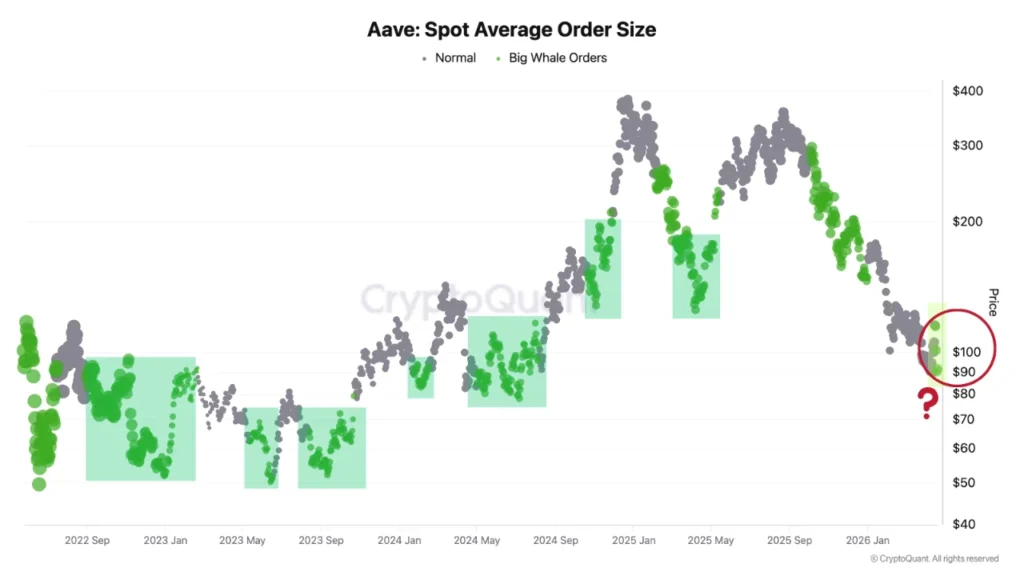
On the chart, both the gray dots and the green bubbles correspond to orders executed in the AAVE spot market. The difference is that CryptoQuant classifies the gray ones as “normal” orders and the green ones as “large” orders or those associated with whales.
According to the analysis, “elevated readings in the large whale order category indicate disproportionate participation by deep-pocketed buyers.” This data is relevant because, historically, These interventions do not usually respond to market noise, but rather to strategic decisions in times of high uncertainty.
Moreno de Vicente also highlights that “since the end of 2022, each large grouping of whale spot orders coincided with a local or general floor in the price of AAVE.” The graph reflects this pattern at different times: during the bear market lows of 2022, in the consolidation phases of 2023, in the corrections of 2024 and again in early 2025.
This does not imply that the price will immediately reverse every time these buy orders appear. However, It does indicate areas where the risk/return ratio begins to become more attractive. In that sense, the analyst warns that “the pattern does not guarantee that a floor has already been formed, but it demands attention.”
The market’s doubt is whether this area will function again as an accumulation level, as occurred in 2022, 2023, 2024 and early 2025, or if the selling pressure derived from the hack still has room to deepen the fall.
The analysis also points out what to watch for going forward, in particular if whale activity remains elevated within the $85 to $95 range. On this point, Moreno de Vicente maintains that “a sustained grouping of orders in that area would replicate the accumulation windows seen on previous occasions.”
The Kelp DAO hack
As CriptoNoticias has reported, on April 18, 2026, an attacker exploited the rsETH (liquid reset ether) bridge of the DeFi protocol, Kelp DAO. The stolen value amounts to $292 million and did not originate from Aave’s own failure, but from its integration with a compromised asset.
The impact was immediate. In just 48 hours, Aave lost $8.45 billion in deposits, in one of the sharpest capital outflows recorded in the decentralized finance (DeFi) ecosystem.
Additionally, the Kelp DAO hack triggered a broader reaction in DeFi, with massive liquidity outflows, collateral stress, and a general deterioration in market sentiment.