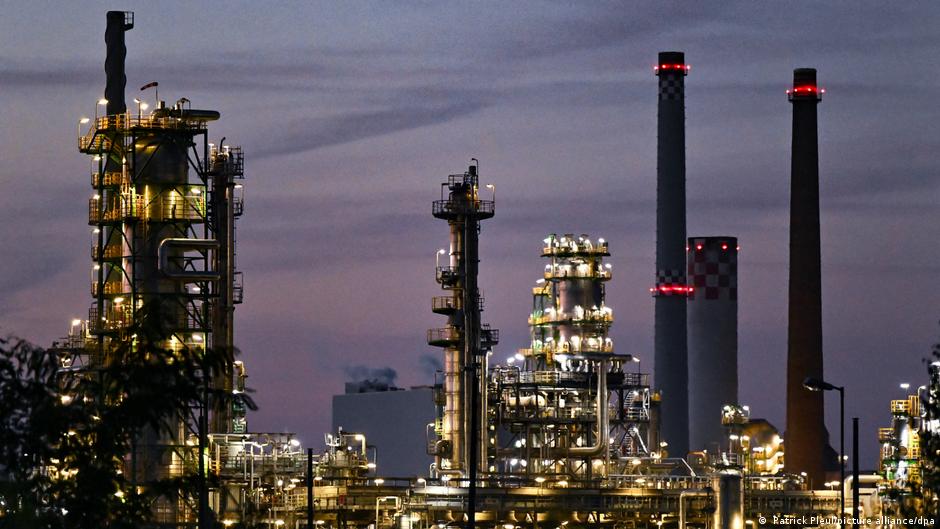
Russia plans to halt oil exports from Kazakhstan to Germany through the Druzhba pipeline from May 1, threatening a key refinery that supplies most of the diesel, petrol and heating oil needed for the city of Berlin.
The PCK refinery, located in the city of Schwedt, about 100 kilometers (62 mi) north of Berlin, receives oil supplies via pipeline. Previously operated by Russian oil major Rosneft, the German government seized operations of the refinery following Moscow’s full-scale invasion of Ukraine in February 2022.
Since 2022, the refinery has imported increasing amounts of Kazakh crude, which is transported from the Central Asian nation, across Russian territory, to Berlin.
The German Federal Ministry for Economic Affairs and Energy confirmed the news to DW in a statement.
“Rosneft Germany has informed the Federal Network Agency, acting as trustee, that, following the instructions of the Russian Energy Ministry, the transit of Kazakh crude oil through the Druzhba pipeline to the PCK refinery on Russian territory is prohibited until May 1, 2026,” the ministry said.
It added, “The Russian Federation has not yet confirmed this to the German government. Rosneft Germany is currently assessing the implications and will adapt to any changes in the situation.”
Reuters first reported the news on Tuesday, April 21, citing multiple industry sources.
an important refinery
The refinery supplies more than 90% of the petrol, diesel and heating fuel to Berlin and the surrounding area.
However, the refinery is not entirely dependent on Kazakhstani oil. From 2022 onwards, most of its oil comes from ports such as Rostock and Poland, rather than via the Druzhba pipeline.
However, a complete halt to deliveries through Druzhba would pose a major challenge as about 17% of the approximately 12 million metric tons of oil per year processed by the refinery comes through that link.
“Ceasing the supply of Kazakh oil to the PCK refinery will ultimately not jeopardize the security of supplies of petroleum products to Germany, even though PCK Schwedt will have to operate at reduced capacity,” a spokesman for the Federal Ministry of Economic Affairs and Energy told DW.
The ministry said Russian state-owned Rosneft’s subsidiary Rosneft Germany, now under the control of the German state, “will fulfill its obligations” and “use existing options to ensure security of supplies in Germany.”
PCK did not respond to DW’s request for comment. While the refinery likely has enough spare capacity to maintain most of its supply, the news comes as Europe and other parts of the world grapple with the worst energy crisis in decades.
The war in Iran and the closure of the Strait of Hormuz have reduced the flow of oil to Europe and Asia and sent prices rising.
Kerosene, essential for jet fuel and a key product of the PCK refinery, is currently in particularly short supply as a result of the crisis. Airlines around the world have been forced to cut flights, with Lufthansa this week cutting 20,000 from its May to October schedule.
‘Threat to Europe’s energy security’
Russia has repeatedly tried to weaponize energy exports since launching a full-scale invasion of Ukraine in 2022. The war ultimately distanced the EU from its dependence on Russian oil and gas.
Since the war began, the EU’s dependence on Russian gas has fallen from 45% of total gas imports to 12% in 2025. For oil, this figure has fallen from 27% to 2%. The REPower EU regulation aims to completely eliminate Russian oil and gas imports by 2027.
Benjamin Hilgenstock, a senior economist at the Kyiv School of Economics, said Russia will continue to threaten Europe’s economic and energy security whenever possible.
“This news once again demonstrates that Russia will retain the ability to threaten European energy security until all imports from and through Russia are stopped,” he told DW.
“Obviously, even reportedly small overall amounts may be quite sensitive for some countries, regions or refineries. Germany and the EU should complete the Russian fossil fuel exit as soon as possible, avoiding any further delays to the REPowerEU agenda.”
a complex future
The Russian government has not yet commented on this news. However, last month, Russian President Vladimir Putin openly called on his government to “explore the possibility” of cutting energy supplies to Europe.
Kremlin spokesman Dmitry Peskov recently criticized the EU for approving and rejecting Russian oil despite the ongoing crisis in the Middle East.
Kazakhstan’s Energy Minister Yerlan Akkenzhenov has suggested that the cessation of supplies through the pipeline may also be due to technical problems resulting from Ukrainian drone attacks on Russia’s energy infrastructure.
Kazakhstan began sending its first shipments of crude oil to Schwedt in January 2023. Until then, the refinery was supplied almost exclusively with Russian oil.
While the latest news is a blow, the refinery’s move away from Russian oil from 2022 onwards suggests it is well-positioned to permanently tap into alternative supplies through Druzhba.
Even before the latest news, the PCK refinery had been a source of deep uncertainty for Germany’s energy future.
Still owned by Russia but operated by Germany, it is currently exempt from US sanctions targeting Rosneft. That waiver was scheduled to expire April 29, but was extended in March without specifying an end date.
Sanctions prevent Western companies and customers from working with Rosneft, but the German government strongly lobbied Washington to allow the refinery to continue operating, given its strategic importance.
Edited by: Srinivas Majumdaru