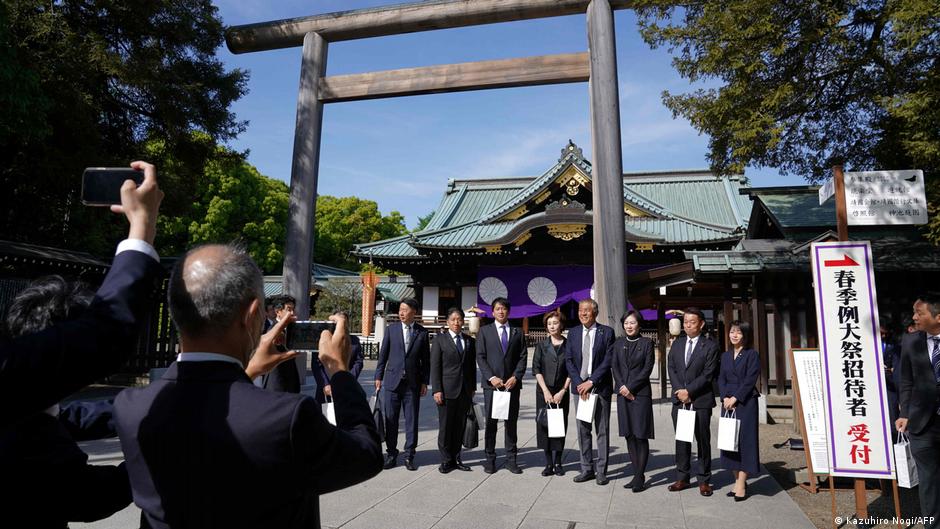
Japanese police said they arrested a South Korean national holding a banner with political messages on Wednesday for disrupting the annual spring festival at Tokyo’s Yasukuni Shrine.
The shrine honors Japan’s 2.5 million war dead, including convicted criminals.
Victims of Japanese aggression and imperialism before and during World War II, particularly in China and Korea, often view a visit to the shrine as demonstrating a lack of remorse regarding Japan’s wartime past.
The 64-year-old man was carrying a banner with messages including one urging “war criminals” to stop praying at the temple and another making territorial claims on the island disputed between Japan and South Korea.
According to the Japanese Kyodo news agency, the man was standing at the main gate in front of the temple in front of the vehicles that were carrying the emperor’s messengers. The temple website said the messengers were delivering the offerings on behalf of the emperor, who did not personally attend the politically sensitive event.
Prime Minister Takachi is candid in his new role, but large delegation of lawmakers attends
Prime Minister Sanae Takachi, a conservative who regularly prayed at the shrine before graduating to the top post, sent a religious ornament and offering rather than visiting in person for the second time.
Yet it prompted criticism from China and South Korea. A Chinese foreign ministry described the temple as a “spiritual instrument and symbol of the aggressive wars launched by Japanese militarism”.
Meanwhile, a South Korean Foreign Ministry spokesman expressed “deep disappointment and regret”.
“Our government urges Japan’s responsible leaders to face history honestly and demonstrate humble reflection on their past and sincere repentance through action,” spokesman Park Il told reporters.
No Japanese prime minister has visited the shrine since 2013, when Shinzo Abe did so, drawing sharp criticism from Beijing and Seoul – as well as a rare rebuke from the US.
But while Japan’s emperor and prime minister stay away from the site, lawmakers regularly pay homage in person. A delegation of more than 120 lawmakers from the ruling Liberal Democratic Party (LDP) visited the Tokyo temple on Wednesday, according to Kyodo.
Although separated from the main group, Cabinet member Minoru Kiuchi, minister of economic and fiscal policy, also attended the three-day Spring Festival, telling reporters that he expressed “sincere gratitude with deep reverence for the souls of the heroes who gave their precious lives for the country.”
Ichiro Aisawa, a veteran LDP member of the House of Representatives, led the group and told reporters: “The many people who died in the war laid the foundation for a peaceful and prosperous Japan.”
“We must vigorously share the memories and records of the war to prevent them from being tarnished,” he said.
This year’s ceremony comes as Japan under Takaichi continues the process of loosening its restrictions on military activity, arms exports and other such issues established after its defeat in World War II.
Edited by: Alex Berry