
The previous industry standard assumed about 1,000 physical qubits for each functional logical qubit.
Analysts estimate that this architecture would break Bitcoin with 25,000 to 30,000 physical qubits.
IonQ, an American quantum computing company, announced this April 21 a new paper in which he proposes a complete architecture to build a fault-tolerant quantum computer.
According to their paper, the new IonQ design achieves 110 logic qubits by executing approximately one million T gates per day (a unit of quantum operation). using only 2,514 physical qubits. The authors state that the machine “can be built in the short term” using “hardware components that have already been demonstrated experimentally.”
The qubits Physicians, when operating them, make mistakes due to their fragile nature. The solution is to group several physical qubits so that they mutually detect and correct these errors. The resulting set is a logical qubit, the truly useful unit for performing reliable calculations.
An industry standard until now assumed that between 100 and 1,000 physical qubits for each functional logical qubit. According to the paper of IonQ, its new architecture reduces that ratio to approximately 23 to 1.
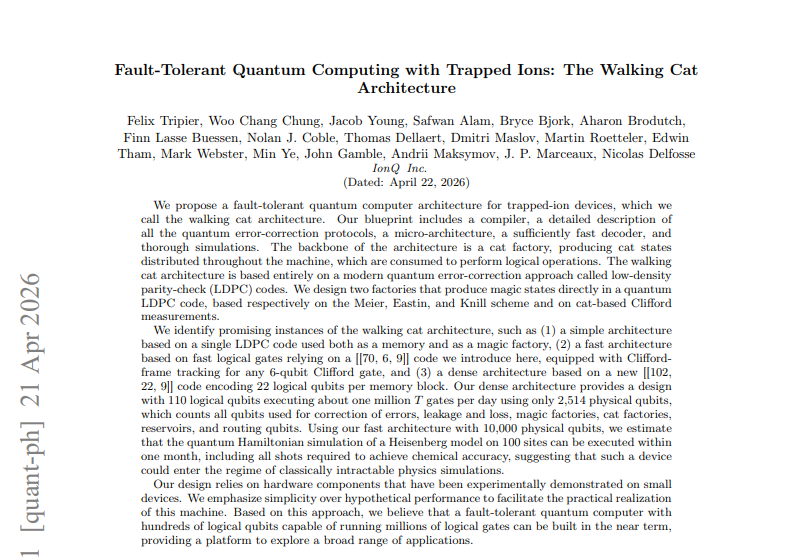
According to the paper from IonQ, the system relies on codes known as ‘qLDPC’an approach of quantum error correctionand in “cat state factories,” which are quantum states that act as probes to detect errors without interrupting the main calculation.
The architecture is modular and scales by adding specialized zones rather than adding connections. IonQ estimates that, with 10,000 physical qubits and this architecture, could run a classically unapproachable physics simulation in a month.
Analysts read the paper like a turning point
The analyst known in X as Desmond explained What makes the design viable in the short term. According to their analysis, any quantum architecture of this type depends on two basic technical capabilities.
The first is the fidelity of two-qubit gatesa measure that indicates how accurately the machine executes operations on pairs of qubits without introducing errors. The design walking cat IonQ requires greater than 99.99% fidelity, notes Desmond.
The second is the reliable ion transportwhich allows the qubits to be physically moved through the chip to specialized areas where operations are executed.
“Both of these capabilities have already been achieved by IonQ’s commercial systems,” Desmond said. In other words, according to the analyst, the paper does not describe a hypothetical machine that requires pending inventions, but rather a design that assembles parts that the company already operates in its current equipment.
What does all this mean for Bitcoin?
Although the IonQ paper does not explicitly mention Bitcoin or any specific encryption system or cryptography as a target, the connection to the cryptography that protects the network created by Satoshi Nakamoto was drawn by external analysts.
In that sense, the account specialized in quantum cybersecurity Qtonic Quantum carried out the calculation that links IonQ’s Walking Cat architecture with the security of Bitcoin and Ethereum.
“Scale the Walking Cat architecture proportionally and you will need between 25,000 and 30,000 physical qubits” to run Shor’s algorithm (the mathematical procedure a quantum computer would use to derive private keys) on the curve ECDSA used in Bitcoin and Ethereum, they claim from Qtonic.
The number of necessary qubits indicated by Qtonic is vastly lower than what Google Quantum AI measured in its recent report. This Google team concluded that, after their experiment, It would take about 500,000 physical qubits to break Bitcoin.
«At the current rate [de fabricación] of T doors, that takes one or two years. If you double the factories, it is halved,” added the account of the time it would take to reach this “dangerous” threshold of qubits needed to break ECDSA. IonQ’s public roadmap contemplates reaching 10,000 physical qubits in 2027 and 200,000 by 2028, as reported by CriptoNoticias.
However, the Qtonic team also admits that code distance (a technical parameter that determines large-scale error suppression capabilities) needs to be improved. before reaching the scale needed for crypto.
Thus, the new paper of IonQ is part of a trend documented by CriptoNoticias of advances that shorten the theoretical deadlines for the arrival of ‘Q-Day’, the moment in which a quantum computer can compromise current cryptography. Although none of these advances demonstrate that ‘Q-Day’ is imminent, it does show that the rate of reduction is accelerating.