April 23, 2026
Israel, Lebanon agree to extend ceasefire by three weeks, Trump says
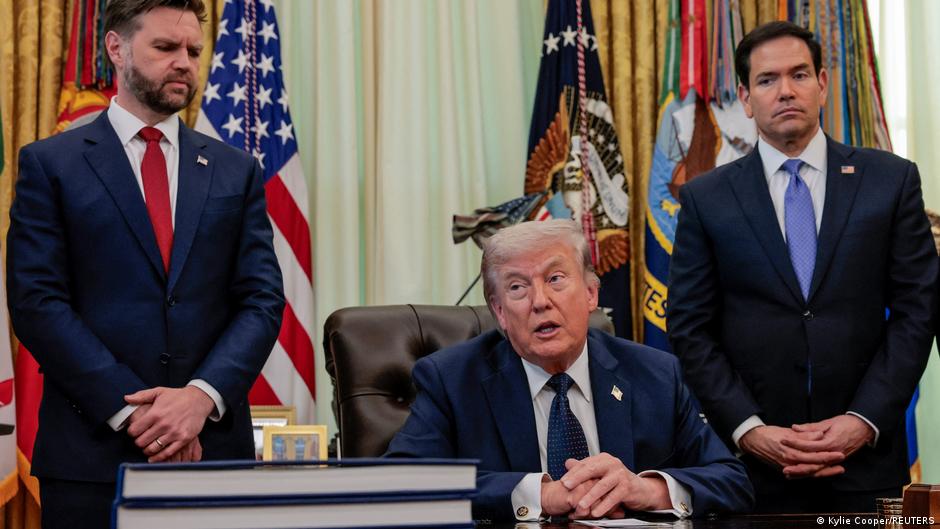
US President Donald Trump announced that Israel and Lebanon have agreed to extend a ceasefire for an additional three weeks, following a rare meeting with envoys from the two countries at the White House.
“The meeting went very well! The United States is going to work with Lebanon in order to help it protect itself from Hezbollah,” Trump said in a statement on his Truth Social platform.
“I look forward in the near future to hosting the Prime Minister of Israel, Bibi Netanyahu, and the President of Lebanon, Joseph Aoun,” he added.
Trump also said he sees a “great chance” for a peace deal between Israel and Lebanon this year.
The initial 10-day ceasefire took effect last Friday and was due to expire on Monday.
While Lebanon is not an active party to the conflict between Israel and the Lebanese-based, Iran-backed militant group Hezbollah, the government in Beirut has been urging de-escalation after fighting between Israel and the militia flared again since the outbreak of the Iran war.
Despite the 10-day ceasefire, the strikes have continued, including on Wednesday when a Lebanese journalist was killed in an Israeli attack.
https://p.dw.com/p/5Cjzz
April 23, 2026
Israeli military says it intercepted rockets launched from Lebanon
The Israeli military said several rockets fire from Lebanon into northern Israel were intercepted. Earlier, it said sirens sounded in the Shtula area near the border.
The Iran-backed militant group Hezbollah said it fired rockets at northern Israel in response to the country’s ceasefire “violations.”
“In defense of Lebanon and its people, and in response to the Israeli enemy’s violation of the ceasefire and its targeting of the town of Yater in southern Lebanon,” Hezbollah “targeted the Shtula settlement with a rocket salvo”, the group said in a statement.
These attacks occurred as the second meeting between the US ambassadors of Lebanon and Israel was set to take place in Washington.
At that meeting, Beirut was expected to request an extension of the 10-day ceasefire that went into effect last Friday.
https://p.dw.com/p/5Cjwc
April 23, 2026
Trump rules out using nuclear weapon against Iran
After previously threatening to destroy Iranian civilization, US President Donald Trump on Thursday ruled out striking Iran with a nuclear weapon.
When asked whether he would use such a weapon, Trump told reporters at the White House: “Why would I use a nuclear weapon? We’ve totally, in a very conventional way, decimated them without it.”
“No, I wouldn’t use it. A nuclear weapon should never be allowed to be used by anybody,” he added.
The White House has said ensuring Tehran cannot develop a nuclear weapon is a “core” goal of the war against Iran.
Trump acknowledged that Iran might have loaded up their weaponry “a little bit” during the two-week ceasefire, but claimed the US military could eliminate those capabilities in “about one day.”
He also repeated his claim that the joint US and Israeli attacks on Iran over the past two months had meant “their navy … their air force is gone.”
“I want to make the best deal. I could make a deal right now… but I don’t want to do that. I want to have it everlasting,” the US president said.
Trump was also asked how long he was willing to wait for a long-term peace deal with Iran and replied, “Don’t rush me.”
He also told reporters that Americans should expect higher gas prices “for a little while.”
Since the start of the war in Iran in late February, energy prices have risen around the world.
https://p.dw.com/p/5CjvK
France, UK see ‘real progress’ in Hormuz military plans
Defense Ministers from Britain and France have said they hope that their military plans to secure the Strait of Hormuz will restore trade flows through the vital waterway.
According to top defense officials, the practicalities of a multinational mission led by the UK and France to protect navigation in a key waterway following a sustainable ceasefire were discussed at a two-day meeting in London.
The meeting’s goal is to form a “defensive, multinational mission that will strengthen the confidence of commercial shipping, and, if necessary, clear mines and protect vessels when the hostilities end”, British Defense Minister John Healey said.
In a joint statement, Healey and his French counterpart, Catherine Vautrin, said they were “confident that real progress can be made.”
On Wednesday, Iran said it would not reopen the Strait of Hormuz as long as the United States maintained its blockade of Iranian ports.
https://p.dw.com/p/5Cjv2
April 23, 2026
A third US aircraft carrier arrives in Middle East
The US military announced that the aircraft carrier USS George H.W. Bush has arrived in the Middle East.
“Nimitz-class aircraft carrier USS George H.W. Bush (CVN 77) sails in the Indian Ocean in the US Central Command area of responsibility,” the military command responsible for the Middle East wrote on X.
This brings the total number of American aircraft carriers operating in the region to three.
According to social media posts by the US Central Command (CENTCOM), the USS Gerald R. Ford aircraft carrier was operating in the Red Sea on Thursday, and a third carrier, the USS Abraham Lincoln, is also in the region.
Each aircraft carrier travels with a group of supporting warships.
https://p.dw.com/p/5Cjtq
WATCH: Iran seizes two container ships
Tehran announced that it had seized two container ships attempting to leave the Gulf through the Strait of Hormuz.
Both Iran and the US are now using this vital shipping lane as leverage by blocking it.
https://p.dw.com/p/5Cjrw
IN DEPTH: Ceasefire extended: What’s next in the Iran war?
With no fixed ceasefire deadline for now, the US and Iran are looking for ways to safeguard their own interests.
The two sides may re-enter negotiations, close the gap between their positions, and eventually reach a peaceful agreement. Or the tone will continue to deteriorate, and the fighting may resume.
DW takes a look at the main sticking points and explains some key issues.
https://p.dw.com/p/5CjrO
April 23, 2026
Pope condemns killing of protesters in Iran, urges peace talks
During a press conference on his return flight from Africa, Pope Leo XIV firmly condemned the killing of protesters in Iran and urged the United States and Iran to resume peace talks.
“I condemn all actions that are unjust. I condemn the taking of people’s lives,” the pope said in response to a question about reports that Iran has killed thousands of protesters.
“When a regime, when a country takes decisions which takes away the lives of other people unjustly, then obviously that is something that should be condemned,” he added.
Leo also urged the United States and Iran to resume negotiations. He called for a new “culture of peace” to replace the recourse to violence whenever conflicts arise.
US President Donald Trump attacked Leo as “terrible” on social media on April 12 after the pope emerged as an outspoken critic of the war with Iran and the president’s hardline anti-immigration policies.
Two days later, Trump posted: “will someone please tell Pope Leo” about the deaths of Iranian protesters.
https://p.dw.com/p/5CjqI
April 23, 2026
Air defense engages ‘hostile targets’ over Tehran, Iranian media report
Iran’s Mehr news agency reported that air defense systems were heard engaging what were described as “hostile targets” in parts of the Iranian capital, Tehran.
Earlier, Iranian media reported that air defense batteries had been activated in the city.
The reports could not be independently verified but the AFP news agency later cited a security source saying that Israel was not currently attacking Iran.
https://p.dw.com/p/5CjlR
April 23, 2026
Israel says waiting for ‘green light’ from US to ‘return Iran to Stone Age’
Israeli Defense Minister Israel Katz said that his country is ready to renew its fight against Iran but is waiting for a signal from the United States.
“The IDF is ready both defensively and offensively, and the targets have been marked,” Katz said in a video statement.
“We are awaiting a green light from the United States first and foremost to complete the elimination of the Khamenei dynasty,” Katz added.
Katz also referenced Trump’s own rhetoric, saying Israel was ready “to return Iran to the Dark Age and the Stone Age by destroying key energy and electricity facilities and dismantling its national economic infrastructure.”
Katz said that this time, when the attack resumes, it will be “different and lethal.” He added that devastating blows will be delivered to “the most sensitive points.”
On Tuesday, US President Donald Trump announced an indefinite extension of the April 8 ceasefire between the United States and Iran, aiming to create space for negotiations with Tehran. However, plans for renewed negotiations in Pakistan remain uncertain.
https://p.dw.com/p/5Cjfq
April 23, 2026
Israeli strike kills 3 in southern Lebanon, medics say
The Lebanese Health Ministry said an Israeli strike on southern Lebanon killed three people, despite a 10-day truce in the Israel-Hezbollah war.
The ministry stated that “an Israeli airstrike on the Shoukine road in the Nabatieh district”, more than 30 kilometers (20 miles) north of Israel, killed three people. It added that a strike on the village of Yater wounded two people, including a child.
These attacks occurred just hours before the second meeting between the US ambassadors of Lebanon and Israel in Washington. At this meeting, Beirut is expected to request an extension of the ceasefire.
Meanwhile, the Israeli military announced that it had killed two armed individuals in the Aynata area of southern Lebanon after identifying them as approaching soldiers and posing an “immediate threat.”
It was unclear whether the incident was related to the strikes reported earlier in the area by Lebanon’s Health Ministry.
https://p.dw.com/p/5Cjch
April 23, 2026
Mojtaba Khamenei seriously wounded but ‘mentally sharp’ — report
According to a New York Times report, Iran’s new supreme leader, Mojtaba Khamenei, was seriously wounded in the US-Israeli airstrike that killed his father and predecessor, Ali Khamenei, but remains mentally sharp.
The report cited several unnamed Iranian officials and said that Mojtaba Khamenei had “at least for now” delegated decision-making to generals in the Revolutionary Guard. He has not appeared in public since succeeding his father, issuing only written statements. This had led some commentators to suggest that he was dead.
According to the report, although Mojtaba Khamenei was “gravely wounded” in the February 28 airstrike, he is “mentally sharp and engaged.”
“One leg was operated on three times, and he is awaiting a prosthetic. He had surgery on one hand and is slowly regaining function. His face and lips have been burned severely, making it difficult for him to speak,” the New York Times cited the officials as saying.
For security reasons, Mojtaba Khamenei remains in hiding. He only passes on handwritten messages, according to the report. Although Revolutionary Guard commanders do not visit him, President Masoud Pezeshkian — a heart surgeon — has reportedly been involved in his care.
https://p.dw.com/p/5CjXo
April 23, 2026
UN says Lebanon wants peacekeepers to stay next year
Lebanon has expressed a desire for UN peacekeepers to maintain a presence in the country once their current mandate expires next year, according to UN officials.
Jean-Pierre Lacroix, the Under-Secretary-General for Peacekeeping Operations, said the UN Security Council has requested a review of all options, the results of which are to be presented by June 1.
Since 1978, the United Nations Interim Force in Lebanon (UNIFIL) has monitored the border area between Israel and Lebanon. Its peacekeepers, known as “blue helmets” for their distinctive headgear, have played a key role in maintaining peace in the region.
Amid decades of fighting between Hezbollah and Israel, the troops have repeatedly found themselves in the crosshairs. On Saturday, two French soldiers were killed and two more were injured when they came under fire while clearing explosive devices from a road in southern Lebanon.
According to the UN, the current mission includes approximately 8,500 troops from nearly 50 countries and expires at the end of the year.
“In terms of the post-UNIFIL, we’re currently in the process of working on these options,” said Lacroix, adding that the Lebanese government has made it “very clear they want to keep UN presence, not necessarily identical to UNIFIL.”
Lacroix did not elaborate on the different options, but he said that any potential presence would probably be smaller than that of UNIFIL.
https://p.dw.com/p/5CjUS
IN DEPTH: Iran’s aily life shadowed by war, scarcity and fear
The US naval blockade aims to put pressure on the Iranian regime, but it is ordinary Iranians who mostly feel the effects. They find their lives shaped by growing exhaustion and fear of job loss.
Many families are now living off their savings and do not know how long they can endure the situation. Sources from Iran report that numerous young people have returned to their parents’ homes. Others are moving out of large cities such as Tehran.
Read more about how the war has worsened living conditions in Iran.
https://p.dw.com/p/5CjJi
April 23, 2026
Five killed by Israeli fire in Gaza, West Bank — medics
Israeli attacks in the Palestinian territories have continued as it fought on fronts in Iran and Lebanon and despite a supposed ceasefire with Hamas in Gaza.
It was no different on Thursday, with at least four Palestinians were killed in Israeli airstrikes in Gaza, according to Palestinian health officials.
Local medics said one person was killed and several others were wounded in a strike in southern Gaza’s Khan Younis.
The Israeli military said it had targeted militants transporting munitions who posed a threat to Israeli soldiers.
A separate strike in Maghazi, a Palestinian refugee camp in the Deir al Balah area in central Gaza, resulted in the deaths of three others, including a rescue worker, according to health officials.
The Israeli military did not immediately comment on that strike.
Since a US-brokered ceasefire came into effect in October, Israel has carried out repeated strikes on Gaza. Both Israel and Hamas have accused each other of ceasefire violations.
Meanwhile, in the occupied West Bank, Israeli troops killed a 15-year-old boy during a raid in Nablus, according to the Palestinian Authority’s Health Ministry.
https://p.dw.com/p/5CjD1