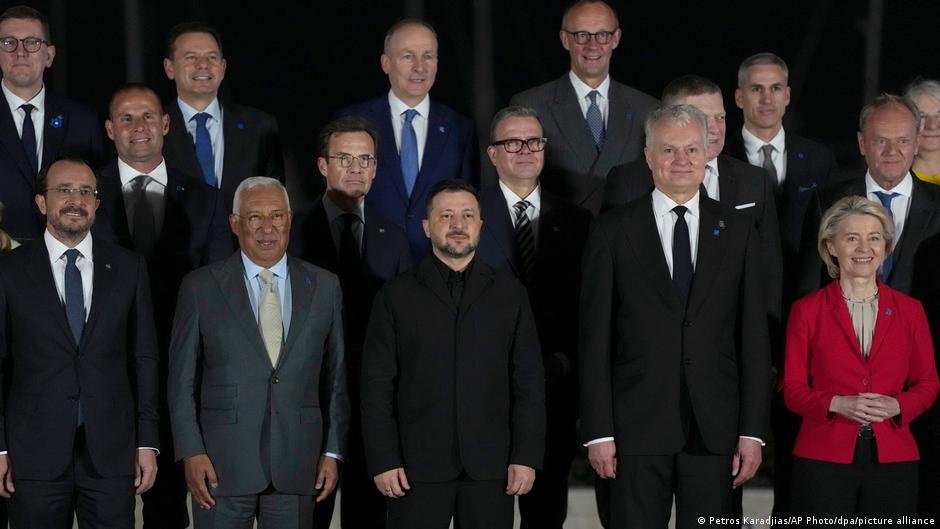
Leaders of the EU’s 27 member states gathered in Cyprus on Thursday to discuss geopolitical challenges facing the bloc, including wars in Iran and Ukraine.
Here’s what EU leaders were discussing:
ukraine
Ukrainian President Volodymyr Zelensky attended the summit in the seaside resort of Ayia Napa on Thursday for talks over Russia’s war with Ukraine.
The two-day meetings began with leaders greenlighting a long-debated €90 billion ($105 billion) loan to Ukraine and agreeing to more sanctions on Russia. German Chancellor Friedrich Merz said upon arrival that he was “very grateful” that the loans were now “definitely approved”.
“For us, this is a very important decision and I am very grateful to all the leaders for their unanimity,” Zelensky told reporters. He said that this amount will serve many purposes.
The Ukrainian leader said the funds would help strengthen the country’s military and domestic production of drones, as well as electronic warfare systems.
Zelensky said Ukrainian defense has destroyed 90% of Russian missiles and drones, “but not everything, and that’s why our energy system was under massive attack, and it was very difficult for us.”
He said that Ukraine is “making great progress in reconstruction – in the field of energy, first of all, in preparation for the next winter – and we need money for this.”
The funds were withheld due to opposition from outgoing Hungarian Prime Minister Viktor Orban, who was not expected to visit Cyprus with his Slovak counterpart Robert Fico. Initial approval for the funds was given by diplomats on Wednesday, as oil supplies to Hungary and Slovakia resumed via Ukraine.
Other European leaders praised the decision. Latvian Prime Minister Ivica Selina said the Baltic members were “working a lot on this issue” and described the outcome as a “meaningful result”.
Irish Prime Minister (known in Ireland as TaoiseachMichael Martin said Ireland welcomed the unblocking of funds “very warmly”.
“This will create great resilience in Ukraine now, and I think it sends a very strong signal that Europe is behind Ukraine for the long term,” Martin said. He expressed hope that this gesture of solidarity would also prove to be a catalyst for stalled peace talks with Russia.
middle east
European leaders will be joined in Nicosia on Friday by Lebanese President Joseph Aoun, Egyptian President Abdel Fattah al-Sisi, Syrian President Ahmed al-Shara and Jordan’s Crown Prince Hussein bin Abdullah.
During a working lunch, they are set to discuss the situation in Lebanon, where a ceasefire is in place to ease hostilities between Israel and the Iran-backed terrorist group Hezbollah.
US President Donald Trump said on Thursday that the ceasefire, which was originally agreed upon for 10 days, has been extended for three weeks.
A separate ceasefire is also currently in force in the US-Israel war with Iran.
Iran’s effectively closing the Strait of Hormuz has sent energy prices soaring and raised fears of a possible jet fuel shortage in Europe. About 20% of jet fuel consumed in the EU depends on imports via major waterways.
Latvia’s Prime Minister Silina said she thought it was “very important that we discussed what to do with Hormuz,” as she said she believed the European Commission’s instruments could prove inadequate to handle rising fuel and energy costs.
“I think we need to discuss what else we can do,” Silena said. “Is there something else we can do as Europe to prevent this high rise in prices that could affect our inflation rate?”
Ireland’s Martin, whose country will take over the EU presidency from Cyprus later this year, said the leaders would discuss the war in the Middle East, in terms of both “the impact that war has on the people of the region in terms of devastation and death” and “its impact on the global economy.”
“The IMF’s forecast is slowing economic growth around the world and so it is vitally important that we also end the conflict,” he said.
increasing the budget of the EU
Also on Friday, leaders are expected to discuss for the first time the bloc’s upcoming long-term budget for 2028-2034.
The EU executive wants a bigger budget of about €2 trillion ($2.3 trillion). A major challenge will be to figure out how to finance goals such as boosting the EU’s competitiveness and defense capabilities at a time when many member states are short of funds.
A final agreement is expected by the end of 2026.
Edited by: Sean Sinico, Alex Berry, Carl Sexton