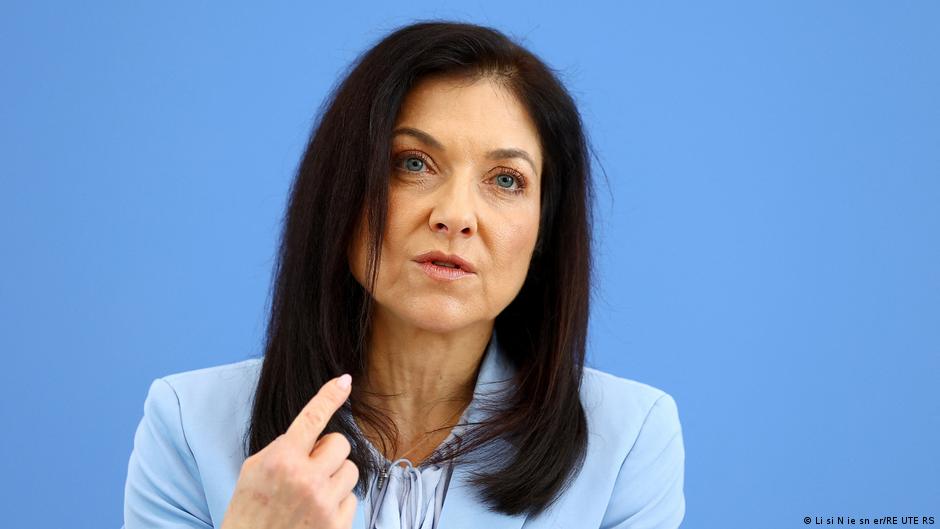
German Federal Economy Minister Katharina Reich, of the conservative Christian Democratic Union (CDU), had only bad news to deliver in Berlin. He expects Germany’s economic growth this year to be limited to only half a percentage point because of the war in the Persian Gulf.
“Growth has pushed us back economically,” the minister said. “The situation remains extremely volatile.”
The annual economic report, presented by the Reich in January before the start of the US–Israeli war against Iran, is now obsolete. At the time, he expected a slow but steady economic recovery.
Several scenarios have been outlined in the Economy Ministry: one in which the Gulf escalation continues – keeping the Strait of Hormuz closed – and another in which the war ends quickly and the free movement of goods through the strait becomes possible again. However, the minister told reporters in Berlin that it was impossible to predict which outcome was more likely.
Reich is certain of one thing: inflation will rise even faster this year – up to 2.8%. Behind the higher prices are the increased costs of gasoline, oil, gas and electricity. According to their estimates, food prices are expected to rise even higher.
Shock, crisis and instability caused by Iran war
The tentative green shoots of economic recovery that had begun following a three-year pause from 2023 to 2025 are now being overshadowed by rapidly increasing headwinds, Reich said: “The war in the Middle East has created an energy-price shock beyond our control, and that is having a huge impact on both households and the economy.”
Structural reforms to increase the competitiveness of German companies are now more urgent than ever, Reich said.
“The crisis cannot be allowed to obscure the tasks before us,” he said. “Our potential growth is very low, and we have to raise it. Our competitiveness is under great pressure.”
Potential growth – the level of long-term growth of the economy that can be achieved under normal capacity utilization – is only 0.5% of Germany’s GDP. Analysis from the Economy Ministry shows this does little to safeguard prosperity in Germany in the coming years.
A growing number of industrial jobs are being cut in Germany and, in some cases, have moved abroad where conditions are more favorable, Reich said. A former head of an energy company herself, she warned that Germany was losing out to competitors in Europe and around the world.
“Our development weakness is above all structural – other countries have done their homework,” he said.
According to the European Commission in Brussels, Germany, still ranks lowest in Europe’s development table.
The rich won’t compensate for higher energy prices
In contrast to Finance Minister Lars Klingbiel of the Social Democratic Party (SPD), Reich views further market interventions and state support measures such as fuel-price caps or tax cuts on energy prices with deep skepticism.
“Tax relief measures don’t fall from the sky,” he said. The money to fund them “must first be earned.”
He argued that some of the measures proposed by the SPD, such as a special tax on extraordinary profits in the oil industry, had significant side effects. Reich rejected the tax, saying it might encourage refinery operations to move out of Germany.
Prices have been rising around the world as missing deliveries from the Gulf country have widened the shortage in the market. On Wednesday, the European Commission presented its assessment of a potential EU-wide excess-profits tax – and the bloc shares the German economy minister’s skepticism. The EU had enabled such a tax once before, during a price rise at the start of Russia’s war against Ukraine. Legal challenges to that levy, which brought €2.5 billion ($2.9 billion) into Germany’s public purse, are still pending before the European Court of Justice in Luxembourg.
Germany’s public debt is increasing
The major economic research institutes released their spring forecasts just before Easter, and they agree with Reich that Germany’s economic growth will be only half of what was envisioned before the start of the war in Iran.
Timo Vollmersheim, a business-cycle researcher at the Ifo Institute in Munich, pointed out that this year’s minimal growth is being driven largely by debt-financed government investment – and it comes at a price.
The researchers point to “long-term risks to the sustainability of public finances and the substantial consolidation needs expected by the end of the decade”. In practice, this means that interest payments to the federal budget will grow rapidly. The money spent on debt repayment will no longer be available for social services or pensions.
Most German companies report negative impacts from the Middle East war, according to one Survey by the German Chamber of Industry and Commerce. He says that existing problems are being increased.
International companies are also stopping investment in Germany: energy is too expensive; Bureaucracy too extensive; According to a survey conducted by KPMG on 400 international companies, digitalization is still sluggish.
This article was originally written in German.