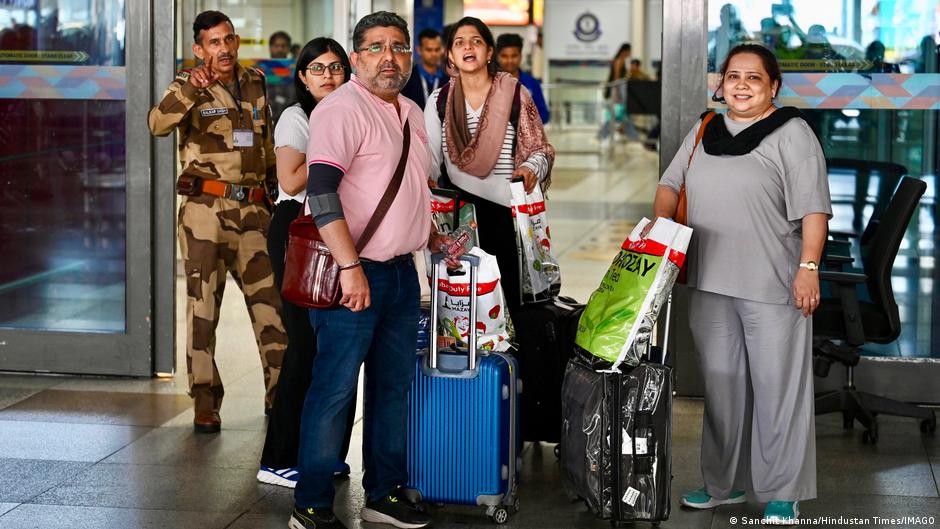
46-year-old Mira Kurien had worked in Dubai for so long that she has lost count of the years. Earlier this month, his hotel let him go. Following the outbreak of the Iran War the occupation declined rapidly.
He is not angry about it and this, more than anything, reflects the overall mood of returning Indian workers.
“Everyone is in the same situation,” Kurien told DW from the southern Indian port city of Kochi.
“You can’t be angry at war.”
Across the Gulf, the Iran war has closed airspace, disrupted shipping and stalled projects, disrupting the trust that keeps the region moving.
The city left by Kurien is holding its breath. Trade that once flowed smoothly through the Strait of Hormuz has now slowed and changed again. Travel has ground to a halt, hotels are emptying, airlines are cutting flights. Even the supermarket shelves are getting thinner.
“When people stop coming, it spills over… retail, logistics, everything. Dubai runs on visitors. Take that away and the whole machine will slow down,” Kurien said.
Nearly one million Indians were evacuated from the Gulf
Kurien is one of the nine million Indian citizens who took up jobs in the Gulf country earlier this year. Indians are the largest migrant community in the region. They operate in sectors ranging from construction and hospitality to logistics, retail and services and send more than $50 billion (€46 billion) of remittances to their home country each year.
According to India’s Ministry of External Affairs, approximately 984,000 Indian citizens returned home between late February and the start of the Iran war in mid-April, although this number includes migrant workers as well as students and other vulnerable groups.
“Our efforts are focused on keeping people safe, with dedicated control rooms issuing updated advisories containing information related to local government guidelines, flight status and travel conditions,” senior ministry official Asim Mahajan told reporters.
Still, most Indian workers have decided to stay behind for now, unwilling to give up the jobs and lives they have built over years. For them, calculation is painful and practical. Returning means abandoning everything they came for. To survive means to live inside an economy that is silently shrinking around them.
It is an indefinite wait with no end in sight. If the war continues, they will face layoffs or be sent on unpaid leave. Those who decide to return to India will have to negotiate expensive plane tickets and relocation costs amid further risks to their jobs.
Some parts of India are feeling its impact
Kurien told DW that shipping goods from Dubai to Kochi cost him 30% more than before. And even though she’s back in her country now, it doesn’t exactly feel like she’s returning home.
“Nobody is saying it out loud. But everyone is waiting,” he told DW.
Economic disruption has also followed Kurien to the Indian state of Kerala. The state is India’s largest remittance recipient, with approximately 2.2 million Keralites working abroad. According to the Kerala Migration Survey, about 90% are in the Gulf.
“The decline in remittances is also beginning to impact domestic consumption and is impacting companies in places like Kerala, which report seeing their sales decline, especially in areas dominated by families of Gulf expatriates,” Venu Rajamony, a former Kerala diplomat, told DW.
He said, “All these trends will escalate the war further. The trust that others had in the Gulf countries as a safe haven has been seriously eroded.”
‘I can’t start everything over’
Ramesh Kumar Reddy, 38, has no work.
He had spent eleven years as an equipment technician at a petrochemical plant outside Muscat in Oman, before being asked to go on unpaid leave with only two weeks’ notice at the end of March.
In Visakhapatnam, in the eastern state of Andhra Pradesh, their Gulf certifications in pressurized systems, hazardous materials and safety compliance mean nothing. The nearest refinery is not hiring. He has applied to a private security company.
“In Oman, I was an expert until the war disrupted everything,” Reddy told DW. “Here, no one knows what to do with me. I can’t start all over again.”
This is an early indication of what a prolonged conflict could bring. The people returning to India are not just blue-collar workers, but also technicians, supervisors and small business owners. For many of them, the exit from the Gulf has been sudden and unforgiving.
Iran raises threat of ‘labor shock’ in India
If the conflict continues to drag on, it will begin to impact consumption, housing and household credit in India, with impacts far beyond the families directly affected.
“A prolonged Iran-related conflict in West Asia will continue to put pressure on Gulf economies and, in turn, put pressure on India’s diaspora. While there has been no sudden exodus yet, a prolonged war could lead to job losses and force many Indians, especially families, to return,” Anil Wadhwa, former ambassador to Oman, told DW.
Wadhwa said, “Even in the long term, the Gulf’s role as India’s employment ‘safety valve’ may weaken as opportunities for reconstruction in the region post-conflict and war fade away.”
Lekha Chakraborty, an economist at the National Institute of Public Finance and Policy, warns of “labor shock.”
“Within a few months, the war-induced labor shock could spill over into broader regional tensions, with rising debt, underemployment and pressure on state finances,” he told DW. “At that time, the fallout of the Iran conflict is no longer limited to the Gulf. It is beginning to impact the Indian economy as well.”
For most of India, the economic shock of the Iran war is still on the horizon. For Kurien, it is already at the doorstep.
“We had our lives there. Now we’re waiting to see what’s left of it,” he said.
Edited by: Darko Janjevic