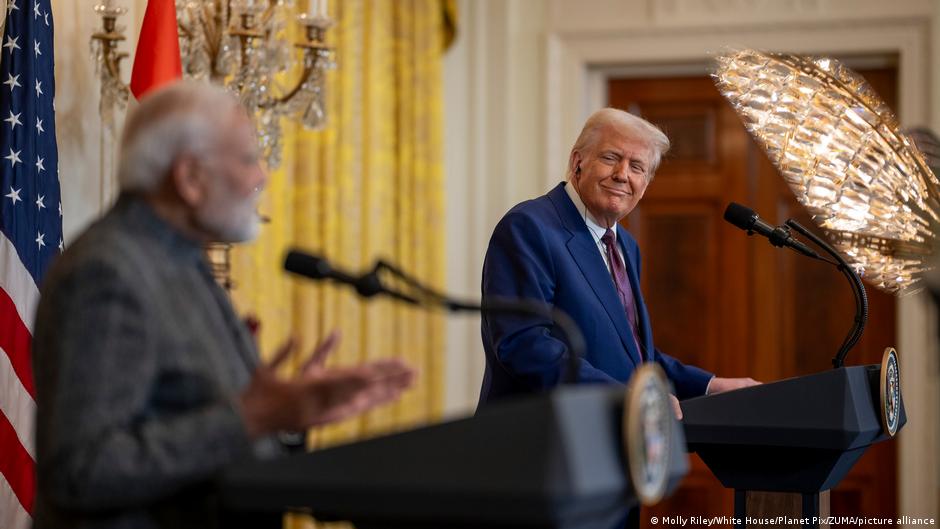
New Delhi termed as “inappropriate” comments shared by US President Donald Trump on social media last week calling India a “hell”.
Trump shared excerpts from The Savage Nation talk radio show, in which conservative commentator Michael Savage said: “A kid here becomes an instant citizen, and then they bring the whole family over from China or India or some other hellhole on the planet.”
India’s Ministry of External Affairs described the comments as “patently uninformed, inappropriate and in poor taste” in a statement cited by Reuters.
“They certainly do not reflect the reality of India-US relations, which have long been based on mutual respect and shared interests.”
The comments come amid macroeconomic pressures that are increasingly weighing on public sentiment in India towards Washington.
Why India-US relations still matter?
India-US relations are at the center of both countries’ global strategies, based on shared economic, security and technology interests.
The United States is India’s largest trading partner and a major destination for its diaspora.
New Delhi is also important to Washington’s Indo-Pacific strategy, particularly as a counterweight to China’s growing influence.
Although changes in formal relations are unlikely, India’s once ambivalent approach towards the US is increasingly being replaced by a more transactional approach.
India enters 2025 with expectations of what Trump’s second term will bring for bilateral relations.
Five months later, the US President and Indian Prime Minister Narendra Modi became embroiled in a diplomatic tussle after Trump announced a ceasefire between India and Pakistan following the Pahalgam attack in Indian-administered Kashmir, in which he described himself as its broker. Pakistan supported Trump’s account.
However, India strongly refuted Trump’s claim and reiterated that ceasefire talks are conducted bilaterally and third party involvement on Kashmir is unacceptable.
How did US tariffs on India affect bilateral trust?
In July 2025, the US said it would impose 50% tariffs on India – one of the highest in the world – partly because India was buying Russian oil.
in August 2025 report Published by the Delhi Policy Group think tank, former diplomat Hemant Krishna Singh said US-India relations were at an “inflection point”.
“Leaving India alone to purchase Russian oil while giving a free hand to other (and larger) buyers cannot be considered anything but a hostile act,” Singh wrote.
He said, “Mutual trust has been shocked, confidence has been shaken, uncertainty has come, public support in India has ended.”
during a speech Last month, at the Raisina Dialogue security conference in New Delhi, US Deputy Secretary of State Christopher Landau had said that “India must understand that we are not going to make the same mistakes with India that we made with China.”
Former Indian ambassador to the US and retired diplomat Navtej Sarna said, “This was a culmination of what happened last year. And the fact that these comments were made in a strategic setting shows how this US administration views India.”
Sarna told DW that this angered many Delhi officials. “The warmth towards Pakistan has also fostered a sense of distrust in India,” Sarna said.
How did American actions affect common Indians?
Experts cited a series of other incidents, including tightening restrictions on the H‑1B visa program largely used by Indian and Chinese immigrants, Trump-linked influencers promoting statements deemed racist about India, and Trump himself offering temporary “permission” to India to buy Russian oil amid shortages related to the effective blockade of the Strait of Hormuz.
Independent journalist and disinformation expert Karen Rebello reported that the Iran war “has turned everything upside down.”
“The rupee hit a record low, stock markets fell, supply chains were disrupted. There was a direct impact on people’s lives and no one was left untouched, especially in import-dependent India,” he told DW.
India’s right-wing voters, a major portion of whom are small, medium and large business owners, have been supportive of Trump largely because of ideological similarity.
“Both are religious, both are conservative and pro-business, both see Muslim minorities as the enemy,” Rebelo said.
But traditional support has turned to quiet disappointment as his business has taken a hit.
“There is even a sense of jealousy. They want India to set its own terms, have the power to take decisions,” he said.
Indian media’s stance changed on America
Modi’s government has been largely restrained in reacting to the second Trump administration, in return for praise from the US President, from time to time calling New Delhi a “very good friend”.
“India has decided to continue to work on the relationships we have built so that everything is not lost,” Sarna said, adding that India has tried to respond with maturity even when a tougher stance might have been appropriate.
But while the government has decided to step back, influential people associated with the government have strongly criticized the US President.
YouTubers with millions of followers – like Nitesh Rajput, Shams Sharma, Abhi from Abhi and Niu, and Abhijeet Chavda – have previously largely supported the government’s stand.
Within the past three months, all of the above have published content that strays far from the “good friends” narrative. Some videos even raise questions on Trump’s sanity.
“Anti-US sentiment is definitely at its highest recently,” said Sandeep Naravani, co-founder of India-based AI research firm Narrative Research Lab.
“The real work of narrative creation is being done by influential YouTubers, including both supporters of the government and its critics,” he said.
Naravani said that even mainstream Indian TV channels have abandoned their pro-Trump stance.
“In the past TV channels have been more pro-American, but now one can clearly feel the balance in the coverage.”
“TV channels are showing casualties and destruction on both sides (in the Iran war) equally. The correction from asymmetric sympathy in the past is a new phenomenon,” he told DW.
Narwani said, narratives set by top influencers are quickly adopted by smaller creators.
“Once reaching regional influencers, the same in-depth geopolitical analysis content becomes overly simplistic and emotionally charged,” Naravani said.
What does this mean for US-India relations?
For now, public sentiment in India is unlikely to derail India-US relations, which are rooted in deep strategic and economic interests. But the changes happening beneath the surface are hard to ignore.
The relationship that was once driven by aspirations and goodwill is increasingly being reshaped by costs, consequences and perceived imbalances.
For many Indians, America is no longer just a partner or a model to emulate, but a power whose decisions can disrupt life even beyond its borders.
That recalibration, driven by geopolitics as well as ongoing economic tensions, may prove more lasting than any one diplomatic rift.
Edited by: Keith Walker