According to the Tropykus team, its 2021 architecture is inefficient in the face of modern risks.
After the closure of the website, the withdrawal of funds will require interaction with smart contracts.
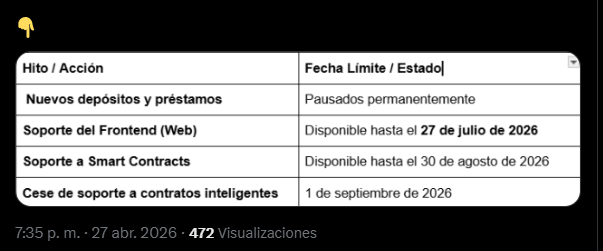
Decentralized finance (DeFi) protocol Tropykus announced the scheduled termination of its Rootstock (RSK) network lending platform. The measure, announced on April 27, 2026, implies the immediate suspension of new deposits and credits, establishing a period of three months for users to withdraw their capital.
According to the organization, the code structure designed five years ago lagged behind the security levels that today demands the technological environment.
The decision to interrupt the service was precipitated after a security report from Money on Chain, a strategic ally of the project. The report identified potential vulnerabilities in the smart contract system.
Although the Tropykus team assures that there have been no attacks or loss of funds, they maintain that the “mostly immutable” nature of their software, where the code cannot be altered once deployed, makes it impossible to correct these weaknesses without migrating to a new infrastructure.
Mauricio Tovar, co-founder of Tropykus, explained to CriptoNoticias that the context in which the protocol was born was radically different from the current one:
The current architecture does not have that flexibility because it was designed more than five years ago and the reality was different. Today we are making this decision because we do not have the possibility of evolving. Now we have been exploring possibilities with all the learning from recent years and new technologies to explore what we could do in the future, without it necessarily being realistic at this time to promise a version two.
Mauricio Tovar.
The departure schedule establishes July 27, 2026 as the deadline to interact with the front-end or web interface. Given the doubt about the destination of the funds after this closure, Tovar clarified that users will be able to continue operating directly on the smart contracts, since only the visual support of the page will cease, although he recommended not waiting until the last moment:
For those who do not close the loans before July 27, they will still be able to operate directly on the smart contracts to do so because only the front-end will no longer be supported on that day. To continue operating in the contracts we will give guides on how you can do it. This has a little complexity, but you can continue doing it. The recommendation is to do it in a simple way before July 27.
Mauricio Tovar.
Regarding the exit mechanics, Tovar pointed out that users are opting for a progressive clearing strategy. In this way they use a fraction of their collateral, They convert it to dollars to pay part of the debt and repeat the process until the loan is released. This manual management seeks to ensure an orderly exit in a market that, for now, is losing one of its best-known unbanked savings options in the region, as CriptoNoticias reported at the time.
The team is looking forward to the AMA scheduled for April 29, where they hope to delve deeper into these answers. Tovar highlighted the community’s attitude, describing it as “constructive and critical”, and stressed that the objective now is to analyze architectures that can evolve flexibly over time, avoiding falling into the rigidity that today forces them to this strategic pause.
This case reflects a common trend in the DeFi sector such as the constant need to update protocols in a rapidly evolving technological environment, especially in the bitcoin finance ecosystem in Latin America.