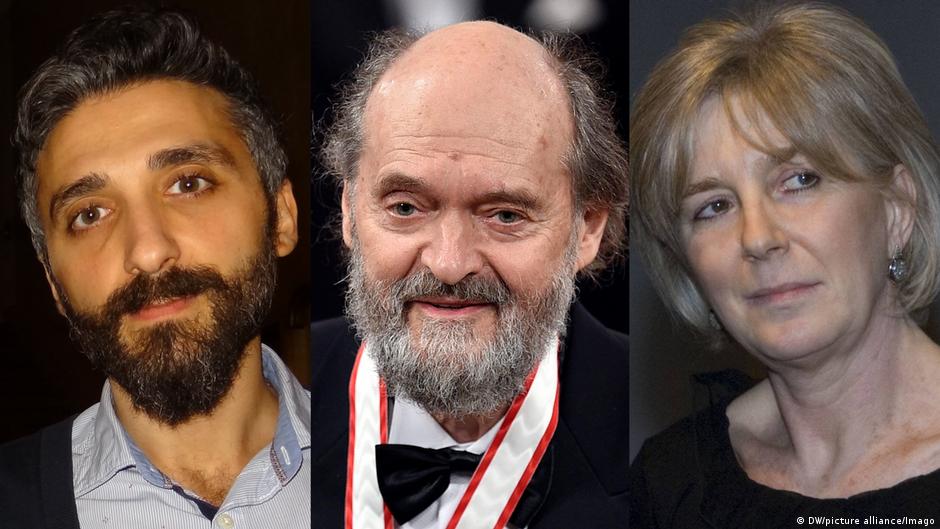
Music, Literature and Theatre: While the respective disciplines of this year’s Goethe Medal recipients vary, what unites them is the belief that their work can contribute to cultural understanding and create cultural connections.
Jury President Thomas Oberender said, “Their lives and works offer an interpretation of migration, displacement and social changes that shaped Europe in the 20th and 21st centuries. They offer a new language and a deeper understanding of our present.”
Arvo Pärt: in search of his musical language
Born in 1935 in Estonia, Arvo Pärt is one of the most frequently performed living composers of contemporary music worldwide.
With a technique developed by Pärt in the 1970s known as the “tintinabuli” method, he created a musical language that is distinct, minimalist, and deeply spiritual.
Pärt’s work has reached a remarkably wide audience and is performed not only in concert halls but also in film and theater productions. His music influences people all over the world.
His path was not easy. The religious nature of his music led to censorship and professional banning in the Soviet Union.
In 1980, he left his homeland with his family and moved first to Vienna, then to Berlin, where he lived for almost 30 years.
After Estonia gained independence in 1991, Part re-established contacts with his home country and returned permanently in 2010.
Anita Raja: Cultural education as a labor of love
For many years, the literary translator played an important role in introducing German-language literature to the Italian-speaking world.
Among other work, Anita Raja translated texts by Christa Wolf, Franz Kafka, Ingeborg Bachmann and Georg Buchner.
In addition to his translation work, he has shaped German-Italian cultural exchange as a librarian and publicist. Beginning in 2005, he served for nearly a decade as the founding director of the Biblioteca Europaea in Rome, considered a model for European-oriented cultural exchange.
“King has always been committed to making libraries a place where people of all classes, ages and educational backgrounds can come together,” the jury said in its decision.
Prodromos Sinicouris: Documentary theater as a bridge between cultures
Prodromos Sinikouris’s parents came to Germany as migrant workers and he was born in Wuppertal in 1981.
Sinikouris works as a theater director, playwright and actor and is one of the leading voices in contemporary Greek and European theatre.
In his documentary productions, he explores the themes of migration, social inequality, and historical perspective.
From 2015 to 2020, Sinikouris directed the Experimental Stage at the National Theater in Athens. Today, he is co-curator of the International Forest Festival in Thessaloniki and teaches at the Directing School of the National Theatre.
The jury said, “Sinikoris is an extraordinary talent who understands that documentary is not only a reflection of reality, but also an artistic space that resonates along social fault lines.”
The Goethe Medal is one of the most prestigious awards in Germany for international cultural work. It will be officially presented in Weimar on August 28, 2026, the birthday of Johann Wolfgang von Goethe.
This article was originally written in German.