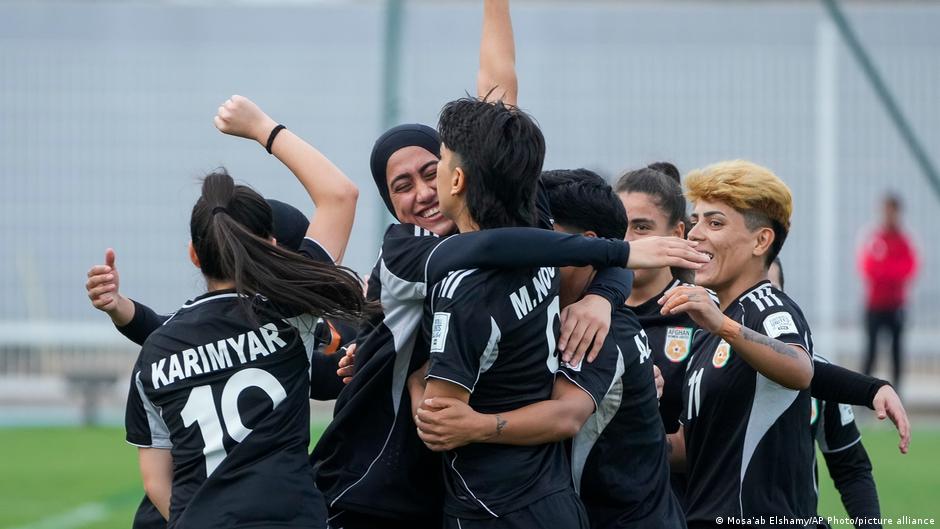
After years of running, fighting, advocating and training, the women of Afghanistan have won the right to compete for football’s biggest prizes as their country’s official national team.
An unprecedented decision taken by world football’s governing body FIFA in Toronto on Tuesday has paved the way for the current team to qualify for the Los Angeles Olympics in 2028 and then future World Cups and Asian Cups.
It is another major step forward for the team, which has had to fight for its right to play after the Taliban-run football association refused to sanction the Afghanistan national women’s team.
“It’s a huge thing for us to show the world that Afghan women and girls are capable of doing amazing things,” national team goalkeeper Ilaha Safdari told DW. “This is a huge slap on the face of the Taliban and those who were against us.
“We’re just showing that we’re capable of doing amazing things through sports. And of course, we’re still raising our voices for all the voiceless people back home.”
Afghan example can open doors for others
Safdari was one of the Afghanistan Women United team that took part in a short tournament called ‘FIFA United Women’s Series’ in Morocco in 2025. The team is made up of refugees who now live mostly in Australia and Europe and has faced many logistical and political challenges. He will likely form a big part of the new national team.
FIFA President Gianni Infantino said the amendment to the organisation’s council was “important”. He said this meant FIFA could now “approve the registration of a national or representative team in exceptional circumstances where a member association is unable to do so.”
“This is a powerful and unprecedented step forward in world sport,” he said. “FIFA has listened to these players as part of its responsibility to protect the right of every girl and woman to play football and represent who they are.”
Infantino also pointed to his organization ‘Strategy of action for Afghan women’s football,’ As a key driver of change, approved in 2025.
Andrea Florence, executive director of the Sport & Rights Alliance advocacy group, explained that the precedent set by this amendment “demonstrates that governing bodies can adapt their rules to protect human rights when exceptional circumstances demand it.”
This would potentially open doors to other national teams, often women’s teams, who are denied the opportunity to play by their federations.
Big moment in Afghanistan and exile
Former Afghanistan captain Khaleda Popal, who has become a key figure for the new generation, was sitting next to Infantino when the news was announced as the current squad watched the match online together elsewhere.
“It means a lot. The whole situation of women in Afghanistan is very emotional,” she said. “This is our moment, this is our time and football is our voice and our platform.”
For Safdari and his teammates, it is a chance to look ahead and build on the momentum and team spirit built at the tournament in Morocco, in which the Afghans were not recognized as a full national team.
“Our situation is quite different from other teams but I think that is a big strength for us,” Safdari said. “We are training hard, we are aiming for it and this is a new hope for us. It shows our resilience and it shows that if we work hard, we can definitely achieve [our goals]”
Don’t fight until Taliban is gone
But as the brutal repression of women continues at home, Safdari and other players know their fight cannot be fully won as long as the Taliban remains in power. Nevertheless, Safdari and the rest of the team enjoy a rare platform as Afghan female international athletes. Now that they are even older, they are determined to keep yelling for their families.
“First of all I [thought of] My parents, who are still back home. They have already heard the news and are proud of how far I have come personally. It’s really something for me to play for my country and make my people, my family and my parents proud.
“Of course, I’ve heard a lot of good things from friends and people who are still at home. And we’ve seen how they’ve been supporting us through this news on social media.”
The team, funded and supported by FIFA during the international break, is set to come together in New Zealand for their first matches since the games in Morocco last October. They will likely play a match against the Cook Islands as part of an eight-day training camp before the Olympic qualifiers begin later this year. Then, eventually, all kinds of other opportunities will be provided to him by the World Cup and Asian Cup qualifiers and his new position.
“It feels really good [to hear Afghanistan can compete in those tournaments] And I still can’t believe that we are finally official and we can play the qualifiers,” Safdari said.
Since the team has barely been in the same country, let alone played together, in recent years, there’s a lot of work to do moving forward. But for players like Safdari, who had to make a new life in a foreign land at a young age while fighting for their right to play football, it is not a difficult thing.
Edited by: Janek Speight