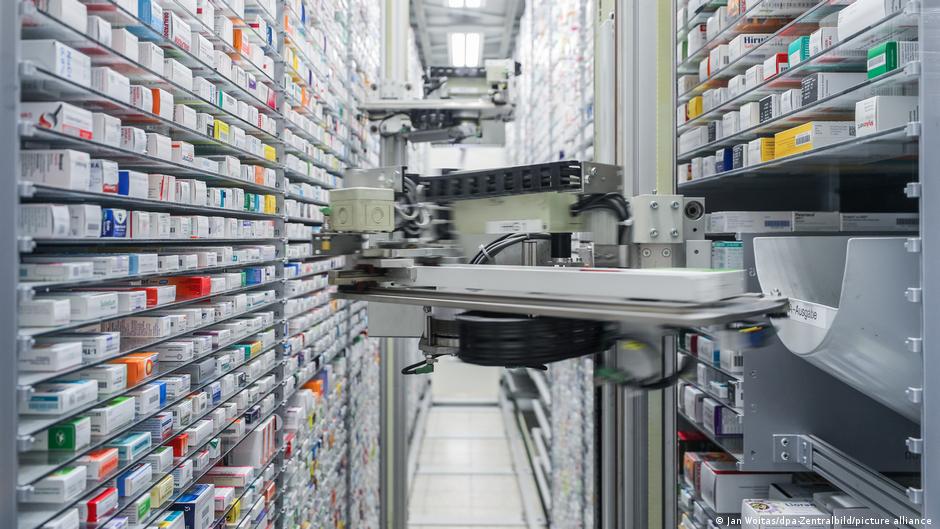
India’s pharmaceutical industry, which is the backbone of the global generic drug supply, is coming under pressure as Iran continues to disrupt energy markets and trade routes.
India is the largest producer of generic drugs, which are cheaper pharmaceutical products made to match brand-name drugs in quality and performance as well as safety.
The country’s $50 billion (€46.44 billion) pharmaceutical sector supplies about 20% of global generic drug volumes, with more than half of its exports going to highly regulated markets including the United States and the European Union. statistics From Indian Brand Equity Foundation.
Indian manufacturers supply about 47% of all generic prescriptions filled in the US, reporting IQVIA Institute for Human Data Science reveals.
At the heart of the strain on India’s healthcare manufacturing sector is its dependence on imported active pharmaceutical ingredients (APIs), the main components of drugs, 60%-70% of which are sourced from China.
Rising oil prices linked to the Iran war are driving up freight rates and the cost of key chemical solvents used in drug manufacturing – even driving up the price of producing basic medicines.
That pressure is already weighing on the supply chain. Prices of raw materials and solvents have soared, packaging costs have increased, and manufacturers face higher logistics and insurance bills.
“This disruption has exposed how fragile the pharma supply chain is,” said Javin Bhinde, a pharmaceutical industry expert and director of India-based business consultancy SynCore.
“Even basic petroleum-related inputs — from solvents like methanol to staples like isopropyl alcohol — saw sharp price increases, pushing up the cost of key drugs like metformin and paracetamol,” Bhinde told DW.
“Although material supplies are now decreasing, prices remain high. API suppliers are already pushing for growth, and the rising costs of packaging, freight and containers are adding further pressure.”
Although many companies are still relieved of a few months of inventory, industry officials have warned that the real impact could emerge within a few months if re-supply remains uncertain.
A fragile supply chain exposed
At present, the prices of some medicines have increased, but marginally. A large increase is still being seen in inputs and raw materials, which have not yet been fully delivered to consumers.
The Indian government has stepped in with a mix of short-term relief and long-term measures, from waiving import duties on key inputs to allowing limited price increases on essential medicines.
“The prolonged conflict in the Middle East could impact India’s exports not only to the region but also to other global markets,” Commerce Secretary Rajesh Aggarwal had said earlier this month.
Agrawal warned that Iran is already putting pressure on supply chains, with the pharmaceutical sector also under pressure. He urged the industry to reduce dependence on imports and emphasize more domestic production.
But with the industry operating on thin margins under price controls, and experts warning of deeper structural risks, the question is whether these steps will be enough to prevent higher prices or supply disruptions in the coming months.
Dinesh Thakur, a former pharmaceutical executive who works as a public health worker, said the risks to the drug supply are uneven but real.
“For older drugs, stockpiles can minimize disruption for a few months. But for cold-chain products like vaccines and injections, the vulnerability is immediate,” Thakur told DW.
He argues that the crisis has failed to reduce India’s dependence on China for APIs, but is instead strengthening it.
Costs rise everywhere
“While domestic production exists, its cost could be 20%-25% higher. With margins already under pressure from rising energy and freight costs, many small manufacturers cannot afford that sovereignty premium,” Thakur said.
Thakur said building new API capacity could take years, arguing that the immediate priority should be to keep existing plants running despite higher energy costs, while building strategic reserves over time.
Also, a series of less visible depressions are forming.
“Solvent prices have increased, insurance now includes conflict-related surcharges, and transit is taking two weeks due to longer shipping routes,” Thakur said.
Companies are holding more inventory, tying up cash, while packaging costs are rising so rapidly that, in some cases, the bottle is worth more than the medicine inside.
The result is rising costs that policymakers have not yet fully understood and which could put pressure on supply.
“If supply chain disruptions continue, drug production is likely to be affected, with rising costs or global shortages,” Soumya Swaminathan, former chief scientist at the World Health Organization (WHO), told DW.
Swaminathan pointed out that this is a good time to discuss with WHO, UNICEF, Gavi, the Vaccine Alliance and other major buyers of Indian products about possible scenarios and mitigation measures.
“Just like during the COVID pandemic, special efforts were made to ensure that the materials required for vaccines could travel across borders and Indian companies like Serum Institute of India and Bharat Biotech could manufacture the vaccines,” he said.
Industry experts and trade bodies have estimated that Indian drug manufacturers could face losses of around $300 million to $500 million due to the disruption, with trade bodies and officials saying the losses could potentially rise further if the disruption in shipping continues.
At present, manufacturers are dependent on two to three months of safety stock.
“But if re-supply remains uncertain, the real impact may start from June,” Bhinde said. “Some plants have already suffered shutdowns associated with energy disruptions and it may take several weeks for them to restart.”
The bigger problem is structural.
“Generic drugmakers operate on thin margins under tight price controls, leaving little room to absorb cost increases of 30%-40%. The risk of supply strains increases if the pressure continues,” Bhinde said.
Edited by: Keith Walker