The current cost of the ZK test is about $66 per transaction, prohibitive for everyday use.
The proposal uses EIP-7702, the improvement that opened phishing vulnerabilities in Ethereum after Pectra.
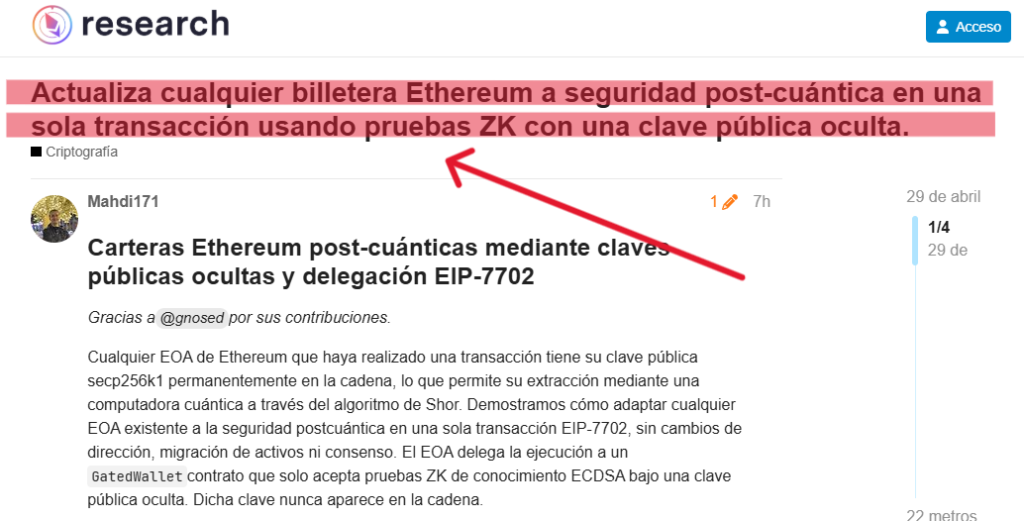
A researcher known as Mahdi171 published this April 29 on the Ethereum Research portal a proposal that would try to shield any Ethereum wallet against potential quantum attacks with a single transaction, without changing the address or migrating funds.
Every time an Ethereum user signs a transaction, their public key remains visible on the network for the time it takes to confirm. That exposure creates a window in which a sufficiently powerful quantum computer could derive the private key and empty the wallet before the original transaction is recorded.
Previous proposals to solve this problem, such as the adoption of the Falcon signature scheme through account abstraction reported by CriptoNoticias, required each user to migrate to a new compatible walleta step that makes mass adoption difficult.
According to the technical document, the proposal removes the key exposure without changing the address or migrating funds. Instead of revealing the public key when signing a transaction, the system stores on chain only one hasha mathematical fingerprint derived from that key that does not allow it to be reconstructed.
Every transaction after the new proposal is activated would include a zero-knowledge proof (ZK proofs), a cryptographic method that mathematically proves that the user knows the key without revealing it. The result would be that a quantum attacker would never obtain the public key they need to execute the attack.
Likewise, explains researcher Mahdi171, the physical devices that institutions use to securely sign transactions (such as hardware security modules (HSM), specialized boxes that store private keys without exposing them) would not require modifications since they would continue to operate with the current signing scheme. while the ZK layer adds quantum protection on the outside.
Mahdi171 developed a test model to verify that the system works technically. That model takes 87 milliseconds to generate the ZK proof that the user must attach to each transaction for the contract to execute, and 65 milliseconds to verify it.
The cost of that verification in Ethereum (what network nodes pay to verify that the proof is valid) would be approximately 3 million gas units per transaction. With ETH trading around $2,200 and a moderate gas price, that represents roughly USD 66 per operationa prohibitive cost for everyday use.
The roadmap includes optimizations that would reduce that cost to 800,000 units of gas, equivalent to about $17 under the same conditions, although that work is pending.
The same tool that opened vulnerabilities now seeks to close them
The current proposal is based on EIP-7702, an Ethereum improvement activated with the Pectra update in May 2025 that allows any normal wallet to temporarily delegate its execution to a smart contract. This functionality also opened a new class of attacks phishing type which CriptoNoticias reported on multiple occasions: attackers trick users into signing a single authorization that gives full control of their wallet to a malicious contract.
Documented cases include thefts of $3 million, $900,000, and $150,000, all executed through phishing that took advantage of exactly that delegation mechanic in a single transaction.
The new post-quantum proposal published today uses the same mechanism, but with a structural difference. Instead of delegating to an arbitrary contract, the wallet becomes a restricted contract that only executes actions verified by a ZK proof.
Without such proof the contract does not operate. This eliminates the vector that the attackers exploited and thus A signature is no longer equivalent to handing over control of the walletbut only to authorize a specific cryptographically verified action.
Thus, while the Ethereum Foundation (EF), an organization that promotes the technical development and adoption of the network, builds its post-quantum roadmap, researchers continue their search to shield the network from a theoretical and future quantum attack.