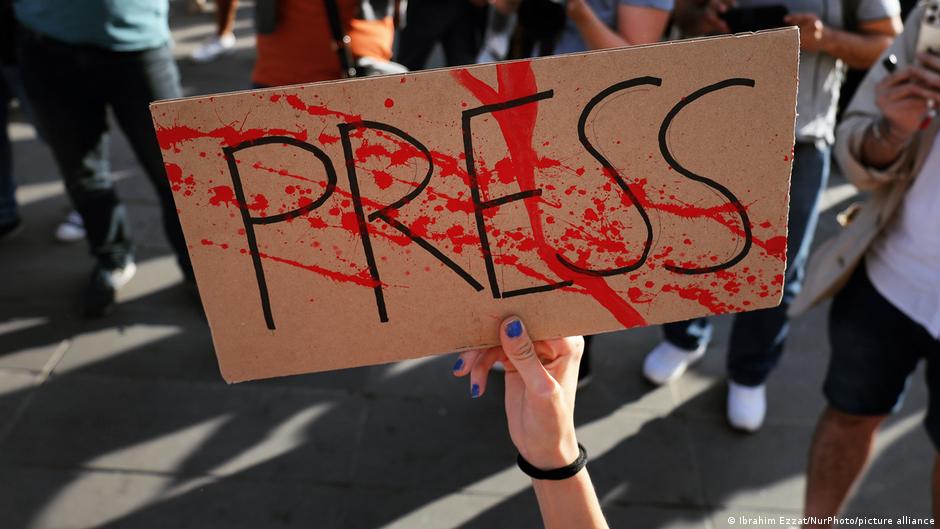
According to the 2026 World Press Freedom Index, the ability of journalists to work safely and independently is at risk globally. Reporters Without Borders (RSF).
The NGO, which has reported annually on the state of journalism worldwide since 2002, defines freedom of the press as “the ability of journalists, individually and collectively, to select, produce and disseminate news in the public interest, independent of political, economic, legal and social interference and in the absence of threats to their physical and mental safety”.
RSF now classifies the press freedom environment as “problematic” or worse in nearly three-quarters of the 180 countries assessed. RSF found that conditions for the media in more than half of the countries were classified as “difficult” to “very serious”.
In 2013, conditions in less than a third of countries were classified as “difficult” to “very severe”. Seven-tenths of the press freedom environment in the decade was classified as “problematic” or worse.
Although there is a declining trend globally, press freedom varies by region. Generally, the freest countries – including the top four: Norway, Estonia, the Netherlands and Denmark – can be found in Europe, while journalists face the harshest conditions in Africa and parts of Asia.
Inconsistencies within regions may also be explained. For example, in Europe, there is a strong divide between the southern and eastern regions, where press freedom challenges are greater, and the northern and western regions, where countries are generally ranked from “satisfactory” to “good”. Similarly, journalists in North Africa are, in general, less independent than their counterparts in the southern region of the continent.
Poland and Slovakia take different paths
An example of interregional divide can be found in the middle of Europe: the press has become free in Poland, while hostility towards the media is increasing in Slovakia. Both countries are classified as “satisfactory”, but they are trending in different directions.
According to RSF, the turning point for Poland was the change in government. The Law and Justice Party (PiS), which opposed abortion and LGBTQ+ rights and pushed anti-immigration policies, was ousted from power in late 2023, with the new government reducing verbal attacks and judicial actions against the press.
That year’s election also marked a turning point in Slovakia, where, after years in opposition, Robert Fico began his fourth term as prime minister in 2023.
“He has a long career behind him, and it was always his statement that journalists are his enemies,” said Lukas Dicko, editor-in-chief of the Investigative Center of Jan Kuciak (ICJK), an independent news organization named after the murder of a journalist during Fico’s third term.
Kuciak was investigating ties between organized crime groups and businesses in Slovakia that were linked to members of Fico’s ruling party. Although Kuciak’s murder sparked a wave of anti-corruption protests that helped topple Fico’s government in 2018, Dicko said attacks on the press have increased since the prime minister returned to office.
“It’s really without any rules,” he said.
Dicko said that the fear and hostile official rhetoric generated by the murder of a young journalist has discouraged people from pursuing careers in reporting.
“Many young people don’t want to be journalists anymore,” he said. “Kuciak’s murder is still something that tells them not to do – but they also don’t want to be verbally attacked on a daily basis.”
Attacks on press as part of political strategy
Argentina is the second country whose index has fallen rapidly. Media advocates say the anti-press smear campaign launched by President Xavier Miley, whose hard-right policies favor financial freedom above all else, has created a hostile environment for journalists. He frequently uses social media to attack critics, and Claims that journalists “aren’t hated enough.”
“When Miley insults a journalist, he is not doing it as Miley, the economist, or Miley, an ordinary citizen,” said Fernando Stanich, president of the Argentine press forum FOPEA, an organization that protects freedom of expression and promotes quality journalism. “He is doing so as the chief representative of the Argentine state.”
Stanich said previous Argentine governments were hostile towards the press – Peronist Cristina Kirchner frequently clashed with the media as president from 2007 to 2015 – but, according to FOPEA monitoring, the current level of verbal attacks on journalists is unprecedented.
Like Argentina’s Miley and Slovakia’s Fico, US President Donald Trump has insulted and threatened the press since his first campaign for office in 2016. Coincidentally, the United States has also seen a significant decline in its standing in world press freedom rankings, in line with other countries where leaders follow a similar playbook – like El Salvador.
Argentina, Slovakia and the United States show how quickly countries considered relatively stable and democratic can turn hostile towards journalists. The press has never been free in Eritrea, China, North Korea and Iran, which have long been ruled by authoritarian regimes that silence independent reporting.
According to the RSF report, “armed conflict is the primary cause [the] Press freedom has declined in countries like Iraq, Sudan, South Sudan and Yemen. More than 220 journalists have been killed by Israeli forces, including at least 70 while working, since Israel began its war in Gaza following Hamas-led terrorist attacks on October 7, 2023, the report said.
Networks fight threats to press freedom
Vera Slavatcheva-Petkova, Professor in the Department of Communications and Media at the University of Liverpool, Social threats to freedom of the press fall into three main categories. The use of political structures to intimidate or harm journalists, including verbal attacks by public officials and threats of violence and imprisonment, is the clearest indicator of the decline in press freedom. But social and economic factors, such as the targeting of journalists based on their gender, race, or sexual orientation and the pressures of an uncertain media labor market, can also undermine press freedom.
Slavchateva-Petkova said journalists can fight such challenges by uniting together, as well as collaborating with organizations that share their values, including rights activists and academics.
“It is very important to know that there is someone you can rely on for support,” said Slavatcheva-Petkova. “When journalists don’t have that, when they don’t know who to turn to for help… then they feel like what they’re experiencing may be their own fault.”
As the 2026 RSF World Press Freedom Index demonstrates, with the majority of journalists around the world now working in conditions that are among the most problematic, the importance of such networks is likely to grow in the coming years – both within countries and internationally. Only 17 countries improved their press freedom scores from 2013 to 2026; The situation became worse in 163.
South Africa is an example of a country with a strong network fighting for press freedom. The country has maintained its “satisfactory” rating since 2013, resulting in a steady rise in the ranking as other countries’ scores have declined.
Glenda Daniels, a journalist and professor of media studies at Wits University in Johannesburg, said a strong civil society has helped South Africa maintain its position on the world stage despite declining press freedom. Despite challenges common to journalists around the world – including bias and threats against women in the media and a shrinking labor market – Daniels said the strong network has helped maintain press freedom in South Africa.
Daniels himself serves as Secretary General of the South African National Editors’ Forum, which defends the right of journalists to do their work. “SANEF is loud and noisy,” he said. “A strong civil society approach, advocacy and activism makes a difference.”
Edited by: Gianna Gruen and Milan Gagnon
All Data, Methodology and Code The story behind this story can be found in this Github repository. More Data-driven stories by DW Can be found on this page.