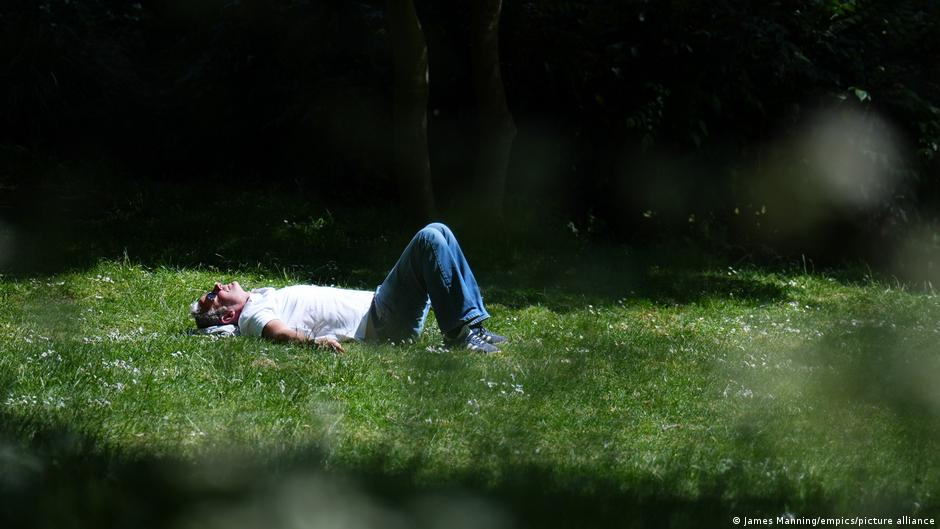
It is one of the first warm days of the year. The first harbingers of spring are carefully poking their heads out of the ground, savoring the taste of new beginnings over a cappuccino in a street café. Looks like winter is over.
Everything seems easy – if it weren’t for that one feeling that haunts many people (at least in German-speaking countries) every year: spring fatigue.
Spring fatigue is called in German spring fatigue.
But – and this may be good news for some people – say researchers at the University of Basel and Bern University Hospital in Switzerland. There is no empirical evidence of spring fatigue.
“We found that people are no more tired or fatigued during the spring than any other season,” study co-author Christine Bloom, a psychologist and sleep researcher, said in a conversation with Gabriel Borud and Connor Dillon of the DW podcast Science Unscripted.
“You’ll find all these possible explanations out there,” Bloom said. “But there hasn’t been a single study that has ever looked at whether this phenomenon exists.”
Finding the truth about spring fatigue in the data
Bloom and his co-researcher, Albrecht Vorster, conducted an online survey of 418 study participants for a year from July 2024.
Every six weeks, they asked participants to rate how tired they had felt over the previous four weeks.
They were also asked to indicate how much sleep they got during the day and how they rated the quality of their sleep.
Since the survey was repeated throughout the year, it covered all seasons.
At the beginning of the study about half of the participants said they suffered from spring fatigue. The survey data should have reflected this – but it did not.
What happens to our body as the weather changes
There are many theories that try to explain the effects of the seasons on the body. For example, warm temperatures dilate blood vessels, lowering blood pressure, or excess melatonin in winter causes fatigue.
But according to Bloom, such theories are unreliable from a chronological perspective. Since melatonin is continuously produced and broken down in a 24-hour rhythm, there is no seasonal surplus.
If spring fatigue were a true biological phenomenon, it should also appear when the seasons change and the body has to adapt, Bloom said on Science Unscripted.
But the data didn’t make this clear: Neither the pace of change in day length, nor the individual months had any effect on participants’ perceived tiredness.
Why do people claim to experience spring fatigue?
Bloom and Vorster conclude that spring fatigue should be less about biology:
“Our interpretation is that this is more of a cultural phenomenon, influencing the way we perceive symptoms rather than actually affecting our fatigue levels,” Bloom said.
“The term ‘spring fatigue’ exists and it allows people to describe how they feel compared to other seasons,” Bloom said. “This shapes the perception of symptoms and leads people to say I am affected by ‘spring fatigue’.”
Psychological processes may also reinforce perception. The likelihood of being active increases when the sun shines. If a person lacks energy, he gets attention through the expectation of being active. Bloom talks about cognitive dissonance and says that spring fatigue provides the perfect explanation for it.
And what about allergies or the winter blues?
According to the study, even pollen allergies, hay fever, or the use of antihistamines fails to provide any explanation for spring fatigue.
“We did not find any effect, so there is no effect [cause] To explain,” Bloom said.
It is also interesting to note that there is no scientific evidence for the equivalent of spring fatigue – winter fatigue.
People may sleep a little longer in winter and a little longer in summer, but this balances the overall need for sleep. Energy levels remain stable throughout the year.
However, winter depression, sometimes abbreviated to SAD (Seasonal Affective Disorder), does indeed exist. SAD is promoted by lack of light and is one of the seasonal depressions that can be accompanied by fatigue, apathy and bad mood.
Vitamin D deficiency, which occurs more frequently in winter due to lack of UV-B radiation, can also cause fatigue.
The body is often unable to produce enough vitamin D during the winter months, and deficiency is associated with symptoms such as persistent fatigue and muscle weakness.
If you feel more tired than usual, don’t think of it as just seasonal fatigue.
“if you feel [your symptoms] If you are a burden, please see a doctor,” Bloom said.
This article was originally published in German.