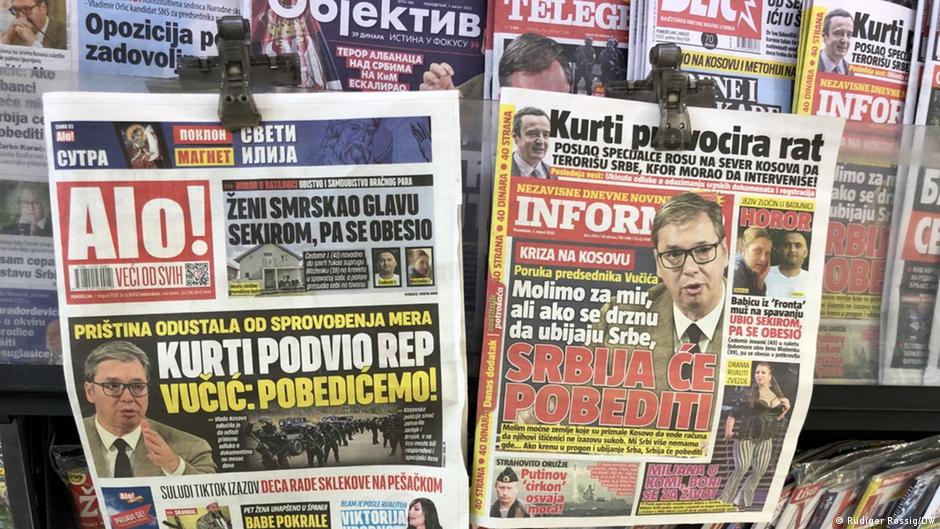
“apostasy” “Pressure,” “Political influence on editorial policy” – this is how many international reports describe the situation of the media in Serbia.
Year after year, the international diagnosis of the health of Serbia’s media landscape remains the same: while the space for professional independent media is shrinking, the government’s propaganda tools are becoming more developed and sophisticated.
“The main goal of the Serbian Progressive Party (SNS) after coming to power in 2012 was to keep the entire media landscape under strong control. And they did it very systematically,” journalist and media analyst Nedim Sejdinovic told DW.
He says the model was simple: media outlets willing to cooperate with authorities received financial and institutional support, while those that refused faced economic and political isolation.
Acquisition of local and provincial stores
One of the first steps was the takeover of the provincial public broadcaster in Vojvodina, where the entire management, including editors and presenters of news programs, was replaced after SNS came to power in the region.
“But one of the most important elements of this media engineering was the purchase of media outlets, especially at the local level, by people who are part of the ruling elite, such as the family of (Minister) Bratislava Gasic, or tycoons like Radojica Milosavljevic,” Sejdinovic said.
“The result is that almost 90% of media outlets are directly or indirectly linked to Aleksandar Vucic’s regime,” he said.
role of public funding
Sejdinovic says that these media are sustained by public funding, which is provided through several parallel channels. This has been confirmed by many watchdog reports.
The first channel is project co-financing, where Public funds are allocated to media outlets through competitive calls To support media content that serves the public interest. According to the analysis of BIRN and Center for Sustainable CommunitiesAbout €120 million ($140 million) has been spent on it at local, regional and state levels over the past decade, with most of it going to media outlets that openly support the government.
The second, much larger and less transparent channel is state advertising, which analyzes show are also largely directed toward the same pro-government outlets.
The third form of pressure comes from the market. Sejdinovic said, “An environment has been created in which even large private companies avoid advertising in independent media, so as not to spoil their relations with the authorities, and in a regulated political and economic environment, which is necessary for doing business.”
The line between journalism and propaganda
In such a system the line between journalism and propaganda almost disappears.
Critical voices are delegitimized and demonized, while scandals are reported without context and framed solely from the perspective of government officials.
At the same time, the public space is saturated with the presence of President Vucic. His addresses are often broadcast live, interrupting regular TV and radio programs, while party rallies are simulcast on national, regional and local TV stations.
Viewers who change channels often encounter the same content: same faces, same messages.
The scale of control was also visible during the 2017 presidential campaign, when almost all daily newspapers placed front-page advertising for then-Prime Minister Aleksandar Vucic – an unprecedented development in Serbia’s modern political history.
The opposition rarely engages in regular reporting, and dissenting voices are often labeled as “traitors,” “foreign mercenaries,” or “enemies of the state.”
In this environment, targeting and defaming government opponents has become common.
From loyal to ‘super-loyal’
Sejdinovic says that as the political crisis deepens, especially after the waves of protests over the past 18 months, control over the media is entering a new phase.
“SNS loyalists are now being replaced with super-loyalists,” he explains.
He says that some pro-government media previously limited themselves to positive coverage of the government and ignoring critical voices, but this was clearly not enough.
“The goal now is to turn all media into a kind of primitive political weapon that will spread the most blatant lies, defame people, use hate speech and create an atmosphere of deep political division in society,” he told DW.
New outlets are opening
This trend is also reflected in the rapid emergence of new media outlets. The Association of Independent Electronic Media (ANEM) in Serbia alone noted the registration of 78 new outlets by the beginning of 2026.
“This is an extension of the media apparatus to disseminate government propaganda,” said Bojan Sevcik of ANEM. “Their texts are unsigned and almost identical, making them more like pamphlets than journalistic material, used for campaigns against critics,” he told DW.
Serbia’s ranking falls
according to The latest World Press Freedom Index published by Reporters Without BordersSerbia has slipped to 104th place and is now classified among countries with a “difficult situation” for media freedom.
The report highlights that, despite some past fluctuations in the rankings, the overall environment for journalists in Serbia is continuously deteriorating, due to increasing political pressure, limited media pluralism and deteriorating conditions for independent reporting.
President Vucic is expected to call parliamentary elections soon, with many estimating that voting could take place sometime between June and the end of the year.
Sejdinovic warned that the situation could worsen, with the next phase potentially involving stronger pressure on the digital sphere, as seen in other authoritarian systems.
Sejdinovic concluded, “The problem of media freedom in Serbia is a political problem.” “It is difficult to solve this without changing the government, because this government, by its very nature, is fundamentally a rival professional journalism“
Edited by: Angiel Flanagan