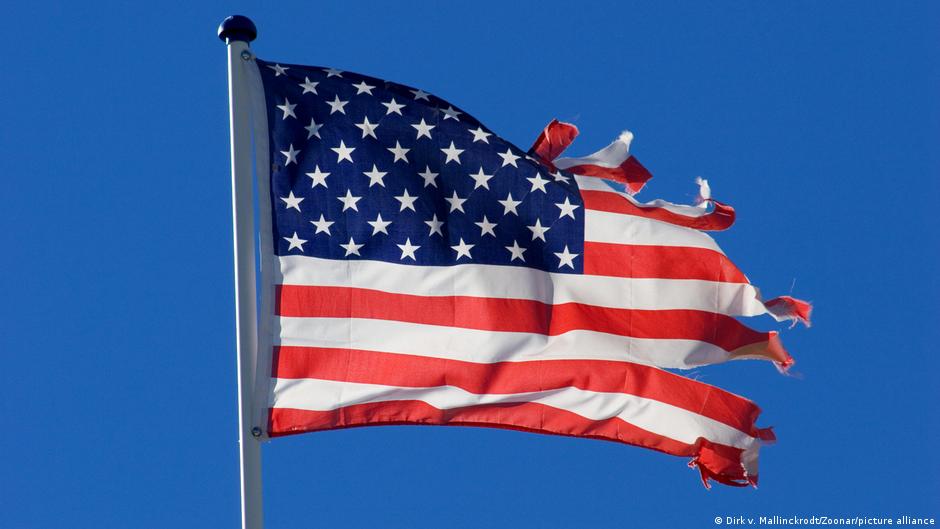
Although they are not representative, comments like these on DW’s social media accounts are increasingly coming up when posts relate to the United States: “Should we really be interested in what’s happening in the US? (…) Please, DW, stop focusing on everything American,” or “It might be worth mentioning that Europeans – and indeed, the whole world – are currently suffering from ‘America fatigue’.”
It has long been seen as the land of promise
For decades, America and the American lifestyle have held a special promise for youth around the world.
Take Germany as an example: After the end of World War II, the people of West Germany quickly realized that their American occupiers not only distributed chewing gum, cigarettes, and chocolate, but also brought their culture with them. Rock ‘n’ roll, jazz, blue jeans and Coca-Cola quickly made an impression on an entire post-war generation – with American GIs as role models.
Additionally, structural support was also provided by the US. Its US Marshall Plan helped 16 Western European countries rebuild after the war with the goal of stabilizing democratic systems.
As the aggressor behind World War II, West Germany received the largest share of aid, followed by Britain, France and Italy. This aid helped launch the German economic miracle of the 1950s and 60s, but it also helped establish democratic processes after National Socialism.
“This is where America was really innovative,” says Frank Mehring, professor of American studies at Radboud University in Nijmegen. “He realized that art and culture could help persuade people to do the right thing, and that films, photography and exhibitions could provide a new perspective that moved away from just focusing on one’s own country to actually finding a new role within Europe. And it was also the beginning of a new perspective on America.”
In 1963, pro-American sentiment in West Germany reached more than 80% – not least thanks to the popularity of the then-young US President John F. Kennedy.
Then came the Vietnam War, and in the decades that followed, there were many reasons to take a more critical view of American politics.
However, overall, America was still widely considered cool – especially among youth culture – and as the place where trends were born, thanks to countless American TV series and films, as well as pop and sports stars.
The state of American democracy? Survey says: not great
But in recent times, the American image has suffered considerable damage – and not only in Germany, where two-thirds of the population has a negative view of the US (Statista, 2025), but also in many countries around the world. According to the Democracy Perception Index (DPI), the largest annual study in the world on public opinion about the state of democracy, only 45% of people surveyed around the world still had a positive perception of the US. Due to this the image of the country has become worse than that of China. In 2024 this figure was 76%.
Another DPI survey highlights the root cause of this development: 82% of countries have an overall negative view of US President Donald Trump – putting him well below Russia’s President Vladimir Putin (61%) and China’s President Xi Jinping (44%). This makes Mr Trump one of the most unpopular heads of state in the world.
It is worth noting that these results reflect the situation before events like ICE’s brutal actions, Trump’s openly expansionist attitude towards Greenland and the US attack on Iran.
Many parents currently ‘don’t have a good feeling’ about America
Traveling to America has also become much less popular. For example, this trend can be clearly seen in the number of German teenagers wishing to spend a semester or the entire school year abroad in 2026-2027.
Nevertheless, according to Thomas Terbek, managing director of education consultancy Weltweiser, “the US is still destination number one.” Comprehensive data for the current and upcoming exchange year is not yet available, but Terbek points out that “at a sector event in January, almost all 45 organizations present confirmed that there were fewer applications.”
Young people are instead choosing other English-speaking countries – Canada above all – or simply staying at home. “Many parents no longer have a good feeling about America — especially because of Trump,” Terbek told DW.
American expert Frank Mehring views this trend with concern: “If people no longer travel to America because of fear, that is a problem, because fear is the greatest enemy of freedom and democracy.” He says fears are often exaggerated or unjustified, as many people in the US remain extremely active in the protest movement, fighting for democracy, and are very well informed. “I don’t want to overstate things,” he emphasizes, adding that “there have been really dramatic changes, with many people – indigenous population groups, ethnic minorities – sometimes living in really dangerous conditions.” But we still shouldn’t turn our backs and feel like America has already gone to hell.
Attraction meets critical inquiry
So are people really fed up with America? Not in Frank Mehring’s opinion: “America may be polarized, but there aren’t many people who don’t care.” He points to the peace movement that organized millions of Germans to protest the deployment of nuclear-armed American Pershing II missiles in the early 1980s, saying, “At that time, people took to the streets in jeans and took inspiration from Bob Dylan songs and Woodstock to formulate their resistance. They found a language in America’s cultural specifics to criticize America.” Even in his harsh criticism, he retained his fascination with American culture.
The current “America fatigue” is mostly related to Donald Trump and the media’s focus on him – meaning everything could change again in the next US presidential election: “America’s image also deteriorated significantly under George W Bush – then along came Barack Obama.”
This article was originally written in German.