
444.3 billion LUNC have already been burned, equivalent to 6.43% of the total supply.
Another 931.644 million LUNC are locked in staking and out of circulation.
Terra Classic (LUNC), the original token of the Terra project, registers a rise of 64% in the last 7 days and is positioned as the best weekly performing asset within the top 100 by market capitalization.
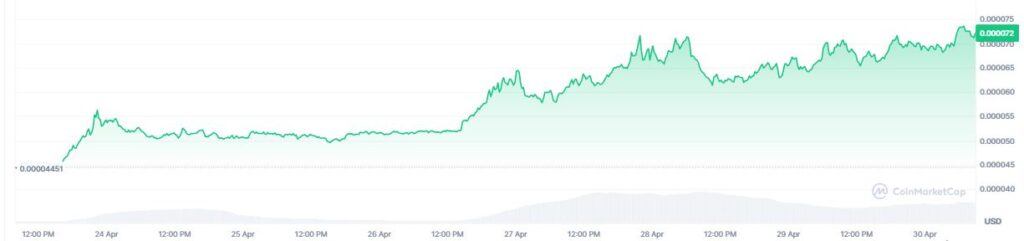
From April 24 to 30, the price of LUNC went from 0.00004451 to 0.0000732 dollars, as seen in the following graph:
This price increase is linked to a combination of reduced supply, a greater number of tokens locked in staking, and expectations for future network improvements.
During the last 7 days, 714,982,541 LUNCs were deleted. In total, 444.3 billion LUNC have already been burned, equivalent to 6.43% of the total supply.
It should be noted that these burns are not completely automatic nor do they respond to a single mechanism.
In Terra Classic, the burning comes from different sources: on the one hand, there are mechanisms implemented in the network, such as transaction taxes that allocate a portion to burning; and on the other, voluntary initiatives by ecosystem actors, such as exchanges or validators that periodically eliminate tokens.
For example, in the last month alone, Binance removed approximately 55.699 million LUNC, according to data from LUNC Metrics.
In addition, another 931,644 million LUNC are locked in staking. This represents 14.42% of the total supply (estimated at 6.46 billion tokens), which implies that a relevant portion of the asset is not available for immediate sale.
Both factors reduce the effective circulating supply. This lower availability of tokens can favor upward movements when demand increases or when the market anticipates improvements in the project.
In turn, the network advances with a technical update. The community is voting on a proposal to update the core Terra Classic software (the “terrad” client) to version v4.0.1, with virtually unanimous support at 99.99%. The final result will be known on May 6.
These types of proposals are part of the governance of the protocol and allow changes to be introduced in its operation. In this case, the update seeks to correct errors detected in previous versions, improve the staking system, optimize interoperability with other networks and update technical tools for developers.
If implemented as planned, the network will temporarily stop at a specific block (height 28,486,158), estimated for May 6, 2026. During that pause, validators will need to update their software for the network to continue operating with the new version.
Anyway, The weekly rebound does not change the historical deterioration of the asset. LUNC is 99% below the all-time high (ATH) of $116.1, reached in April 2022, a month before the collapse of the Terra ecosystem, as reported by CriptoNoticias.
This background forces us to look at the current rise with caution. The collapse of Terra left heavy losses among investors and called into question the value of its tokens in the market.
The usefulness of LUNC was severely affected after the fall of the UST stablecoin, which was the axis of its operation within the original ecosystem. Since then, the asset lacks a clear use case and its dynamics largely depend on the activity of a community that continues to drive initiatives to sustain its value.
Therefore, although supply burning, staking and technical improvements can drive speculative movements, It remains to be seen whether LUNC can sustain a recovery beyond the short term.