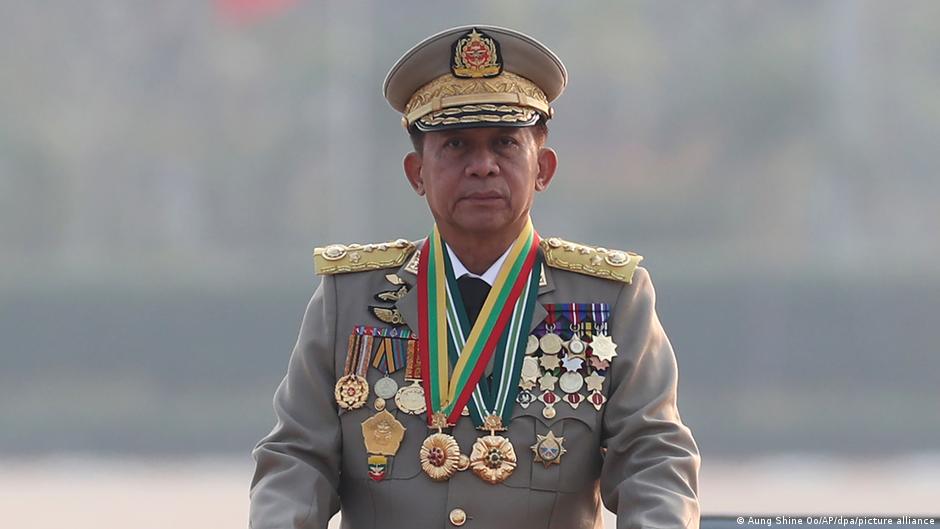
Since toppling the democratically elected government five years ago, Myanmar’s military has lost control of large swaths of land to armed resistance groups across the country.
It has severely damaged the economy and isolated the regime internationally while facing multiple accusations of war crimes.
However, over the past year and a half, the military has recovered some territorial losses and launched new offensives on multiple fronts with the help of thousands of drones and new troops.
As it comes back into power, the military regime has also begun to make carefully measured political signals.
Aung San Suu Kyi was placed under house arrest
Against that backdrop, the country’s former leader Aung San Suu Kyi has been placed under house arrest, officials revealed on Thursday. He has been detained since February 2021, when the military seized power from his elected government.
U.N. chief Antonio Guterres called the move “a meaningful step toward facilitating conditions for a credible political process,” U.N. spokesman Stephane Dujarric said.
However, Burma Campaign UK director Mark Farmaner said Aung San Suu Kyi’s transfer “is not about change or reform, it is about public relations designed to maintain the military regime,” Reuters news agency reported. “No one should be fooled.”
Regime claims greater political legitimacy
Myanmar’s recent elections, though widely rejected as rigged, opened the way for the regime to return to the international stage.
“I don’t know that I would characterize it as a victory,” said Steve Ross, a senior fellow at the Stimson Center, a U.S. think tank. However, the analyst said he believed “the momentum toward the military has certainly changed over the last 18 months.”
With dozens of parties barred from contesting the election – including the ultra-popular National League for Democracy (NLD), whose Aung San Suu Kyi-led government was ousted in 2021 – the military-backed Union Solidarity and Development Party won elections in December and January.
The new parliament duly elected coup leader Min Aung Hlaing as president, fulfilling a long-standing ambition of the former general, who had recently stepped down as commander-in-chief of the army.
Many Western countries dismissed the elections as a sham and dismissed the new government as a military junta in all but name, with no interest in putting Myanmar back on the democratic path it was on before the coup.
Still, some countries globally are lining up to welcome the new government.
“The elections have enabled Min Aung Hlaing and the regime to come to heel [their] “Returning to the international arena in ways that weren’t possible a year and a half or two years ago,” Ross said.
The foreign ministers of Thailand and China have already paid an official visit to President Min Aung Hlaing, which Ross described as a “slippery slope” that would likely lead to more countries rejoining.
Thailand is lobbying hard for the Association of Southeast Asian Nations (ASEAN), which has barred Myanmar from the bloc’s top-level meetings since the coup, to restore full privileges.
Changes in battlefield dynamics
On the battlefield, armed resistance groups still control or contest much of the land they have seized since the coup that sparked the civil war.
But the military is retaking more and more of it, including vital trade routes with neighbors China and Thailand that were cut off.
China has played a role by pressuring some large armed groups to hand over some of the land they have captured and to stop fighting forces or sell their weapons to other groups that are still fighting.
Amara Thiha of the Peace Research Institute Oslo argues that the “rapid collapse” of the People’s Defense Forces (PDF) has been as unhelpful to the military as it has been to it.
Following the coup, the PDF took up arms against the regime in hundreds of communities across the country. Since then they have often fought alongside Myanmar’s older and larger ethnic-minority armies.
However, Amara Thiha said that her own field research had found more flaws in PDFs in recent months than in previous years, with some PDFs now “too small for coordinated operations.”
Even two of the ethnic-minority armies that until recently were making the biggest gains against the army, the Arakan Army and the Kachin Independence Army, are now struggling, he said.
a weakening resistance movement
Overall, Amara Thiha said, the immediate path forward for Myanmar is to confront a regime “in structural decline” that is “stagnating”, especially in the country’s ethnic-majority Bamar centre, the military’s traditional power base.
He said, “The conflict is not over, and the regime faces its own structural weaknesses, including elite bargaining tensions with the USDP, governance deficits outside the main urban areas, and an economy that has not recovered.” “But the army is no longer merely surviving. At the moment, it is increasingly being reinforced.”
Htet Shein Lin, program associate at the Institute for Strategy and Policy-Myanmar, another think tank, says the military is neither winning nor losing.
He says it has regained only a fraction of the ground lost over the past five-plus years, and is still losing ground on some fronts.
Myanmar’s military is not winning, he said, but “has reached a point where it is no longer in a state of sustained defeat.”
what comes next?
During the resistance groups’ Operation 1027, in late 2023 and early 2024, the army lost two regional command headquarters and hundreds of battalion bases – the heaviest losses of the civil war.
Htet Shein Lin said, “They have now managed to take advantage of Chinese assistance to prevent further military losses and stabilize their position.”
He and Ross say Myanmar’s myriad resistance groups are fragmented and divided enough to pose a lethal threat to the military, but they are unlikely to suffer definitive defeat in the near future.
“The seeds have been sown for a long-term, sustainable counterterrorism campaign in Myanmar,” Ross said. He said widespread access to weapons and deep public anger over the coup mean that armed resistance to military rule is likely to continue for the foreseeable future.
While the overall level of fighting since the coup has decreased slightly after peaking during Operation 1027, it is still far higher than before the civil war began. Thousands of soldiers and civilians have been killed, and more than 3 million people are still displaced.
Ross said, “You look at where the country was before the coup in 2020 and where it is now, and I think any honest, reflective military leader will tell you that from a military standpoint they are in a much weaker position than they were then.”
“They’re a lot more confident than they were two years ago, but I don’t think they’re so confident that they’ll honestly say they’re winning.”
Edited by: Keith Walker