The motorcade is moving through New York City traffic, sirens blaring, horns blaring, New Yorkers complaining. Finally, Germany’s Foreign Minister Johann Waddefull reaches the United Nations with only a few minutes to spare.
Wadful is at the center of the 80-year-old institution, its most powerful body, the Security Council. His three-minute address addressed maritime security, the damaging effects of the war in Iran and particularly the closure of the Strait of Hormuz.
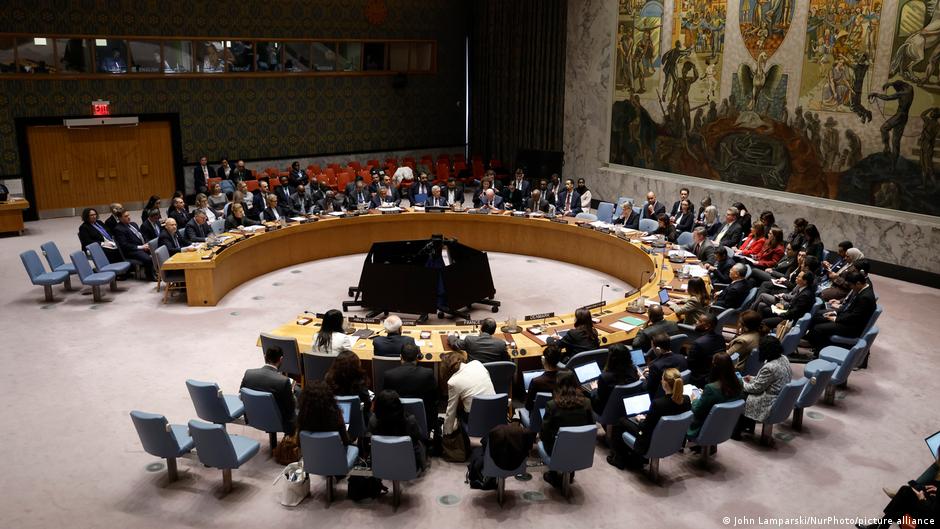
While giving speeches, Wadefull sits at the famous horseshoe-shaped Security Council table. But someone immediately asked him to take a seat in the front row because Germany is not a member of the Security Council – at least not yet.
Why is Wadeful in the United Nations?
Wadeful’s mission is Germany aims to get back into that table for two years from 2027 to 2028.
This won’t be the first time. Germany (and the former West Germany) has been a non-permanent member of the Security Council six times; Once the former East Germany. The permanent members are the US, China, Russia, France and Britain, all of whom have veto powers.
In an exclusive interview with DW, Wadful expressed cautious optimism over Germany’s prospects.
“I would say the chances are good, but it’s a competition and it’s a democracy,” he told DW. “So we can win. We can lose. Both are possible. We have good arguments. We engage in this world. We engage in the United Nations system.”
How are non-permanent seats won on the UN Security Council?
Elections are to be held for five of the 10 non-permanent seats of the Security Council in June. If Germany is to win, it will need two-thirds of the 193 members in a secret ballot.
The campaign is never really a straightforward affair. There are too many changes, compromises, and demands to make this an easy endeavor. This time it is even more complicated because Germany announced its candidature relatively late. The Group of Western Europeans and Others, one of the UN’s five regional groupings, had by then already settled on Austria and Portugal, so support would have to come from elsewhere.
Does Germany have support for a seat on the UN Security Council?
Wadful appears to be pinning its hopes on African countries, which form the largest voting bloc at the UN with 54 countries. A number of bilateral talks were planned for his 29-hour visit to New York, but one of the most important appointments for the Security Council bid is the visit of the Minister for Representation of the African Union.
Here, Wadful talks about Germany’s spending in the development aid sector. However, he also stressed that it is not money or donations that qualifies Germany for a seat on the Security Council.
“I would say the slogan is to choose a country that has experience and that has an interest in being more understanding to other countries and other continents,” he told DW.
Another factor that could help when the vote is held in June: Germany’s support for the African Union’s demand for two permanent seats on the Security Council. This may or may not come as part of far-reaching reform plans at the United Nations.
Is the United Nations still relevant?
However, there is a question that needs to be answered: At a time when the law of the jungle appears to be winning, is all this diplomacy worth the effort?
“Of course, we are stressed,” Wadefull admitted. “The United Nations system is under stress, [but] I think diplomacy is still too important for this world to prohibit [law of the jungle] To win the race.”
With numerous wars breaking out from Ukraine to Sudan to the Middle East, many in the UN are hoping that the rules-based order implemented in the UN after World War II will actually recover.
It is clear that Germany is quietly advocating to become one of the standard bearers of that potential return – ideally with a seat on the Security Council.
Edited by: Matthew Moore