
Murch does not deny the need to prepare, but rather the weight given to the immediacy of the threat.
Adam Back responded that “Q-decade” is a more accurate horizon than “Q-day”.
Murch, a renowned Bitcoin Core developer and editor of the Bitcoin Improvement Proposals (BIP) repository, expressed this May 3 on
Every time I open Twitter, the so-called quantum alarmist experts demonstrate an extreme lack of technical rigor. It’s hard to take concerns about the immediacy of Q-Day seriously when so-called experts can’t seem to hold their own in any conversation.
Murch, Bitcoin Core developer.
Additionally, Murch expressed that “we need to have plans ready for when the time comes. “It is good and important to continue investigating solutions.” However, he added that what he reads “does not help assign weight to concerns about the immediacy of Q-Day.” His questioning does not point to the threat itself or the preparation work, but to the strength of the arguments that justify treating it as urgent.

Adam Back proposes talking about “Q-decade” in Bitcoin
Adam Back, cryptographer and co-founder of Blockstream, responded to Murch: “Maybe ‘Q-decade’ is a better track”. For Back, the key is not whether the threat will arrive, but whether Bitcoin will have an active migration mechanism «opt-in»that is, a voluntary way for users to migrate their keys to quantum-resistant formats when there are concrete signs of danger.
If that mechanism exists and users can accelerate migration when quantum computing research demands it, the decade-long horizon is manageable.
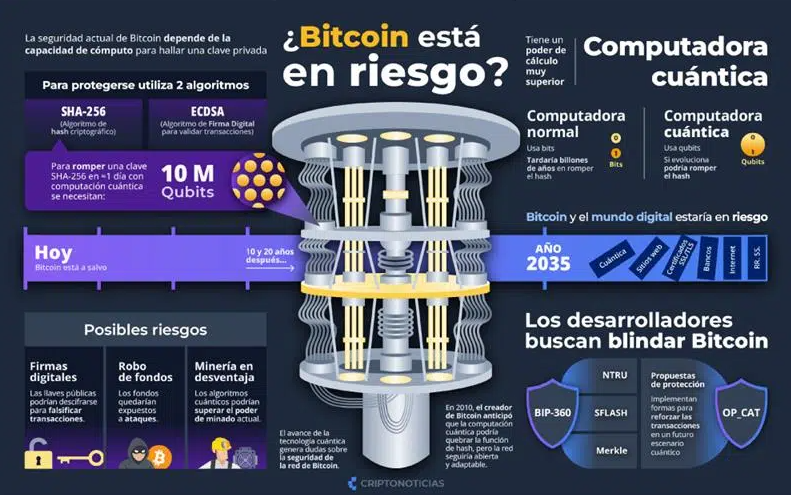
A quantum debate with defined positions
Murch and Back’s positions are part of a broader debate that CriptoNoticias has followed. Back puts the horizon of potential quantum danger at about a decade, which is why he suggested the idea of calling it ‘Q-decade’.
Samson Mow, CEO of JAN3, coincides in that range of 10 to 20 years and also warns that rushing has real technical costs, since post-quantum signatures can be up to 125 times larger than current ones, which would reduce the network’s processing capacity.
However, not all actors in the ecosystem share this optimism about deadlines. Vitalik Buterin, co-founder of Ethereum, estimates that the threat to the cryptography that protects Bitcoin could arrive in 2028 and Charles Edwards, CEO of Capriole, believes that Bitcoin should be shielded before that same year.
Likewise, Google established 2029 as the deadline for migration to post-quantum cryptography and warns that part of the quantum threat is already current, not future. Other companies join this position, such as Cloudflare and Grayscale, which also defined post-quantum security migration plans for the end of this decade.