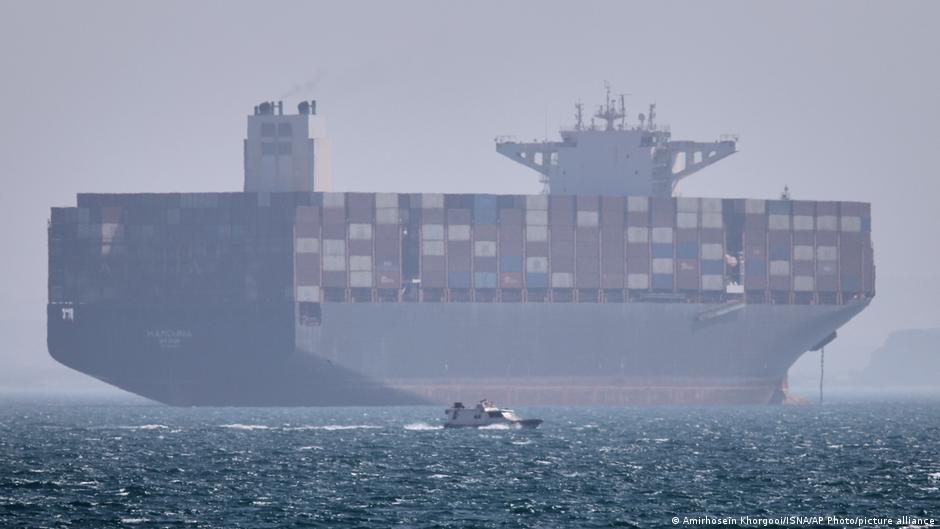
Is it possible for US forces to safely escort tankers and merchant ships through the Strait of Hormuz? DW has compiled the most important questions and answers regarding the transportation of oil and gas shipments through the waterway, which connects the Gulf to the Arabian Sea.
What do we know about “Project Freedom”?
According to US Central Command (centcom), “Project Freedom” will deploy more than 100 land- and sea-based aircraft as well as 15,000 service members.
Their idea is to coordinate efforts to help commercial ships navigate in the Strait of Hormuz. The project does not call for the US Navy to provide security by escorting ships through the waterway.
so According to the Lloyd’s Market Association (LMA) – an association of around 100 companies that collectively underwrite risks to ships and oil platforms – a total of around 1,000 vessels are currently affected by the blockade around the Strait of Hormuz. About 20,000 crew members are stranded on ships. At least 25 ships have come under fire since the end of February Iran was began.
According to the Lloyd’s report, there was no prior consultation with the industry by the US government regarding how ships stranded in the Middle East would be safely evacuated from the waterway.
Are ships still operating in the Strait of Hormuz?
Yes, although traffic is minimal and stops frequently. Before February 28, when the US-Israeli war over Iran began, 125 to 140 ships a day passed through the strait. According to data from commodity analyst Kpler, only seven ships had passed through there the previous day on April 30.
Currently, the strait is being blocked by both Iran and the United States. The blockade imposed by Iran since February 28 is aimed at reducing maritime traffic overall. According to Israeli maritime intelligence firm Windward, which keeps an eye on For international shipping traffic, all ships wishing to pass through the strait have to coordinate with Iranian authorities and pay a toll of $1 per barrel for transporting oil tankers.
The US blockade of the strait, which began on April 13, targets ships entering and leaving Iranian ports. According to Windward, the blockade has caused a sharp decline in Iranian crude oil exports to Asia.
International Shipping Association BIMCO It has “urged all parties involved in the conflict to show restraint and help protect innocent seafarers.”
In response to questions about what the shipping industry needs to resume transit, the association said in a statement, “For most shipping companies, they will need a stable ceasefire and assurances from both sides of the conflict that the Strait of Hormuz is safe for transit.” He also said that the threat of mines is also a matter of particular concern.
Has the cost of ship insurance increased?
Yes, Iran has significantly increased the cost of shipping insurance through the Strait of Hormuz. However, according to the German Insurance Association (GDV), it is still possible to insure ships.
“The normal market mechanism is working in the face of the increasing risk of war,” said Jörg Asmussen, chief executive of GDV.
However, according to agency reports, several major marine insurers have already suspended their war-risk coverage for Iran and the region around the Persian Gulf since March 5, or have stopped offering new policies in the region. These include insurers Guard, Scaled, Northstandard, London P&I Club, American Club and Japanese group MS&AD Insurance.
Why is the Strait of Hormuz important?
The Strait of Hormuz connects the Persian Gulf in the west to the Gulf of Oman in the east and provides access to the Arabian Sea. OPEC members such as Saudi Arabia, Iran, United Arab Emirates (UAE), Kuwait and Iraq export most of their crude oil through this strategic chokepoint.
In 2024, an average of about 20 million barrels of crude oil per day would pass through the strait – about 20% of global consumption. Qatar, one of the world’s largest exporters of liquefied natural gas (LNG), ships almost all of its LNG via this route. Overall, about one-fifth of global LNG trade passes through the strait.
Which countries are affected by the blockade?
The effective blockade of the Strait of Hormuz is affecting the Persian Gulf countries to varying degrees. While Saudi Arabia, UAE and Iran have some alternative routes available, this is not the case with Iraq, Kuwait, Qatar and Bahrain.
Iran can also use the port of Jask, which is located in the Gulf of Oman and has direct access to the Arabian Sea. Therefore, tankers do not have to pass through the Strait of Hormuz.
Have US forces already taken ships in the Strait of Hormuz?
Yes, in 1987, during the Iran–Iraq War (1980–1988), Kuwait requested American escort for its oil tankers. In what became known as the Tanker War, both Iran and Iraq attacked hundreds of tankers in the Persian Gulf and the Strait of Hormuz. The US registered several Kuwaiti oil tankers under its flag.
Approximately 60% of the ships attacked during the Tanker War were oil tankers. according to a Analysis By the Robert Strauss Center for International Security and Law, 55 of the 239 oil tankers (23%) were completely sunk or declared lost.
Merchant shipping declined 25% due to tankers. But the price of crude rose only temporarily as Iran lowered the price of oil to compensate for higher insurance premiums for shipments.
This article was originally published in German.