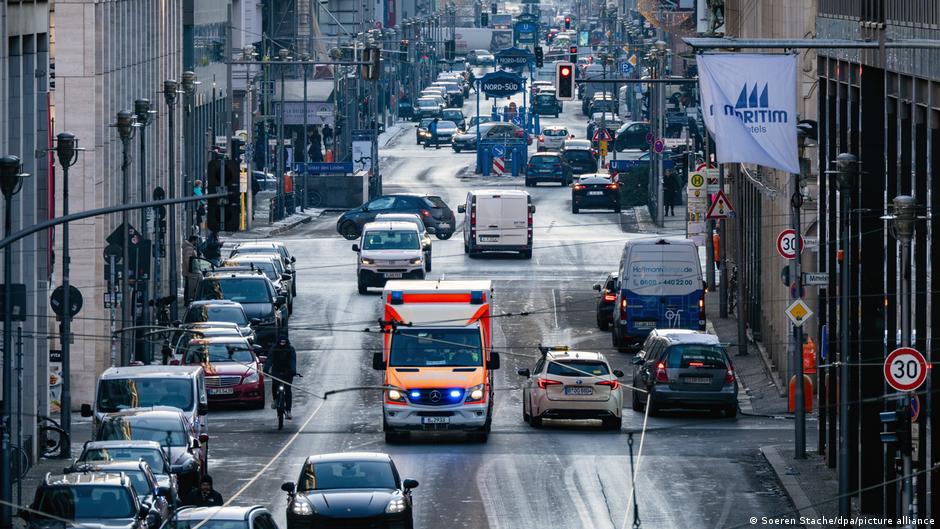
Berliners lost 60 hours a day last year due to traffic congestion, which Oliver Coleman is hoping to change. The engineer spent years working on software for self-driving cars before he realized he really wanted to use his skills for things “that are in the general interest of mankind.”
After being released from his job, he joined a group campaigning for a referendum to reduce traffic in the center of the German capital.
“Berlin is one of the few European capitals that is still very car-centric in traffic policy,” said Coleman, co-spokesperson for the movement. “Cars occupy about 75% to 80% of the available space in the city.”
The center of Berlin is surrounded by a 37-kilometre (23-mile) circular railway and campaigners want to see all roads inside it reclassified as “car-less”.
The model would mean that motorized vehicles would only be allowed inside the zone in specific cases – such as for the transport of people with restricted mobility, by emergency services or for large commercial deliveries. Every Berliner will be allowed to drive his or her private car in the city center up to 12 times a year.
Coleman says the proposed law is not anti-car but rather “against the excessive use of cars and the use of large cars in urban areas.”
He and other campaigners believe the changes will result in cleaner air and less noise, as well as create more space for trees which will help reduce heat and contribute to better public health. Trees reduce surface and air temperatures by providing shade and coolness by absorbing water through their roots and evaporating it through their leaves.
But for Oliver Lah, assistant professor of spatial planning at Blekinge Institute of Technology in Sweden, prohibition is not a solution.
“Delivering something that people really want – that’s what helps,” he said, adding that he wanted Berliners to “build consensus on something that is really sensitive and useful for businesses in the city and for people living in the city centre.”
Other places in Europe are experimenting with different methods to reduce traffic in city centers. Which includes Vienna, Copenhagen, Barcelona and Oslo.
Oslo gives priority to pedestrians
The Norwegian capital implemented its own car-free program in 2017 to give pedestrians priority in the city centre, while also discouraging private cars.
An automated ring toll system monitors vehicles entering the city and charges them for the privilege. Electric cars are cheaper to get into than combustion engine models.
A 2020 evaluation conducted by city officials showed that traffic within the program area declined by 28%.
In addition to reducing traffic, the program, which invited public participation, also aimed to create more space for nature and humans. In 2022, parts of central Oslo were converted into “livable streets” by temporarily closing them to private cars.
During this time, streets were redesigned with benches, seating areas, plant beds, and other natural elements such as logs. To create a more comfortable and attractive space for people of all ages, the areas were filled with greenery, including flowers, shrubs, herbs and grassy plants.
Oslo’s city center is busier than a decade ago, with pedestrian activity increasing by 38% on Saturdays and conditions for cyclists improving.
The number of people walking and cycling in the Norwegian capital is expected to increase from 36% in 2014 to 46% in 2023, according to city data. But that doesn’t mean the roads are completely car-free.
98.1% of all new cars registered in Oslo so far this year have been zero-emissions.
Paris popularizes 15 minute cities
Paris has made its name as a 15-minute city, which means designing urban areas so that most daily necessities and services are accessible within a quarter-hour walk or bike ride.
concept The project was the brainchild of Franco-Colombian urban researcher Carlos Moreno, but caught the attention of former Paris mayor Anne Hidalgo.
“Have you ever stopped to ask yourself: Why does a noisy and polluted street need to be a noisy and polluted street? Just because it is? Why can’t it be a quiet street surrounded by trees, where people can actually meet and walk by the bakery and kids can go to school?” Moreno asked in a 2020 TED talk.
As part of its 15-minute cities concept, Paris has reduced the number of cars in the city center without imposing restrictions. Instead, from the end of 2024, the French capital introduced limited traffic zones in key parts of the city centre.
The rule allows traffic that begins or ends inside the zones, but drivers are not allowed to use these zones merely to get somewhere else. This rule reduced traffic inside the restricted area by about 6% and in the surrounding central area by about 8% during the last two months of 2024.
The city has not imposed any fines for breaking this rule, giving drivers ample time to adapt to the transition. Now Moreno is helping other countries like the Netherlands implement the same concept in different cities.
A 2026 study shows that walkable city models like Paris exhibit lower per capita transportation emissions.
In Berlin, campaigners have until May 8 to collect signatures from at least 7% of the city’s eligible voters for a car-free initiative. If the threshold is met, residents of the German capital could vote in a referendum later this year that will shape the heart of their city.
Edited by: Tamsin Walker