As Southeast Asian governments struggle to respond to the unprecedented energy crisis, the European Union is increasing pressure on them to stop buying Russian energy.
Despite years of Western sanctions, Russia remains one of the top energy suppliers on the global stage. It is the world’s second-largest oil exporter, behind Saudi Arabia, and second-largest gas exporter, behind only the US.
Crucially, Russia’s geography allows it to export its energy without passing through the Strait of Hormuz, which has been disrupted by the US-Israeli war against Iran.
Last week, EU foreign policy chief Kaja Kallas warned Southeast Asian countries not to turn to Russian oil. After meeting foreign ministers of the Association of Southeast Asian Nations (ASEAN) in Brunei, Kallas said increased purchases of Russian oil would help Moscow finance the war in Ukraine.
The EU’s top diplomat also said Brussels was not trying to directly punish Southeast Asian governments or companies, but was instead hoping to reduce Russian oil revenues.
Yet the warning comes as many Southeast Asian capitals face threats to fuel security and food production, looming over the diplomatic fallout from the war in Ukraine.
“Facing severe energy crises that could devastate their economies and trigger street protests, some Southeast Asian governments would prefer oil supplies rather than a distant conflict in which they have no direct stake,” Ian Storey, senior fellow at the ISEAS-Yosof Ishak Institute in Singapore, told DW.
Indonesia, Philippines are already buying Russian oil
The region consumes about 5 million barrels of oil a day, but produces only 2 million, forcing it to buy the rest from the global energy market. Most of its oil imports come from the Middle East.
Indonesia announced last week it would import about 150 million barrels of Russian crude this year following President Prabowo Subianto’s visit to Moscow.
The Philippines, considered a US ally in the region, received a shipment of Russian crude in March – the first such delivery in five years. Manila also asked Washington to extend sanctions relief to allow further purchases.
Thailand is looking for ways to secure fertilizers and other agricultural inputs from Russia, while Vietnam has sought alternative fuel supplies after China and Thailand restricted exports of refined fuel. Hanoi depends on China and Thailand for more than 60% of Vietnam’s jet fuel needs.
Oil imports dropped to 2015 levels
According to the International Energy Agency, the war in the Middle East has caused the largest supply disruption in the history of the global oil market, with crude and oil-product flows through the Strait of Hormuz falling from about 20 million barrels per day before the war to much less.
The first month after Russia’s February 2022 invasion saw Brent crude prices rise from $95 to $115 (€80.7 to €97.7) per barrel, an increase of 21%.
In contrast, the ongoing crisis in the Middle East caused Brent to rise from $71 to $103 in March, representing an increase of nearly 27%, which was followed by another surge in April, taking the benchmark price to around $120 a barrel before falling amid expectations of an agreement to end the conflict.
Southeast Asian crude oil imports fell 30% year-on-year in April, the lowest level since 2015, according to data compiled by Belgium-based analytics firm Kpler.
ASEAN countries warned that the cost of living is already rising across the region, with low-income households and small businesses being hit hardest.
How are ASEAN countries dealing with the oil crisis?
Southeast Asian governments have moved quickly following the US and Israel attacks on Iran in late February.
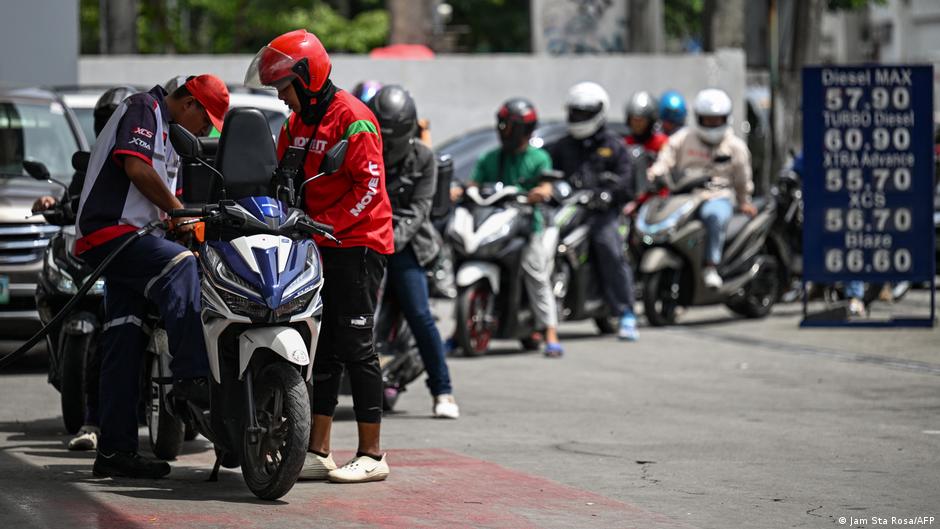
The Philippines has declared a one-year national energy emergency and created a contingency committee for fuel and essential commodities. However, despite these measures, inflation rose to 7.2% last month, from 2.4% in March, according to government data.
Indonesia has relied on administered prices and subsidies, allocating $22.4 billion for energy subsidies and compensation, while Thailand froze cooking fuel prices until May and used its oil fund to reduce fuel costs.
Malaysia has also absorbed most of the shock through subsidies, with its monthly fuel subsidy bill reportedly rising from about $179 million in January to $1.5 billion.
A few weeks after the Iran war, Philippines officials said the country had enough fuel for about 45 days. On March 25, President Ferdinand Marcos Jr. said he was “fairly confident” that the nation had secured additional shipments that would keep its inventory in stock.
With the original deadline approaching, the crisis is already seeping into daily life. The country’s transport groups and consumer organizations have threatened to strike over fuel prices, raising the risk of disruption in cities where commuters rely heavily on buses, minibuses and motorcycle taxis.
Aviation officials in Vietnam warned airlines to prepare for domestic flight cuts starting in April, after China and Thailand halted jet fuel exports.
Across the region, farmers are being hit by high diesel and fertilizer costs, with rice growers in Thailand, Vietnam, the Philippines and Indonesia already rethinking planting plans.
Can the fuel just run out?
Indra Overland, head of the Center for Energy Research at the Norwegian Institute of International Affairs, told DW that today’s crisis is bigger than the oil shocks of 1973 and 1979, as well as other previous oil shocks, because oil, LNG and fertilizer markets are tightening simultaneously.
Unlike previous price increases, this crisis is unfolding alongside Ukraine’s increasingly effective attacks on Russian oil and gas infrastructure, which further reduces the scope for alternative supply, he said.
Rogelio Elicor Panao, a political science professor at the University of the Philippines Diliman, told DW that the fundamental difference between this crisis and previous energy shocks is that it is not just about higher prices, but also about shortages.
“This means countries can’t pay more to get what they need. Instead, they could run out of fuel or energy,” Panao said.
Food production affected due to lack of fertilizer
Fertilizer shortages make this crisis particularly dangerous for Southeast Asia, where food prices are politically sensitive, and many governments still remember the social unrest caused by previous inflation surges.
Russia accounts for about a quarter of regional fertilizer imports, while China, previously Southeast Asia’s largest exporter of fertilizer, has also cut exports, “so Southeast Asian countries are feeling the pressure,” Hunter Marston, director of Southeast Asia at the Lowy Institute, told DW.
Aloysius Joko Purwanto, senior energy economist at the Economic Research Institute for ASEAN and East Asia, told DW that countries that heavily subsidize energy and electricity and are less dependent on imports, such as Indonesia, Thailand and Malaysia, have been better able to contain inflation and commodity-price rises since the crisis began in late February.
But countries with more market-based pricing, such as the Philippines, or high import dependence, such as Laos and Cambodia, have seen sharper inflation or consumer-price increases, he said.
Best case scenario means months of disruption
The IMF has urged Asian governments to keep support targeted, warning that broad price caps and subsidies could strain public finances, even if they ease the immediate blow to households.
Sam Reynolds, head of research at the Institute for Energy Economics and Financial Analysis, told DW that even if the conflict ended tomorrow, it would take six months or more for oil and gas production to return to “normal.”
Reynolds said one likely event would be increased competition between European and Asian buyers of LNG and oil, especially as European gas storage is currently only 30% full but needs to reach 90% capacity by October.
But this energy crisis is unprecedented, “and I’m not sure anyone can say for sure how bad things will get,” he said.
Edited by: Darko Janjevic