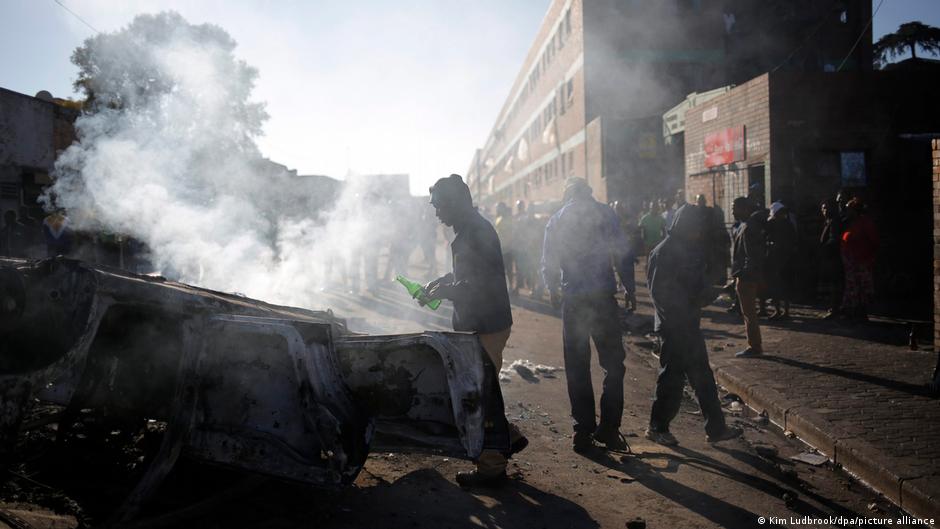
For more than two decades, South Africa has faced repeated anti-immigrant violence, primarily targeting African migrants and refugees from some neighboring countries and beyond.
Critics say that political rhetoric around immigration, coupled with deep economic frustrations, helps foster xenophobic sentiment; Time and again, foreign nationals have been beaten, displaced, killed and their businesses looted in different parts of the country.
DW takes a look at how xenophobia has evolved in South Africa over the past few years.
1994-2007: Increasing tension after apartheid
Following the end of apartheid in 1994, South Africa became a major destination for immigrants seeking work and stability. Many came from neighboring countries that were experiencing economic decline, conflict, or political repression.
At the same time, South Africa was struggling with rising unemployment, inequality and persistently poor service delivery, while the government’s focus during this new chapter was largely on nation building.
But while political power structures changed, much of the country’s wealth, land, and major businesses remain concentrated in white hands, leaving deep economic inequalities inherited from decades of segregation largely unchanged.
A 2021 World Bank study found that the richest 10% of South Africans – who identify predominantly as white – still own more than 85% of the country’s wealth.
Attacks on migrants began to become more prevalent in the townships in the late 1990s and early 2000s. Foreign shop owners were accused of “stealing jobs” or undercutting local businesses, especially in the informal economy.
2008: First burst of attacks on foreigners
In May 2008, xenophobic violence erupted in the Alexandra township near Johannesburg before spreading throughout the country.
At least 62 people were killed, more than 670 were injured and more than 100,000 were displaced during the attacks, according to the UN refugee agency UNHCR. Many of the victims were immigrants from Zimbabwe, Mozambique, Malawi and Somalia.
One of the most infamous images of the violence shows Mozambican migrant Ernesto Nhamuwe being burned alive by a mob in the Ramaphosa informal settlement near Boksburg.
Then-President Thabo Mbeki condemned the attacks, saying at the time that “Nobody in our society has the right (…) to explain away naked criminal activity under the guise of xenophobia.”
However, Mbeki’s administration was heavily criticized for this approach, with many commentators labeling his administration’s frequent attacks as opportunistic acts of crime, rather than as “denialism” reflecting deep-seated anti-immigrant sentiment.
Human Rights Watch later said the series of attacks had exposed “deep-rooted intolerance and poor local governance”.
2015: Further attacks in Durban and Johannesburg
Another major wave of violence broke out in 2015, mainly in the cities of Durban and Johannesburg. Countless foreign-owned shops were looted and burned.
According to Human Rights Watch, at least seven people were killed and thousands displaced during this wave of attacks.
The violence followed controversial comments by the late Zulu king Goodwill Zwelithini, who reportedly said at the time that foreigners should “pack their bags and leave.”
King later denied encouraging the violence.
Several African countries arranged evacuations for people wishing to leave South Africa during this turbulent time: neighboring Zimbabwe sent buses to bring its citizens home, while Malawi and Mozambique also assisted returnees with logistics.
2019: Nigerians targeted amid diplomatic fallout
In September 2019, violence once again broke out in parts of Johannesburg and Pretoria.
At least 12 people were killed, and hundreds of businesses were looted or destroyed, according to South African police figures cited by Reuters. Nigeria evacuated more than 500 of its citizens from South Africa.
The attacks caused a diplomatic crisis across Africa, with Nigeria even temporarily boycotting the World Economic Forum on Africa held in Cape Town.
President Cyril Ramaphosa condemned the violence, saying “There is no justification for any South African to attack people from other countries.”
Yet critics again argued that the government continued to present the unrest as being rooted in crime rather than calling it pure xenophobia.
2021–2022: Operation Dudula Rise
The anti-migrant group Operation Dudula emerged in the city of Soweto in 2021, and quickly gained national attention for its ambitions.
The movement organized marches against undocumented immigrants, raided businesses and accused foreigners of taking jobs from South Africans, overburdening public services in the country.
Human rights organizations accused the group of promoting vigilantism and xenophobia, including preventing foreign nationals from accessing health care, schools, and informal trading venues.
Operation Dudula leader Zandile Dabula told DW at the time: “Rising crime, drug trafficking, human trafficking, it’s bad,” he linked these incidents to foreign nationals, while emphasizing that Operation Dudula sought only to fight irregular immigration and crime.
The movement later registered as a political party ahead of the 2024 elections, and has since been growing alongside other anti-immigrant groups.
2024-2026: ‘South Africans are not xenophobic’
Tensions over immigration have remained high in recent years, particularly against the backdrop of South Africa’s growing economic crisis: according to Statistics South Africa, South Africa’s official unemployment rate stood at around 33% in the first quarter of 2025, while youth unemployment remained above 45%.
The latest outbreak of violence in 2026 has sparked protests from leaders in Ghana and Nigeria, as well as renewed criticism of South Africa’s handling of xenophobia. Nigeria’s Foreign Minister Bianca Odumegwu-Ojukwu insisted: “The lives and businesses of Nigerians in South Africa should not be put at risk.”
Nigeria meanwhile has expanded its official response to the latest attacks by announcing a “voluntary repatriation” program for its citizens after two of its citizens were killed as part of the repeated violence.
At the same time, South African presidential spokesman Vincent Mgwenya rejected claims of a re-emergence of widespread xenophobia in the country, saying that “South Africans are not xenophobic.”
He said what is currently being seen are only “pockets of protest, which are acceptable within our constitutional framework.”
Why are foreigners being targeted again?
Around the world, migrants are often used as scapegoats for deep structural problems ranging from inequality and corruption to weak economic growth and state failure.
In South Africa, This scapegoating has largely targeted black African immigrants, who make up more than two-thirds of South Africa’s estimated three million foreign residents.
As these outbreaks reoccur, many observers have warned that the country’s problem with xenophobic violence has become cyclical, increasing whenever economic or political pressure increases, and highlighting how quickly hardship can turn into hostility.
Edited by: Serton Sanderson